Gun Violence on College and University Campuses

Executive Summary
On October 11, 2025, as students and visitors celebrated homecoming week, gunfire erupted on four university campuses. By the end of the day, eight people were shot, including an 11-year-old attending a football game tailgate, and thousands of students and campus community members were exposed to the trauma of America’s gun violence epidemic.1Five shootings occurred on four campuses: Alcorn State University, Jackson State University, Langston University, and Louisiana State University. Pam Dankins, “Shootings Break Out at Jackson State, Alcorn State on Homecomings in MS: 1 Dead at Alcorn,” Clarion Ledger, October 13, 2025, https://www.clarionledger.com/story/news/2025/10/11/shootings-happen-at-jackson-state-alcorn-state-football-homecoming-celebrations/86653306007/; Dylan Brown, “One Person Shot at Langston University Saturday Morning,” KFOR, October 13, 2025, https://kfor.com/news/one-person-shot-at-langston-university-saturday-morning/; Piper Hutchinson, “LSU Will Have More Police, Use Surveillance Drones for Game Days,” Louisiana lluminator, October 16, 2025, https://lailluminator.com/2025/10/16/lsu-will-have-more-police-use-surveillance-drones-for-game-days/.
Over the past decade, shootings on college and university campuses have increased, exposing a growing number of students, educators, and campus communities to gun violence and its lasting effects. Yet gun violence at institutions of higher education remains comparatively understudied.2Jason R. Silva, “Advancing Knowledge of School Shootings: Analyzing a Quarter Century of College/University Shootings in America,” Crime and Delinquency (July 23, 2025), https://doi.org/10.1177/00111287251359195.
To better understand this violence and how to prevent it, Everytown for Gun Safety Support Fund (Everytown Research) analyzed nearly 400 shootings3Shootings include any incident in which a firearm discharges a live round inside or into a school building or on or onto a school campus or grounds. Both incidents that resulted in a person being shot and killed or wounded, and those in which a gun was discharged and no one was shot are both included. For more information, see the methodological note here: https://everytownresearch.org/report/methodological-note-for-gun-violence-on-college-and-university-campuses/. on over 260 US college and university campuses4“College and university” refers to a postsecondary educational institution, including public, private nonprofit, and private for-profit institutions, as well as both degree-granting and non-degree-granting institutions. For more information, see the methodological note here: https://everytownresearch.org/report/methodological-note-for-gun-violence-on-college-and-university-campuses/. between August 2016 and July 20265During the study period, Everytown Research’s Gunfire on School Grounds database recorded 389 incidents of gunfire on 264 college and university campuses. Of the 264 schools, 71 (27 percent) experienced more than one shooting. and conducted a focus group with student survivors from five Historically Black Colleges and Universities (HBCUs). The analysis revealed several key findings:
- Campus shootings increased over the past decade, with year-over-year changes averaging 20 percent. The number of people killed or wounded increased as well.6Between August 2016 and July 2026, year-over-year, on average, campus shootings increased 20 percent, the number of people killed increased 52 percent, and the number of people wounded increased 31 percent.
- Most campus shootings do not resemble the mass shootings that dominate public attention. Over half of campus shootings were gun homicides and assaults, including mass shootings that represented just 5 percent of all campus shootings.7Of 389 campus shootings, 202 (52 percent) were gun homicides and assaults, including mass shootings. Twenty (5 percent of all campus shootings) resulted in four or more people being shot and killed or wounded (i.e., a “mass shooting”). Shootings were also most likely to occur in outdoor spaces, parking lots, and residence halls.8Of 389 campus shootings, 143 (37 percent) occurred in outdoor spaces, and 88 (23 percent) occurred in parking lots and residence halls, compared to 33 (8 percent) in academic buildings.
- Campus gun violence frequently involves people from outside the institution. Unlike at K–12 schools, the majority of shooters at colleges and universities were unaffiliated with the institution.9Of 453 shooters, 234 (52 percent) were unaffiliated with the college (i.e., they were not current or former students or employees). Unaffiliated individuals also made up a substantial share of those shot, highlighting the connections between campuses and their surrounding communities.10Of 443 victims or survivors, 183 (41 percent) were unaffiliated with the college (i.e., they were not current or former students or employees).
- Shootings were concentrated during the fall semester, particularly in October. October had the highest number of shootings of any month—more than twice the monthly average—and nearly half of October shootings occurred during homecoming weeks, when campuses often experience an influx of visitors.11Of 389 campus shootings, 204 (52 percent) occurred during the fall semester (i.e., August–December). Among them, 67 occurred during the month of October, compared to a monthly average of 32. Of the campus shootings that occurred in October, 31 (46 percent) were identified as occurring during the college’s homecoming week. This analysis counts any shooting that occurred on campus during the homecoming week regardless of whether it happened at a school-sponsored homecoming event.
- HBCUs experienced a starkly disproportionate share of campus gun violence, particularly around homecoming. Although HBCUs represent about 2 percent of postsecondary institutions in the United States,12Everytown Research analysis of US Department of Education, College Scorecard data, accessed September 15, 2026, https://collegescorecard.ed.gov/data/. See “Merged” data files for school years: 2016–17 to 2025–26. During the study period, there were an average of 5,067 accredited postsecondary institutions active in the United States each year, of which, on average, 99 (2 percent) were HBCUs. Analysis excludes schools in US territories. For more information, see the methodological note here: https://everytownresearch.org/report/methodological-note-for-gun-violence-on-college-and-university-campuses/. they accounted for 29 percent of campus shootings13Of 389 campus shootings, 111 (29 percent) occurred at an HBCU. and experienced shootings at a rate 20 times that of non-HBCUs.14Everytown Research analysis of Gunfire on School Grounds and US Department of Education, College Scorecard data, 2016–17 to 2025–26 school years. The campus shooting rate per 1,000 postsecondary institutions was 111.9 (111/992) at HBCUs and 5.6 (278/49,681) at non-HBCUs.
- HBCU students discussed how their experiences with gun violence are not limited solely to what happens on campus. In focus groups, student survivors described safety on and around campus, as well as how their institutions responded to incidents of violence. These perspectives underscored the importance of addressing the factors that influence safety both on campus and in the surrounding community.
Campus gun violence cannot be addressed through emergency preparedness or security measures alone. Preventing campus gun violence requires strong gun safety policies that reduce access to firearms, alongside rejection of harmful policies such as allowing guns on campus and arming teachers. Further, coordinated institutional- and community-level interventions like identifying risks early, expanding mental health and student supports, building the trust necessary for students to report concerns, and strengthening partnerships with surrounding communities can help reduce gun violence both on campus and beyond its boundaries.
Introduction
Colleges and universities remain among the safest environments for young adults in the United States,1National Center for Education Statistics, “Table 329.20: On-Campus Crimes, Arrests, and Referrals for Disciplinary Action per 10,000 Full-Time-Equivalent (FTE) Students at Degree-Granting Postsecondary Institutions, by Whether Institution Has Residence Halls, Control and Level of Institution, and Type of Incident: Selected Years, 2001 through 2021,” Digest of Education Statistics, 2023, https://nces.ed.gov/programs/digest/d23/tables/dt23_329.20.asp; George Leef, “The Clery Act: Greater Campus Safety, or Just Greater Cost?,” Forbes, August 21, 2014, https://www.forbes.com/sites/georgeleef/2014/08/20/the-clery-act-greater-campus-safety-or-just-greater-cost/; Kelsey Cundiff, “Colleges and Community Crime: An Analysis of Campus Proximity and Neighborhood Crime Rates,” Crime & Delinquency 67, no. 3 (November 24, 2020): 431–48, https://doi.org/10.1177/0011128720974312; US Department of Justice, Office of Justice Programs, “In Focus: Campus Safety,” August 18, 2020, https://www.ojp.gov/news/infocus/campus-safety. yet no place is truly untouched by the nation’s gun violence crisis, including institutions of higher education. Moreover, today’s college students have come of age in an era largely defined by the gun violence epidemic, influencing both campus climates and students’ perceptions of safety.
While gun violence at K–12 schools has received increasing public attention and academic examination, firearm violence at colleges and universities remains comparatively understudied. The emerging K–12 literature has supported significant advancements in evidence-informed school gun violence intervention and prevention strategies. However, institutions of higher education differ substantially from K–12 schools in their infrastructure, student populations, size, and relationships with local communities and government. These distinctions demand a detailed inquiry into how gun violence impacts college and university campuses and strategies that can help prevent it.
This report examines trends in shootings on college and university campuses over the 10 years from August 2016 through July 2026, as recorded in Everytown Research’s Gunfire on School Grounds in the United States database. In light of the quantitative finding that Historically Black Colleges and Universities (HBCUs) experience campus shootings at 20 times the rate of non-HBCUs,2Everytown Research analysis of Gunfire on School Grounds and US Department of Education, College Scorecard data, 2016–17 to 2025–26 school years. The campus shooting rate per 1,000 postsecondary institutions was 111.9 (111/992) at HBCUs and 5.6 (278/49,681) at non-HBCUs. Everytown Research staff also conducted a qualitative focus group with HBCU student survivors to center their lived experiences and examine the realities of navigating safety on campus and within the surrounding community ecosystems.
Tracking Gunfire on School Grounds
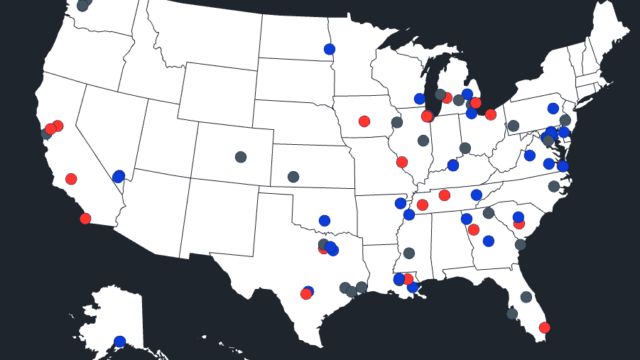
In 2013, Everytown Research began tracking gunfire on the grounds of K–12 schools and colleges and universities, collecting information through media reports about incidents in which a firearm discharges a live round inside or into a school building or on or onto a school campus or grounds. You can view the data referenced in this report in this data tracker.
What Do We Know About Gun Violence on College and University Campuses?
Campus shootings increased over the past decade.
From August 2016 through July 2026, Everytown Research’s Gunfire on School Grounds database recorded 389 shootings at 264 colleges and universities.3Shootings include any incident in which a firearm discharges a live round inside or into a school building or on or onto a school campus or grounds. Incidents that resulted in a person being shot and killed or wounded, and those in which a gun was discharged and no one was shot, are both included. For more information, see the methodological note here: https://everytownresearch.org/report/methodological-note-for-gun-violence-on-college-and-university-campuses/. Seventy-one percent of campus shootings involved at least one person shot, resulting in 124 people killed and 319 people wounded.4Of 389 campus shootings, 277 (71 percent) resulted in gun deaths or injuries and 112 (29 percent) resulted in no one shot (i.e., shots-fired incidents). This is likely an undercount, as the database relies primarily on media reports to identify shootings, which often fail to cover a significant portion of shootings that occur in the United States.5Elinore J. Kaufman et al., “Making the News: Victim Characteristics Associated with Media Reporting on Firearm Injury,” Preventive Medicine 141 (2020): 106275, https://doi.org/10.1016/j.ypmed.2020.106275; Daphne Marvel et al., “More Than Mass Shootings: Gun Violence Narratives in California News,” Berkeley Media Studies Group, no. 25, June 18, 2018, http://www.bmsg.org/resources/publications/gun-suicide-community-domestic-violence-news-narratives-california/.
Overall, campus shootings increased by an average of 20 percent year-over-year.

These trends indicate that a growing number of people in college communities are being exposed to gun violence on their respective campuses. Over the last decade, campus shootings increased by an average of 20 percent year-over-year, while the number of people killed increased by 52 percent and those wounded by 31 percent.6An “average year-over-year increase” measures the mean percentage by which shootings, number of people killed, and people wounded changed from one year to the next over the ten-year study period. A previous national analysis found that between the 2005–06 and 2015–16 school years, shootings on or near US college campuses increased as well, contextualizing this recent finding within a longer-standing trend.7Ashley Cannon, “Aiming at Students: The College Gun Violence Epidemic,” Citizens Crime Commission of New York City, October 2016, https://search.issuelab.org/resources/28327/28327.pdf. These shootings directly and vicariously impact millions of students,8Everytown Research analysis of Gunfire on School Grounds and US Department of Education, College Scorecard data, 2016–17 to 2025–26 school years. This estimate was calculated using institutional undergraduate degree-seeking enrollment at colleges and universities that experienced an incident of gunfire during the study period. Summing enrollment across incidents yields over 4 million potential student exposures. This figure should not be interpreted as the number of unique students exposed: Students may be counted more than once when an institution experienced multiple shootings, and enrollment represents the population attending an institution rather than the number of students who were present or directly exposed to an incident. The estimate is therefore intended to illustrate the potential scale of the student population affected, rather than provide a precise count of individual students exposed to gunfire. negatively affecting their learning and living environment9Liam Knox, “After the Smoke Clears, When Should Classes Resume?,” Inside Higher Ed, March 9, 2023, https://www.insidehighered.com/news/2023/03/09/offering-academic-flexibility-after-campus-shooting; Bill Hutchinson, “Following Mass Shooting, FSU Students Given Option Not to Return for Final Week of Classes,” ABC News, April 20, 2025, https://abcnews.com/US/mass-shooting-fsu-students-option-return-final-week/story?id=120990162. and often resulting in trauma, which can contribute to lifelong detriments to emotional, educational, and earning outcomes.10Sarah R. Lowe and Sandro Galea, “The Mental Health Consequences of Mass Shootings,” Trauma, Violence, & Abuse 18, no. 1 (2017): 62–82, https://doi.org/10.1177/1524838015591572; Erika D. Felix, Erin Dowdy, and Jennifer G. Green, “University Student Voices on Healing and Recovery Following Tragedy,” Psychological Trauma: Theory, Research, Practice, and Policy 10, no. 1 (2018): 76–86, https://doi.org/10.1037/tra0000172; Christopher Flynn and Dennis Heitzmann, “Tragedy at Virginia Tech: Trauma and Its Aftermath,” Counseling Psychologist 36, no. 3 (2008): 479–89, https://doi.org/10.1177/0011000008314787; Michael Hughes et al., “Posttraumatic Stress Among Students After the Shootings at Virginia Tech,” Psychological Trauma 3, no. 4 (2011): 403–11, https://doi.org/10.1037/a0024565; James Hawdon and John Ryan, “Well-Being After the Virginia Tech Mass Murder: The Relative Effectiveness of Face-to-Face and Virtual Interactions in Providing Support to Survivors,” Traumatology 18, no. 4 (2012): 3–12, https://doi.org/10.1177/1534765612441096; Heather Littleton, Danny Axsom, and Arnie E. Grills-Taquechel, “Longitudinal Evaluation of the Relationship Between Maladaptive Trauma Coping and Distress: Examination Following the Mass Shooting at Virginia Tech,” Anxiety, Stress, & Coping 24, no. 3 (2011): 273–90, https://doi.org/10.1080/10615806.2010.500722; Maya Rossin-Slater et al., “Local Exposure to School Shootings and Youth Antidepressant Use,” PNAS 117, no. 38 (2020): 23484–89, https://doi.org/10.1073/pnas.200080417; Marika Cabral et al., “Trauma at School: The Impacts of Shootings on Students’ Human Capital and Economic Outcomes,” NBER Working Paper 28311, March 2024, https://www.nber.org/papers/w28311; Tara Mathews, Margaret Dempsey, and Stacy Overstreet, “Effects of Exposure to Community Violence on School Functioning: The Mediating Role of Posttraumatic Stress Symptoms,” Behaviour Research and Therapy 47, no. 7 (2009): 586–91, https://doi.org/10.1016/j.brat.2009.04.001.
The vast majority of shootings were gun homicides and non-fatal gun assaults.
Gun homicides and assaults accounted for over half of campus shooting intents.
Last updated: 10.14.2026
Over half of campus shootings were gun homicides or assaults.11“Gun homicides and assaults” are incidents in which the shooter intended to shoot someone else (e.g., mass shooting, domestic violence, murder-suicide, robbery, exchanges of gunfire between two or more people). Everytown Research’s Gunfire on School Grounds map refers to this intent as “attack on others” or “mass shooting (4+ Shot).” Of the 389 campus shootings, 202 (52 percent) were gun homicides and assaults. Common preceding circumstances included arguments between two people, robberies, or other criminal activity. Mass shootings in which four or more people were shot (i.e., a subset of homicides and assaults) accounted for 5 percent of all campus shootings.12Of 389 campus shootings, 20 resulted in four or more people shot (i.e., mass shooting), which comprise 5 percent of all campus shootings and 10 percent of all gun homicides and assaults. The vast majority of mass shootings were not planned in advance.13Of 20 campus mass shootings over the study period, six were planned mass shooting attacks. These six incidents occurred at Brown University, Florida State University, Michigan State University, University of Nevada–Las Vegas, University of North Carolina at Charlotte, and University of Virginia. Instead, many arose from conflicts between two or more people that escalated into exchanges of gunfire or evolved from the commission of another crime.14See for example, Chester County District Attorney’s Office, “Four Charged in Connection to the Homecoming Shooting at Lincoln University,” press release, May 5, 2026, https://www.facebook.com/ChesCoDA/posts/news-release-four-charged-in-connection-to-the-homecoming-shooting-at-lincoln-un/1363251325626232/; State of Georgia, Office of the Attorney General, “Carr Indicts Suspected Gang Member for Deadly Homecoming Shooting at Albany State University,” press release, August 25, 2025, https://law.georgia.gov/press-releases/2025-08-25/carr-indicts-suspected-gang-member-deadly-homecoming-shooting-albany; Sarah Vogelsong, “Police Explain Why No Charges Were Filed Over One Victim’s Death in Huguenot Graduation Shooting,” The Richmonder, August 12, 2025, https://www.richmonder.org/police-explain-why-no-charges-were-filed-over-one-victims-death-in-huguenot-graduation-shooting/. Domestic violence and/or stalking-related shootings (another subset of homicides and assaults) accounted for another 5 percent of all campus shootings, with murder-suicides being prominent in this subcategory as well.15Of the 389 campus shootings, at least 21 (5 percent) were domestic violence– or stalking-related. Of those 21, at least 10 (48 percent) were murder-suicides. Domestic-violence-related incidents include those in which someone shoots (or shoots at) a current or former intimate partner or family member (e.g., parent, child), and incidents in which someone shoots another person who is connected to their current or former partner (e.g., a classmate, family member, new partner). Stalking-related incidents include those in which the shooter and victim had no known relationship and unrequited love interests. Some incidents involved multiple victims or survivors.
While suicides appear to constitute a relatively small portion of campus shootings in the dataset,16Of the 389 campus shootings, 13 (3 percent) were reported as suicides with no intent to harm others. In comparison to overall gun death trends, on average, 40 percent of gun deaths among 18- to 24-year-olds, nearly 60 percent among all ages, are suicides. Everytown Research analysis of Centers for Disease Control and Prevention, National Center for Health Statistics, WONDER Online Database, Provisional Mortality Statistics, Multiple Cause of Death, accessed September 21, 2026, 2021–2025. their sensitive nature may contribute to underreporting by media outlets17Merike Sisask and Airi Värnik, “Media Roles in Suicide Prevention: A Systematic Review,” International Journal of Environmental Research and Public Health 9, no. 1 (2012): 123–38, https://doi.org/10.3390/ijerph9010123; World Health Organization, Preventing Suicide: A Resource for Media Professionals, 2023, https://iris.who.int/server/api/core/bitstreams/92773496-dc8b-4d42-aef3-3a5a517dfa63/content.—which Everytown Research relies on for incident tracking—and thus are likely underrepresented.
Campus shootings were most likely to occur in outdoor spaces, not inside classrooms.
Outdoor spaces18Outdoor areas include sidewalks or pathways, outside of academic buildings or student housing, open gathering spaces, and other locations on campus where the school community frequently interacts or passes through. accounted for the largest share of campus shootings, making up nearly four in 10 shootings on campus, followed by parking lots19Parking lots were analyzed separately from other outdoor areas because some state laws and/or college policies allow for firearms to be stored in vehicles parked on campus in at least some circumstances (even if firearms are restricted in other campus locations), and prior school shooting research has identified parking lots as a distinct and particularly common location for shootings on K–12 school grounds. Everytown for Gun Safety Support Fund, “Everytown Gun Law Rankings: Which States Don’t Force Colleges and Universities to Allow Concealed Guns on Campus?,” https://everytownresearch.org/rankings/law/no-guns-mandate-on-college-campuses/; National Center for Education Statistics, “Table 228.14: Number of School Shootings at Public and Private Elementary and Secondary Schools, by Location and Time Period: School Years 2000–01 Through 2021–22,” Digest of Education Statistics (2022), https://nces.ed.gov/programs/digest/d22/tables/dt22_228.14.asp. and residence halls.20Of 389 campus shootings, 143 (37 percent) occurred in outdoor spaces, 88 (23 percent) occurred in parking lots and residence halls, respectively, 33 (8 percent) in academic buildings, 16 (4 percent) at athletic facilities, and 18 (5 percent) in other campus locations. The location was unknown for three shootings (0.8 percent). The prominence of shootings outdoors and in parking lots may reflect the open nature of college and university campuses. Campuses are designed to cultivate cross-functional environments that best suit students, allowing them to live, study, work, and socialize all in one place and enabling campuses to function as independent academic and social communities.21Tod Stevens, “Belonging as Campus Infrastructure,” Progressive Companies, February 18, 2026, https://www.weareprogressive.com/insights/belonging-as-campus-infrastructure. Conversely, the same spaces that allow for students to build and connect with their community were those most affected by gun violence.
Campus shootings were most likely to occur in outdoor spaces, parking lots, and residence halls.
Campus shootings peaked on weekends and in the month of October.
Saturday had the highest number of campus shootings.
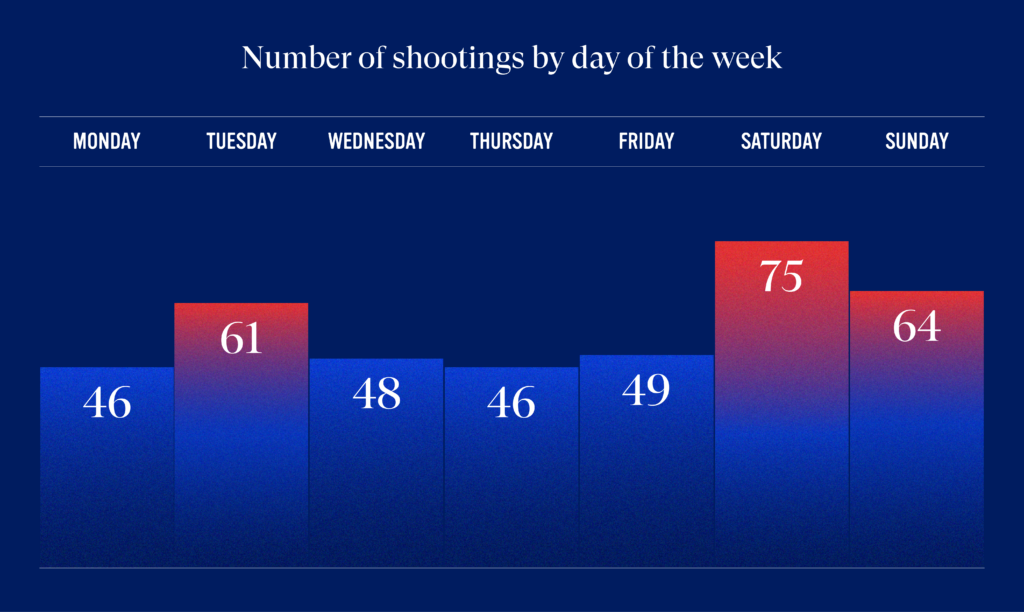
Over the 10-year study period, over one-third of all campus shootings occurred over the weekend, with shootings occurring with greatest frequency on Saturdays.22Of 389 campus shootings, 139 (36 percent) occurred on Saturday or Sunday (70 shootings per day on average), and 250 (64 percent) occurred on weekdays (50 shootings per day on average). Just 6 percent of campus shootings occurred during the summer months of June and July.23Of 389 campus shootings, 22 (6 percent) occurred during June and July. Shootings instead were most likely to occur during the fall semester.24Fall semester is defined as August through December, and spring semester is defined as January through May. Of 389 campus shootings, 204 (52 percent) occurred during the fall semester, and 163 (42 percent) occurred during the spring semester.
October had the most campus shootings, followed by November and September.
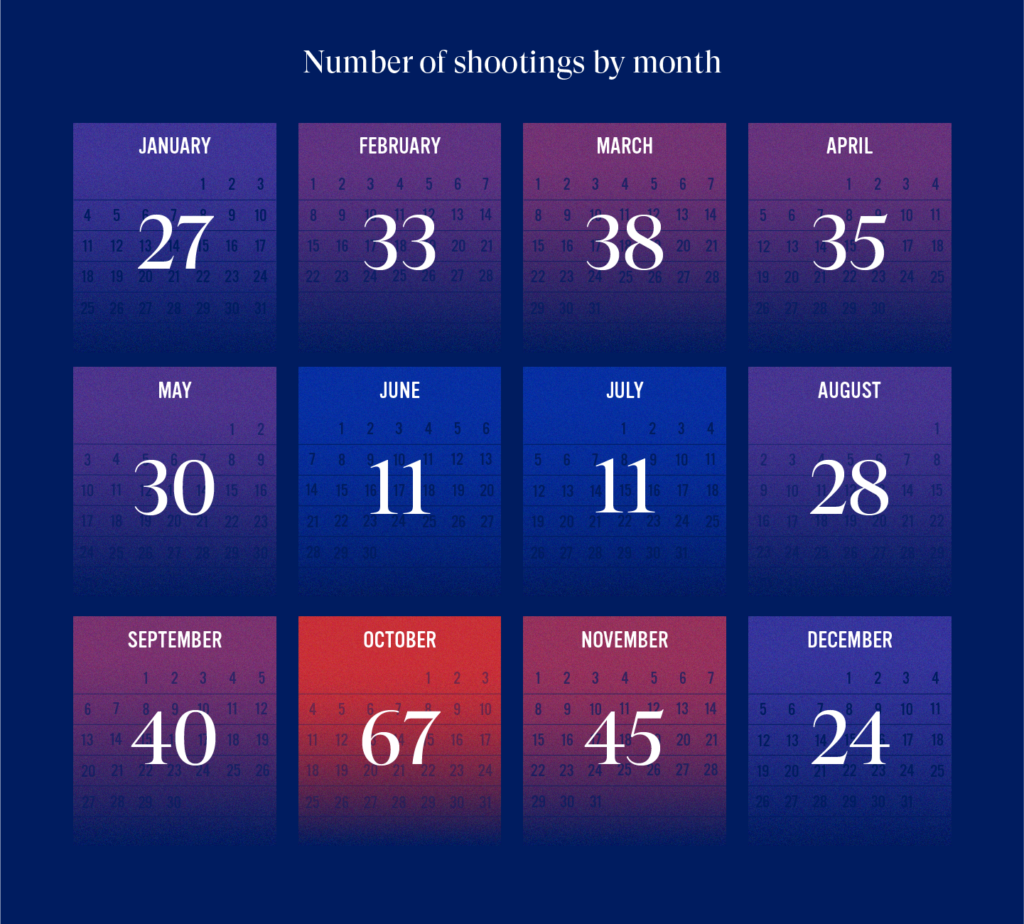
In particular, October saw the highest number of shootings over the ten-year study period, more than twice the monthly average of 32.25Of 389 campus shootings, 67 occurred in October. This period coincided with collegiate homecoming seasons, when colleges and universities host football games, alumni reunions, Greek life parties, spirit events, and more that draw attendees from surrounding communities and across the nation. While generally positive, these events can also create elevated risks through social conflicts and alcohol consumption.26Ellicott C. Matthay et al., “Assessing Links Between Alcohol Exposure and Firearm Violence: A Scoping Review Update,” Alcohol Research 45, no. 1 (2025), https://doi.org/10.35946/arcr.v45.1.01; Kawon V. Kim et al., “Relationship Between Alcohol Use and Firearm-Involved Suicide: Findings from the National Violent Death Reporting System, 2003–2020,” American Journal of Preventive Medicine 66, no. 5 (2024): 832–39, https://doi.org/10.1016/j.amepre.2023.11.019; Charles C. Branas, SeungHoon Han, and Douglas J. Wiebe, “Alcohol Use and Firearm Violence,” Epidemiologic Reviews 38, no. 1 (2016): 32–45, https://doi.org/10.1093/epirev/mxv010; Shane Drake, “The Toxicology of Homicide Offenders and Victims: A Review,” Drug and Alcohol Review 29, no. 2 (2010): 202–25, https://doi.org/10.1111/j.1465-3362.2009.00099.x; Jennifer C. Karberg and Doris J. James, “Substance Dependence, Abuse, and Treatment of Jail Inmates, 2002,” Bureau of Justice Statistics, July 2005, https://bjs.ojp.gov/content/pub/pdf/sdatji02.pdf. For example, in October 2025, a conflict escalated into a mass shooting at Lincoln University, killing one person and wounding six others, one of whom was a student and another an alumnus, outside the school’s cultural center following the university’s homecoming football game.27“1 Dead, 6 Others Injured After Shooting During Homecoming Celebration at Lincoln University,” 6 ABC, October 27, 2025, https://6abc.com/post/multiple-victims-injured-shooting-lincoln-university/18071874/. Perhaps unsurprisingly, nearly half of the October shootings were found to have occurred during homecoming weeks.28Of 389 campus shootings, 67 (17 percent) occurred during the month of October, compared to a monthly average of 32. Of the campus shootings that occurred in October, 31 (46 percent) were identified as occurring during the college’s homecoming week. This analysis counts any shooting that occurred on campus during the homecoming week regardless of whether it happened at a school-sponsored homecoming event. Homecoming weeks are generally held between late September and early November, with most schools holding it in October. Individual school event calendars were used to determine whether a shooting occurred during each schools’ respective week of homecoming.
Shooters were often unaffiliated with the school.
Consistent with past research,29Ashley Cannon, “Aiming at Students: The College Gun Violence Epidemic,” Citizens Crime Commission of New York City, October 2016, https://search.issuelab.org/resources/28327/28327.pdf; Jason R. Silva, “Advancing Knowledge of School Shootings: Analyzing a Quarter Century of College/University Shootings in America,” Crime and Delinquency (July 23, 2025), https://doi.org/10.1177/00111287251359195. the majority of shooters on college and university campuses were not affiliated with the institution—they were guests, visitors, or unauthorized trespassers.30Of 453 shooters, 234 were unaffiliated, 73 were students (including 12 former students), 13 were employees (including two former employees), 35 were law enforcement, and the relationship was unknown for 98. While shooters are more likely to be unaffiliated with the school, students and employees are as likely as unaffiliated individuals to be victims or survivors.31Of 443 victims or survivors, 183 were unaffiliated, 174 were students (including 11 former students), 19 were current employees, 11 were law enforcement, and the relationship was unknown for 56. Shooters and victims or survivors were overwhelmingly male32Of 453 shooters, gender was reported for 322 (71 percent), and among them, 308 (96 percent) were male. Of 443 victims or survivors, gender was reported for 333 (75 percent), and among them, 262 (79 percent) were male. and college-age.33Of 453 shooters, age range was reported for 246 (54 percent); among them, 159 (65 percent) were 18 to 24. Of 443 victims or survivors, age range was reported for 230 (52 percent); among them, 146 (63 percent) were 18 to 24. Together, the shooter and victim data highlighted a key characteristic of shootings on college and university campuses: Shooters and victims or survivors were often unaffiliated with the institution.
Over half of shooters, and four in ten victims or survivors, were unaffiliated with the school.
Campus shootings were most likely to occur in the South.
Campus shootings were not evenly distributed across the country, with substantial differences across regions and states. The data showed that campus shootings were largely concentrated within the southern region of the United States.
By far, the South experienced the highest rate of shootings on campuses.
Last updated: 10.14.2026
The South experienced campus shootings at more than twice the rate of the next-highest region, the Midwest. Shootings were least likely to occur in the Northeast.34Everytown Research analysis of Gunfire on School Grounds database and US Department of Education, College Scorecard data, 2016–17 to 2025–26 school years. Campus shooting rate per 1,000 schools was 13.6 in the South, 5.6 in the Midwest, 4.8 in the West, and 2.9 in the Northeast.
Nevada has the highest rate of campus shootings.
Last updated: 10.14.2026
At the state level, four out of the top five states with the highest rates of campus shootings were located in the South: Nevada had the highest rate of shootings on campus, followed by Alabama, North Carolina, Louisiana, and Georgia.35Everytown Research analysis of Gunfire on School Grounds database and US Department of Education, College Scorecard data, 2016–17 to 2025–26 school years. The campus shooting rate per 1,000 schools was 32.26 in Nevada, 26.51 in Alabama, 25.14 in North Carolina and Louisiana, and 23.18 in Georgia. Several states experienced no campus shootings during the study period: Hawaii, Idaho, Maine, New Hampshire, South Dakota, Vermont, and Wyoming.
Contrary to the widely held notion that gun violence is a predominantly urban issue,36Jeffrey A. Butts, “Gun Violence Is Not an ‘Urban’ Problem,” John Jay Research and Evaluation Center, Data Bits, January 2020, https://johnjayrec.nyc/2018/05/24/databit201801/; Everytown for Gun Safety Support Fund, “Gun Suicide in Cities: The Lesser-Known Side of City Gun Violence,” September 8, 2022, https://everytownresearch.org/report/gun-suicide-city-gun-violence/. campuses located in mid-size cities and distant towns had higher shooting rates than campuses located in large cities.37Everytown Research analysis of Gunfire on School Grounds database, US Department of Education, College Scorecard data, and Integrated Postsecondary Education Data System (IPEDS), August 1, 2016–July 31, 2026. Schools and their locale were determined using the US DOE dataset based on schools that were determined to be the main campus and were not distance-learning-only institutions. For school years where data on locale was not available, the locale was determined based on the IPEDS data. The campus shooting rate per 1,000 schools was 14.3 in mid-size cities and 11.9 in distant towns, compared to 9.7 in large cities. For locale definitions, see US Department of Education, National Center for Education Statistics, “Locale Definitions,” Education Across America, https://nces.ed.gov/surveys/annualreports/topical-studies/locale/definitions. These findings mirrored overall gun violence trends in recent years: A 2024 analysis found that, during a 10-year period, half of all shootings occurred in small cities and towns with populations under 1 million people, and most cities and towns with the highest rates of shootings were located in the South.38Olga Pierce, Jennifer Mascia, and Chip Brownlee, “You’re More Likely to Be Shot in Selma Than in Chicago,” The Trace, March 27, 2024, https://www.thetrace.org/2024/03/gun-violence-statistics-urban-rural/.
A Closer Look at Shootings on Historically Black College and University Campuses
Historically Black Colleges and Universities (HBCUs) are institutions of higher education with the principal mission of educating Black Americans and fostering the next generation of Black professionals, educators, and leaders.39HBCUs were established mostly during and after Reconstruction in the United States as a response to legal segregation and the exclusion of Black students from predominantly white institutions of higher education. US Department of Education, “White House Initiative on Historically Black Colleges and Universities,” August 31, 2026, https://sites.ed.gov/whhbcu/one-hundred-and-five-historically-black-colleges-and-universities/; 20 U.S. Code, Section 1061 (2). Although HBCUs enroll students from all racial and ethnic backgrounds, their historic mission to uplift Black students remains central to their institutional identities and to the individuals they serve. Today, there are about 100 HBCUs located across 19 states and the District of Columbia, representing roughly 2 percent of postsecondary institutions in the United States.40Everytown Research analysis of US Department of Education, College Scorecard data, accessed September 15, 2026, https://collegescorecard.ed.gov/data/. See “Merged” data files for school years: 2016–17 to 2025–26. During the study period, there were an average of 5,067 accredited postsecondary institutions active in the United States each year, of which, on average, 99 (2 percent) were HBCUs. Analysis excludes schools in US territories. For more information, see the methodological note here: https://everytownresearch.org/report/methodological-note-for-gun-violence-on-college-and-university-campuses/. Alabama is home to the greatest number of HBCUs, with a total of 14 colleges and universities.41Everytown Research analysis of US Department of Education, College Scorecard data, accessed September 15, 2026, https://collegescorecard.ed.gov/data/. See “Merged” data files for the 2025–26 school year. For more information, see the methodological note here: https://everytownresearch.org/report/methodological-note-for-gun-violence-on-college-and-university-campuses/.
Despite being only a small fraction of colleges and universities in the United States, HBCUs accounted for a disproportionately large share of campus shootings in our analysis—resulting in a campus shooting rate 20 times that of non-HBCUs.42Everytown Research analysis of Gunfire on School Grounds and US Department of Education, College Scorecard data, 2016–17 to 2025–26 school years. The campus shooting rate per 1,000 postsecondary institutions was 111.9 (111/992) at HBCUs and 5.6 (278/49,681) at non-HBCUs.
HBCUs face a disproportionate number of campus shootings during homecoming.
While shootings at HBCUs generally paralleled patterns observed at non-HBCU campuses, several key differences emerged. Over the 10-year study period, the average year-over-year increase in campus shootings was higher at HBCUs than at non-HBCUs (63 versus 16 percent).43HBCUs experienced a 63 percent year-over-year increase, on average, compared to a 16 percent increase among non-HBCUs. Homecoming week shootings also hit HBCUs particularly hard, with the vast majority of homecoming week shootings—81 percent—taking place on HBCU campuses.44Of 36 campus shootings that occurred during homecoming weeks, 29 (81 percent) occurred on HBCU campuses. Homecoming weeks are generally held between late September and early November, with most schools holding it in October.
Nearly one-third of all shootings at HBCUs occurred during October.
At HBCUs, unaffiliated individuals made up just over half of victims or survivors, while students accounted for about one-third.45Of 175 victims or survivors at HBCUs, 91 (52 percent) were not affiliated with the school, 58 (33 percent) were current or former students, the relationship was unknown for 24 (14 percent), and the other two (1 percent) were employees or law enforcement. Of 268 victims or survivors at non-HBCUs, 92 (34 percent) were not affiliated with the school, 116 (43 percent) were current or former students, the relationship was unknown for 32 (12 percent), and the other 28 (10 percent) were employees or law enforcement. Among shooters, only 14 percent were HBCU students, largely in line with the proportion of non-HBCUs,46Of 135 shooters at HBCUs, 71 (53 percent) were not affiliated with the school, 19 (14 percent) were current or former students, the relationship was unknown for 40 (30 percent), and the other five (4 percent) were employees or law enforcement. Of 318 shooters at non-HBCUs, 163 (51 percent) were not affiliated with the school, 54 (17 percent) were current or former students, the relationship was unknown for 58 (18 percent), and the other 43 (14 percent) were employees or law enforcement. suggesting that campus gun violence was often not perpetrated by members of the campus community.
Student Perspectives on HBCU Campus Safety
For students and parents alike, feeling safe is critical to the college experience. Colleges often define campus safety through visible security measures, emergency procedures, and campus crime statistics. But for students, safety is shaped by their firsthand, everyday experiences, which determine whether they feel supported, comfortable, and able to fully participate in campus life. As student survivors from five HBCUs in our focus group shared, institutional definitions of safety did not always align with their experiences.
Students saw a distinction between the portrayals of safety on campus and their lived experiences.
“I think the main thing for me is the reality versus the actual idea of safety.”
—HBCU Student
While most students reported feeling generally safe attending classes during the day, their sense of security depended on the time of day, whether campus events were taking place, and where they were on or near campus. Rather than relying solely on campus security measures, many students described adopting their own routines to reduce their risk of victimization. A student discussed these decisions:
“Pick a different route, go to a different place, or don’t do this at night.”
—HBCU Student
Several participants also questioned whether the security measures put in place were sufficient for preventing gun violence. Students observed that during high-profile events, there were often additional police and security personnel, but shootings at campus events persisted despite this increased presence. This raises broader questions about the other types of prevention measures that must be put into place alongside security to maximize student safety.
“When [a celebrity or something] comes, security is heightened. But if it’s a random Monday, I might catch a security guard asleep while I go get my DoorDash order from the back gate.”
—HBCU Student
Scholars have described similar concerns where colleges and universities may prioritize visible demonstrations of safety during moments of public attention.47Barbara A. Fedders, “The End of School Policing,” California Law Review 109 (August 2021), https://www.californialawreview.org/print/the-end-of-school-policing/. One focus group student suggested that these measures did more harm to the campus environment overall and instead served as “security theater”48“Security theater” refers to visible protocols designed to bolster public perception of safety without meaningful risk mitigation. Bruce Schneier, Beyond Fear: Thinking Sensibly About Security in an Uncertain World (Springer Nature, 2003). to quell the worries of parents and other college or university stakeholders.49Kenneth S. Trump, “Security Theater vs. Real School Safety: Why the Most Effective Prevention Is Often Invisible,” National School Safety and Security Services, March 10, 2026, https://schoolsecurity.org/security-theater-vs-real-school-safety-why-the-most-effective-prevention-is-often-invisible/. Students also acknowledged that the majority of these shootings took place during the month of October during homecoming celebrations. These celebrations are culturally paramount to the HBCU identity, encompassing unique traditions that attract a diverse and expansive volume of visitors, including local residents and alumni from across the nation. Violence during homecoming therefore disrupts an occasion that fosters cultural identity, institutional pride, and connections across the broader HBCU community.50“Homecoming: A Celebration of HBCUs and Their Legacies,” National Museum of African American History and Culture, accessed September 27, 2026, https://nmaahc.si.edu/explore/moments/homecoming-celebration-hbcus-and-their-legacies.
“Around homecoming, that’s when everybody is on campus; that’s when you have different types of people, different groups, so then that level of safety shifts. But I do believe there are places on campus that you can be safe and have access or proximity to safety. But I do think it all just really depends around the timing.”
—HBCU Student
Students remarked that campus safety efforts often felt reactive, with policy changes or increased security occurring only after shootings and other acts of violence. One student discussed the environment created by reactive security following a recent shooting on campus: “Our security has strengthened. . . .I know me personally, as a student, [I] feel like I’m not on campus anymore. It’s almost like a military base.”
While many still appreciated the efforts, some were concerned that investments to prevent violence on campus were not made earlier.
Students’ experiences of safety extended beyond campus boundaries.
The communities surrounding colleges and universities are part of students’ daily lives, shaping where they live, travel, work, and socialize, and, in turn, how they experience safety. Students in the focus group described their campus and the surrounding community as interconnected. Many acknowledged that HBCUs are rooted in communities with a history of disinvestment, affecting both permanent and on-campus residents who share some of the same safety challenges. Research confirms this: Violence is influenced by historical and structural inequities, including poverty, housing instability, economic disinvestment, limited access to opportunity, and concentrated disadvantage.51Everytown for Gun Safety Support Fund, “Invisible Wounds: Gun Violence and Community Trauma Among Black Americans,” May 14, 2024, https://everytownresearch.org/report/invisible-wounds-gun-violence-and-community-trauma-among-black-americans/; Johns Hopkins School of Public Health, Johns Hopkins Center for Gun Violence Solutions, “The Public Health Approach to Prevent Gun Violence,” accessed September 27, 2026, https://publichealth.jhu.edu/center-for-gun-violence-solutions/our-work/the-public-health-approach-to-prevent-gun-violence.
“One thing that someone gave me a good perspective of, they’re from [the area]. They were like, ‘Yeah, this is your community, this is your environment, but this is our home. We live here. You go to school here. This is my house. You’re in my backyard.’”
—HBCU Student
This perspective affected students’ understanding of violence as a shared community challenge rather than an exclusively institutional problem. Students also described how racial bias shaped their experiences of safety beyond campus. One student explained: “I’m not going to walk—just my own self as a young Black man, I’m not about to walk with my hood on at 9 p.m. to the gas station, because even the gas station person won’t even open up the door for me. It’s so weird. They’ll lock the door.”
For students, campus and community safety were inseparable, suggesting that creating safer campuses also required addressing the structural conditions around safety in surrounding neighborhoods.
The normalization of gun violence shaped students’ experiences of safety.
Many students in the focus group described how their experiences as gun violence survivors informed their perceptions of safety and risk on campus.
“[City]52Student is referring to the city that their college is located within, not their hometown. City and state were omitted to protect the participants’ anonymity. has one of the highest gun homicides or gun violence rates in [State], is something that I was like, ‘Wow, I didn’t even know this.’ Because of what I’ve experienced back home, I wouldn’t have noticed that this was abnormal.”
—HBCU Student
These reflections from students showed how repeated exposure to gun violence can lead to a feeling of normalization. Research shows that childhood exposure to violence often results in emotional desensitization as individuals mature,53Sylvie Mrug, Anjana Madan, and Michael Windle, “Emotional Desensitization to Violence Contributes to Adolescents’ Violent Behavior,” Journal of Abnormal Child Psychology 44, no. 1 (January 2016): 75–86, https://doi.org/10.1007/s10802-015-9986-x. fostering a perception that violence is an inevitable part of life,54Luci Pfeiffer, “The Effects of Submission and Exposure to Real-World and Virtual Violence During Childhood and Adolescence,” Journal of Pediatrics (Rio de Janeiro) 102(Suppl 1) (2026): 101494, https://doi.org/10.1016/j.jped.2025.101494. even on campus. This burden is not equally distributed, as Black and Latinx students are more likely to grow up in communities with greater exposure to gun violence.55Rachel Martin et al., “Racial Disparities in Child Exposure to Firearm Violence Before and During COVID-19,” American Journal of Preventative Medicine 63, no. 2 (2022): 204–12, https://doi.org/10.1016/j.amepre.2022.02.007; Megan Bears Augustyn, Marie Skubak Tillyer, and Kellie R. Lynch, “The Cascade of Victimization: Multiple Victimizations, PTSD Symptoms, and Educational Consequences Among College Students at Hispanic-Serving Institutions,” Journal of American College Health 74, no. 2 (2026): 525–36, https://doi.org/10.1080/07448481.2025.2538064; Jonathan Jay, “Structural Racism and Long-Term Disparities in Youth Exposure to Firearm Violence,” JAMA Network Open 6, no. 5 (2023): e2312425, https://doi.org/10.1001/jamanetworkopen.2023.12425; Everytown for Gun Safety Support Fund, “Invisible Wounds: Gun Violence and Community Trauma Among Black Americans,” May 14, 2024, https://everytownresearch.org/report/invisible-wounds-gun-violence-and-community-trauma-among-black-americans/; Everytown for Gun Safety Support Fund, “The Impact of Gun Violence on Latinx Communities,” November 8, 2024, https://everytownresearch.org/report/the-impact-of-gun-violence-on-latinx-communities/.
To better understand students’ perspectives, Everytown researchers also shared the preliminary findings of this report with focus group participants. Instead of reacting with surprise at the findings, students commiserated about the realities of gun violence.
“These [stats] are not surprising to me, and the fact that they’re not being highlighted in the media as much as they should, like… the shootings at PWIs [Predominantly White Institutions] and things like that, it’s not surprising to me, just simply because these are Black institutions and we’re Black students… so of course we’re not going to be represented fairly or making the people aware of what’s going on.”
—HBCU Student
Students viewed the limited awareness of violence at HBCUs as both a consequence and a reinforcement of broader racial inequities. They argued that the relative lack of media attention contributed to diminished public awareness, fewer opportunities for accountability, and less urgency to invest in violence prevention strategies that protect Black students. These concerns about violence at HBCUs can be situated within a broader history of racial inequity in the US, as Black Americans have long been subjected to racialized media depictions, especially regarding issues related to crime, gun violence, and gun policy.56Nadine Finigan-Carr et al., Racialized Media Frames in Depiction of Gun Violence in Maryland, UMB Center for Violence Prevention, 2026, https://www.umaryland.edu/media/umb/provost/Racialized-Media-Frames-CVP-White-Paper-April-2026.pdf.
Students believed that institutions should prioritize effective communication regarding active and recent shootings.
While students recognized the difficult circumstances colleges and universities face, including frequent HBCU scrutiny and underfunding, they felt these challenges should not come at the expense of transparency, communication, or safety. Several participants perceived university leaders as prioritizing institutional reputation over keeping students informed during incidents affecting their campus community.
Students were particularly frustrated when officials minimized incidents that occurred near, rather than on, campus. Students wanted administrators to acknowledge the impact of violence on the broader campus community.
“[The administration] basically were like, ‘This had nothing to do with the university; this didn’t even happen on campus.’ Just trying to distance the school as far away from the issue as possible… they eventually did make a statement the next day, like, ‘Okay, guys, there was a shooting.’ But the fact that they were comfortable enough to even make that statement in the first place, knowing that they aren’t telling the whole truth and that students were near the scene, was just really disheartening.”
—HBCU Student
Another significant concern among students in the focus group was effective communication from institutions of higher education during emergencies. Several participants described delayed emergency notifications and inconsistent messaging following shootings. These experiences contributed to feelings of mistrust and uncertainty, raising questions about whether institutions were equipped to respond appropriately during emergencies.
“They didn’t make a call, a text, an email to anybody until 30 minutes after the shooting happened. So, people are like, ‘I’m finding out more through my friends or Fizz and GroupMe57Fizz is a pseudonymous social media platform created for use on college and university campuses, and GroupMe is a group messaging app often used by college and university students. Ian Shepherd, “Gen Z’s Underground Social Network Just Went National—And It’s Blowing Up,” Forbes, Apr. 18, 2025, https://www.forbes.com/sites/ianshepherd/2025/04/18/gen-zs-underground-social-network-just-went-national-and-its-blowing-up/; Microsoft Support, “What Is GroupMe?,” accessed September 24, 2026, https://support.microsoft.com/en-us/groupme/what-is-groupme; GroupMe, “Private Group Chat Trusted by Millions,” accessed September 24, 2026, https://groupme.com/blog/blog-private-group-chat-trusted-by-millions-discord-alternative. than I am from the actual school.’ So, yeah, I think that while our schools and institutions do need help from governments, from whatever, they definitely need to take accountability when these things happen, because at the end of the day, students are impacted.”
—HBCU Student
Students concluded that they should be treated as partners in campus safety rather than just recipients of institutional decisions. They contended that their everyday experiences provided firsthand knowledge of campus conditions that administrators or policymakers may not have. For them, meaningful accountability included creating space for students to shape planning, emergency preparedness, and violence prevention.
“Young voices are the ones who, when it comes to the school shootings, we’re the ones setting up the vigils, we’re the ones getting the balloons for our fallen friends. So, it’s like the students who have the lived experiences are being excluded from the conversation.”
—HBCU Student
Students were committed to safety and looked to the future.
“If you love a community, the community is going to try to love you back…. My friend that lost his life to gun violence could have had a different route if he had other people pour into him, or [do] stuff like my college was doing.”
—HBCU Student
Despite student concerns about institutional responses to gun violence, their reflections were grounded in a deep sense of care and commitment to their campuses and broader communities. Students expressed motivation to strengthen the HBCU experience and protect future generations of students. They praised the work their colleges and universities had done to invest in their local communities. Others reflected on the importance of investing in young people—describing the benefits of mentorship, community engagement, and support systems as means for violence prevention.
“Investing in these organizations, partnering with these organizations, even student volunteers, they take volunteers, referring students to these organizations, just because they are working to prevent gun violence or even violence period in the community, which we are impacted by. So, just creating a mutual relationship.”
—HBCU Student
Encouragingly, participants also highlighted examples of successful collaboration among HBCUs, local government, community organizations, and law enforcement. Those who felt their school had strong partnerships also reported improvements in trust and communication over time, suggesting that sustained, mutually beneficial relationships among students, institutions, and the surrounding community could contribute to a safer campus environment.
“I think in order for us to see something different, we have to see institutions be very intentional about engaging their student body and working with student leaders across different disciplines. … Because there are more students on my campus who have dealt with gun violence being on campus than any student should have to ever go through.”
—HBCU Student
Students aspired for a world where prevention was a priority. They envisioned investment in long-term and comprehensive solutions to gun violence centered on collaboration, transparency, mental health, and community investment. Taken together, students’ experiences reinforced a central finding from the quantitative data: Campus gun violence cannot be understood solely by examining what happens on campus. The conditions surrounding an institution—including community violence, economic disinvestment, access to services, and gun availability—can shape the safety of the campus itself.
How Can We Prevent Campus Gun Violence?
Preventing gun violence on college and university campuses requires a layered approach combining prevention, preparedness, institutional support, community partnerships, and policies that reduce firearm-related harm.
Gun Safety Policies
Research shows that allowing guns on campuses is associated with more shootings, homicides, and suicides, and that it is unlikely to prevent mass shootings on campus,58Daniel W. Webster et al., “Firearms on College Campuses: Research Evidence and Policy Implications,” Johns Hopkins Bloomberg School of Public Health, October 15, 2016, https://issuelab.org/resources/30243/30243.pdf. making gun safety policies central to shaping campus safety. Several of the states with the highest rates of campus shootings are missing key gun safety policies. Local, state, and federal policymakers play a critical role in creating an environment that supports safety and reduces firearm-related harm. Further, advocacy by students, parents, faculty, and administrators can also play an important role in advancing these evidence-informed policies across the country.
-
Prohibit Guns on College Campuses
For decades, the gun lobby has pushed legislation that would force colleges and universities to allow students, faculty, and/or visitors to carry guns on campus,1National Rifle Association Institute for Legislative Action, “ALEC Task Force Adopts Model ‘Campus Personal Protection Act,’” May 23, 2008, https://bit.ly/33LTh4i. despite research showing that campuses face unique risk factors that make access to guns particularly dangerous2American College Health Association, National College Health Assessment III: Reference Group Executive Summary, Spring 2025, 2025, https://www.acha.org/ncha/data-results/survey-results/academic-year-2024-2025/; Daniel W. Webster et al., “Firearms on College Campuses: Research Evidence and Policy Implications,” Johns Hopkins Bloomberg School of Public Health, October 15, 2016, https://issuelab.org/resources/30243/30243.pdf. and campus community members—including gun owners—expressing opposition and safety concerns.3Jennifer McMahon-Howard, Heidi L. Scherer, and James T. McCafferty, “Examining the Effects of Passing a Campus Carry Law: Comparing Campus Safety Before and After Georgia’s New Campus Carry Law,” Journal of School Violence 20, no. 4 (2021): 430–44, https://doi.org/10.1080/15388220.2021.1930016; Matthew R. Hassett, Bitna Kim, and Chunghyeon Seo, “Attitudes Toward Concealed Carry of Firearms on Campus: A Systematic Review of the Literature,” Journal of School Violence 19, no. 1 (2020): 48–61, https://doi.org/10.1080/15388220.2019.1703717; James A. Shepperd et al., “The Anticipated Consequences of Legalizing Guns on College Campuses,” Journal of Threat Assessment and Management 5, no. 1 (March 2018): 21–34, https://doi.org/10.1037/tam0000097. To prevent campus shootings, state legislatures should reject any proposal to force guns onto college campuses, and should instead act to prohibit the possession of firearms in these critical learning environments.
Visit Everytown’s Gun Law Rankings to learn which states force colleges and universities to allow concealed guns on campus.
-
Reject Arming Teachers Laws
There is currently no evidence that supports the effectiveness of arming teachers or staff. On the contrary, evidence from K–12 schools shows that this practice poses a range of serious physical and educational risks, as well as unintended harms to members of school communities, especially for children and teens.1Everytown for Gun Safety Support Fund, “Unpacking Arming Teachers Laws,” October 13, 2025, https://everytownresearch.org/report/unpacking-arming-teachers-laws/. Concerningly, Florida enacted a law in 2026 to extend its K-12 Guardian Program2The Guardian Program is formally known as the “Chris Hixon, Coach Aaron Feis, and Coach Scott Beigel Guardian Program,” named after the educators killed during the Marjory Stoneman Douglas High School mass shooting in Parkland. The Guardian program trains armed personnel, including teachers, to prevent, deter, and stop active-assailant incidents on school campuses in addition to their official job duties. Florida Department of Education, “Safe Schools: Chris Hixon, Coach Aaron Feis, and Coach Scott Beigel Guardian Program,” accessed September 18, 2026, https://www.fldoe.org/safe-schools/guardian-program.stml. to public colleges and universities in the state,3Florida H.B. 757 (2026). despite a history of related misconduct,4Stephanie Brown, “Duval School Safety Assistant Arrested for Pawning Service Weapon,” WOKV Radio, October 18, 2018, https://www.wokv.com/news/local/duval-school-safety-assistant-arrested-for-pawning-service-weapon/nDWY1faR6xqISvJCgsiB4M/; David Fleshler and Lois K. Solomon, “‘Scathing’ Report: School Guards Got Shoddy Training,” South Florida Sun Sentinel, August 21, 2019, https://www.sun-sentinel.com/2019/08/21/scathing-report-school-guards-got-shoddy-training/; Pinellas County Sheriff, “19-244 Detectives Arrest Former School Guardian For Pawning His Issued Firearm And Equipment,” press release, September 19, 2019, https://pinellassheriff.gov/19-244-detectives-arrest-former-school-guardian-for-pawning-his-issued-firearm-and-equipment. including Guardians unintentionally firing their guns, leaving them unattended, and sexually abusing a student.5While the Florida Department of Education would not release the records detailing the misconduct, some school districts did disclose instances of misconduct cited. Katie LaGrone, “New Calls for Transparency as Florida Shields Information About Disciplined School Guardians,” WTXL Tallahassee, February 16, 2023, https://www.wtxl.com/features/insiders/new-calls-for-transparency-as-florida-shields-information-about-disciplined-school-guardians. States should repeal these types of laws where they have been enacted, and reject proposals to arm teachers in states where it is being considered.
-
Raise the Minimum Age to Purchase Firearms to 21
Young adults account for a disproportionate share of both firearm victimization and perpetration: 18- to 20-year-olds commit gun homicides at over triple the rate of adults 21 and older,1Everytown analysis using FBI Supplementary Homicide Report (SHR) and US Population Data obtained from CDC WONDER, 2022. and the present study found that people in this age group are the ones frequently involved in campus gun violence.2Of 453 shooters observed in the present analysis, age range was reported for 246 (54 percent) of them; among them, 159 (65 percent) were 18 to 24 years old. Of 443 victims or survivors, age range was reported for 230 (52 percent) of them, among them, 146 (63 percent) were 18 to 24 years old. Federal statutes require a person to be 21 years old to buy a handgun, or 18 years old to buy a long gun, from a licensed firearm dealer. The law is weaker for purchases from an unlicensed seller (e.g., online sales, gun shows) with a minimum age of 18 for handguns and no minimum age for long guns.318 USC § 922; ATF, “Minimum Age for Gun Sales and Transfers,” June 21, 2016, https://www.atf.gov/resource-center/infographics/minimum-age-gun-sales-and-transfers. The Trump administration has taken steps to undermine these foundational public safety laws, with the Department of Justice’s Office of Legal Counsel opining that the law prohibiting dealers from selling handguns to people under 21 is unconstitutional.4US Department of Justice Office of Public Affairs, “Justice Department Concludes Federal Ban on Handgun Sales to 18- to 20-Year-Olds Is Unconstitutional and Cannot Be Criminally Enforced,” press release, September 18, 2026, https://www.justice.gov/opa/pr/justice-department-concludes-federal-ban-handgun-sales-18-20-year-olds-unconstitutional-and. State-level protections are thus more important than ever to limit firearm access among this high-risk age group, and states should take action to require buyers to be 21 in order to purchase a firearm—whether from a dealer or an unlicensed seller—to help reduce access among individuals at the highest risk of involvement in violence.5Limited exceptions for the purchase of certain types of long guns by people who are 18, 19, or 20 years old may be appropriate in some circumstances.
Visit Everytown’s Gun Law Rankings to learn which states have raised the minimum age for purchasing firearms.
-
Require Background Checks on All Gun Sales
Requiring background checks on gun sales helps prevent prohibited persons, including people below the minimum purchase age or subject to an extreme risk or domestic violence protection order, from purchasing guns. Current federal law requires licensed firearm dealers to run background checks on all gun buyers, but it does not require background checks when guns are sold by unlicensed sellers. This dangerous loophole makes it easy for prohibited people to buy a gun with no questions asked.1Everytown for Gun Safety Support Fund, “Everytown Gun Law Rankings: Which States Require Background Checks and/or Permits to Purchase Handguns?,” accessed September 24, 2026, https://everytownresearch.org/rankings/law/background-check-and-or-purchase-permit/; Everytown for Gun Safety Support Fund, “Update Background Check Laws,” June 22, 2021, https://everytownresearch.org/report/update-background-check-laws/. States should require background checks on all gun sales.
Visit Everytown’s Gun Law Rankings to learn which states require background checks.
-
Pass Extreme Risk Laws
Extreme Risk laws empower family members, law enforcement, and other designated community members, including educators and household members in some states, to petition a court for a civil order that will temporarily prevent a person who is exhibiting dangerous warning signs from accessing guns. Extreme Risk Protection Orders (ERPOs) limit access to guns during the period of crisis, providing a critical intervention for protecting public safety while simultaneously allowing the person the chance to obtain the help they need. These laws have shown to be an effective intervention to address threats to schools1April M. Zeoli et al., “Extreme Risk Protection Orders in Response to Threats of Multiple Victim / Mass Shooting in Six U.S. States: A Descriptive Study,” Preventive Medicine 165 (2022): 107304, https://doi.org/10.1016/j.ypmed.2022.107304; Veronica A. Pear et al., “Gun Violence Restraining Orders in California, 2016–2018: Case Details and Respondent Mortality,” Injury Prevention 28, no. 5 (2022): 465–71, https://doi.org/10.1136/injuryprev-2022-044544; April M. Zeoli et al., “Use of Extreme Risk Protection Orders to Reduce Gun Violence in Oregon,” Criminology & Public Policy 20, no. 2 (2021): 243–61, https://doi.org/10.1111/1745-9133.12544; Garen J. Wintemute et al., “Extreme Risk Protection Orders Intended to Prevent Mass Shootings,” Annals of Internal Medicine 171, no. 9 (2019): 655–58, https://doi.org/10.7326/M19-2162. and other forms of gun violence.2Aaron J. Kivisto and Peter Lee Phalen, “Effects of Risk-Based Firearm Seizure Laws in Connecticut and Indiana on Suicide Rates, 1981–2015,” Psychiatric Services 69, no. 8 (2018): 855–62, https://doi.org/10.1176/appi.ps.201700250; Jeffrey W. Swanson et al., “Suicide Prevention Effects of Extreme Risk Protection Order Laws in Four States,” Journal of the American Academy of Psychiatry and the Law Online 52, no. 3 (2024), https://jaapl.org/content/early/2024/08/27/JAAPL.240056-24; Jeffrey W. Swanson et al., “Implementation and Effectiveness of Connecticut’s Risk-Based Gun Removal Law: Does It Prevent Suicides?” Law and Contemporary Problems 80 (2017): 179–208; Matthew Miller et al., “Updated Estimate of the Number of Extreme Risk Protection Orders Needed to Prevent 1 Suicide,” JAMA Network Open 7, no. 6 (2024): e2414864, https://doi.org/10.1001/jamanetworkopen.2024.14864; Jeffrey W. Swanson et al., “Criminal Justice and Suicide Outcomes with Indiana’s Risk-Based Gun Seizure Law,” Journal of the American Academy of Psychiatry and the Law Online 47, no. 2 (2019): 188–97; Everytown for Gun Safety Support Fund, “Examples of How Extreme Risk Laws Save Lives,” February 3, 2025, https://everytownresearch.org/report/appendix-a-extreme-risk-laws-save-lives-stories/. States without Extreme Risk laws should enact them, and states that already have them can improve them by expanding the groups of eligible petitioners, clarifying and strengthening existing laws, and implementing training programs and public awareness campaigns.
Visit Everytown’s Gun Law Rankings to learn which states have Extreme Risk laws.
-
Enact and Enforce Secure Gun Storage Laws
Despite the high number of campus shootings that occur in outdoor areas and parking lots, and vehicles being the number-one source of stolen guns in US cities, under some state laws and/or pursuant to some university policies, guns may legally be present in certain locations on campus, or within vehicles on campus parking lots.1Armed Campuses, “Guns on Campus’ Laws for Public Colleges and Universities,” The Campaign to Keep Guns Off Campus,” accessed September 27, 2026, https://www.armedcampuses.org/. Although few students report owning guns, among those who do, only about two out of five reported storing them securely.2Mackenzie Adams, Catherine Gong, and Justin E. Heinze, “Firearm Ownership and Storage Among US College Students: Results from the Healthy Minds Study, 2021–2022,” Journal of Behavioral Medicine 47, no. 4 (August 2024): 662–71, https://pubmed.ncbi.nlm.nih.gov/38460062/. Secure gun storage laws are among the policies with the strongest evidence base for reducing gun violence,3RAND Corporation, “The Effects of Child-Access Prevention Laws,” July 16, 2024, https://www.rand.org/research/gun-policy/analysis/child-access-prevention.html. and practicing secure storage can reduce theft and unauthorized access.4David Hemenway, Deborah Azrael, and Matthew Miller, “Whose Guns Are Stolen? The Epidemiology of Gun Theft Victims,” Injury Epidemiology 4, no. 11 (2017), https://doi.org/10.1186/s40621-017-0109-8; Catherine Barber et al., “Who Owned the Gun in Firearm Suicides of Men, Women, and Youth in Five US States?” Preventive Medicine 164 (2022): 107066, https://doi.org/10.1016/j.ypmed.2022.107066; Brent R. Klein et al., “Characteristics and Obtainment Methods of Firearms Used in Adolescent School Shootings,” JAMA Pediatrics 178, no. 1 (2024): 73–79, https://doi.org/10.1001/jamapediatrics.2023.5093. States should enact and enforce laws requiring secure gun storage whenever the gun is not in the person’s immediate possession or control, including in unattended vehicles.
Visit Everytown’s Gun Law Rankings to learn which states require secure gun storage.
-
Stop the Spread of Rapid-Fire Devices
Fully automatic machine guns—those that fire bullets in rapid succession with a single pull of the trigger—and the parts used to create them have been tightly regulated under federal law since the 1930s.1US Bureau of Alcohol, Tobacco, Firearms and Explosives, “National Firearms Act,” April 7, 2020, https://www.atf.gov/rules-and-regulations/national-firearms-act. However, the gun industry and third-party sellers continue to produce devices that make it easy to convert semiautomatic firearms into illegal machine guns in a matter of minutes. Machine gun conversion devices, which include auto sears or “Glock switches,” dramatically increase a gun’s rate of fire, making them attractive to mass shooters and other criminals, and pose an increased danger to the public. These devices have increasingly been recovered at crime scenes,2The number of recovered and traced machine gun conversion devices increased by 784 percent from 2019 to 2023. US Bureau of Alcohol, Tobacco, Firearms and Explosives, “National Firearms Commerce and Trafficking Assessment (NFCTA): Volume IV: Protecting America from Trafficked Firearms—Part V: Privately Made Firearms Updates and New Analysis,” July 2026, https://www.atf.gov/media/18631/download. including campus shootings.3Morgan State University, “Timeline of Events Regarding the Shooting on the Morgan State University Campus,” press release, October 4, 2023, https://www.morgan.edu/news/2023-10-04_timeline-of-events-regarding-shooting; Erin Murphy, “RE: Senate Bill 334—Criminal Law—Firearm Crimes—Machine Gun Convertible Pistols,” Baltimore Police Department, February 5, 2026, https://mgaleg.maryland.gov/cmte_testimony/2026/jpr/1ohyWrK9b4-8_fQNTEJPVLIuxCXt5XShh.pdf; Emma Bowman, “Arrest Made in Tuskegee University Shooting That Left 1 Dead, 16 Injured,” NPR, November 10, 2024, https://www.npr.org/2024/11/10/nx-s1-5185988/tuskegee-university-shooting-homecoming-alabama; United States Attorney’s Office for the Middle District of Alabama, “Montgomery Man Charged with Possession of a Machinegun Conversion Device on the Campus of Tuskegee University,” press release, November 12, 2024, https://www.justice.gov/usao-mdal/pr/montgomery-man-charged-possession-machinegun-conversion-device-campus-tuskegee. States can take action by enacting laws prohibiting the manufacture, sale, and possession of machine gun conversion devices as well as any rapid-fire devices that increase a semiautomatic weapon’s rate of fire.
Visit Everytown’s Gun Law Rankings to learn which states prohibit auto sears.
-
Stem the Flow of Illegal and Trafficked Guns and Improve Law Enforcement Data Sharing Practices
ATF data show that the majority of traced crime guns are recovered within 25 miles of the dealer from which they were purchased,1ATF, “National Firearms Commerce and Trafficking Assessment (NFCTA), Volume II: Crime Guns—Part III: Crime Guns Recovered and Traced within the United States and Its Territories,” February 2023, https://www.atf.gov/media/15426/download. highlighting the importance of firearm dealer regulations in crime prevention. Guns can move from legal commerce into illegal markets through straw purchasing, unlicensed dealing, and theft; therefore, strong gun dealer oversight is necessary to stem the flow of illegal and trafficked guns within and across state borders. States should adopt a strategy that includes using data to identify and interrupt trafficking and implementing robust oversight of gun dealers, alongside laws like waiting periods and limiting the number of guns that a person can purchase per month. Because guns used in violence can cross jurisdictions,2ATF, “National Firearms Commerce and Trafficking Assessment, Volume IV: Protecting America from Trafficked Firearms: NFCTA Updates, New Analysis, and Policy Recommendations, Part VI: National Integrated Ballistics Information Network,” January 2025, https://www.atf.gov/media/18626/download. all law enforcement agencies should also participate in ATF’s eTrace system3ATF, “Fact Sheet—eTrace: Internet-Based Firearms Tracing and Analysis,” June 10, 2026, https://www.atf.gov/resource-center/fact-sheet/etrace-internet-based-firearms-tracing-and-analysis.—including the collective data sharing feature—to trace the sources of recovered crime guns, help identify traffickers, and stop violent crime.
Visit Everytown’s Gun Law Rankings to learn which states require gun dealer licensing and give law enforcement tools designed to address crime guns.
Institutional-Level Interventions
Colleges and universities themselves can leverage a range of strategies to strengthen campus gun safety. Institutional leaders—including administrators, faculty, and governing boards—play a critical role in implementing evidence-informed campus policies and investing in prevention, communication, and security.59American College Health Association, Addressing Gun Violence on College and University Campuses: An ACHA White Paper, August 1, 2023, https://www.acha.org/resource/addressing-gun-violence-on-college-and-university-campuses-an-acha-white-paper/. Together, these efforts can reduce risk and help prevent campus gun violence.
-
Strengthen and Prioritize Prevention Infrastructure
Mitigating gun violence on campus requires an integrated approach that prioritizes identifying risk before tragedy strikes. Because institutions vary widely in their size, populations, infrastructure, and surrounding communities, prevention strategies should be tailored to each campus’s unique needs and risks. Institutions should establish multidisciplinary behavioral intervention and threat assessment teams to identify warning signs, coordinate support services, and facilitate early intervention before a situation escalates into a crisis.1Pauline Moore et al., “Safety and Security at Institutions of Higher Education: Understanding Trends, Practices, and Future Needs,” RAND Corporation, May 20, 2025, https://www.rand.org/pubs/research_reports/RRA2999-1.html; Michael L. Sulkowski and Philip J. Lazarus, “Contemporary Responses to Violent Attacks on College Campuses,” Journal of School Violence 10 no. 4 (2011): 338–54, https://doi.org/10.1080/15388220.2011.602601; Brian O. Hemphill and Brandi H. LaBanc, eds., Enough Is Enough: A Student Affairs Perspective on Preparedness and Response to a Campus Shooting (Stylus, 2010). These teams are increasingly used in institutions of higher education to provide a structured process for assessing concerning behavior and connecting individuals with appropriate interventions and support, while simultaneously protecting the safety of all individuals involved.2Pauline Moore et al., “Safety and Security at Institutions of Higher Education: Understanding Trends, Practices, and Future Needs,” RAND Corporation, May 20, 2025, https://www.rand.org/pubs/research_reports/RRA2999-1.html; Eugene R. D. Deisinger and Mario J. Scalora, “Threat Assessment and Management in Higher Education in the United States: A Review of the 10 Years Since the Mass Casualty Incident at Virginia Tech,” Journal of Threat Assessment and Management 3, no. 3–4 (2016): 186–99, https://digitalcommons.unl.edu/cgi/viewcontent.cgi?article=1816&context=psychfacpub. In addition, relevant campus stakeholders should be trained on when and how to use Extreme Risk laws appropriately, in states where they apply, as part of a greater violence prevention strategy.3Chelsea Parsons et al., “Promising Approaches for Implementing Extreme Risk Laws: A Guide for Practitioners and Policymakers,” Everytown for Gun Safety Support Fund and Johns Hopkins Center for Gun Violence Solutions, May 30, 2023, https://everytownresearch.org/report/extreme-risk-laws-guide/; Veronica A. Pear, Alaina De Biasi, and Amanda Charbonneau, “Law Enforcement Officer Knowledge of, Attitudes Toward, and Willingness to Use Extreme Risk Protection Orders,” JAMA Network Open 6, no. 10 (2023): e2338455, https://doi.org/doi:10.1001/jamanetworkopen.2023.38455; Emma L. Gause et al., “Survey of Washington Clinicians’ Willingness to Use and Preferences Related to Extreme Risk Protection Orders,” Preventive Medicine Reports 28 (July 5, 2022): 101883, https://doi.org/10.1016/j.pmedr.2022.101883. Similarly, institutions should provide information to students and faculty on the importance of, and best practices for, securely storing guns, as it is a critical piece of the continuum of creating time and distance between a gun and someone experiencing a crisis or an escalating conflict.
-
Cultivate Trust Through Transparency and Clear Communication
Ensuring safety on campus is contingent upon the strength of the bonds between students, faculty, and institutional stakeholders.1SchoolSafety.gov, “School Climate,” accessed September 18, 2026, https://www.schoolsafety.gov/school-climate. This is particularly important for prevention since students are more likely to report threats when they feel connected to their campus and trust their institutions.2Michael L. Sulkowski, “An Investigation of Students’ Willingness to Report Threats of Violence in Campus Communities,” Psychology of Violence 1, no. 1 (2011): 53–65, https://doi.org/10.1037/a0021592. Institutions should reinforce this trust by providing clear, reliable pathways for reporting concerns, like anonymous tip lines,3Pauline Moore et al., “Safety and Security at Institutions of Higher Education: Understanding Trends, Practices, and Future Needs,” RAND Corporation, May 20, 2025, https://www.rand.org/pubs/research_reports/RRA2999-1.html; Duke University, “Duke Reach,” accessed September 18, 2026, https://students.duke.edu/wellness/dukereach/; Michael L. Sulkowski and Philip J. Lazarus, “Contemporary Responses to Violent Attacks on College Campuses,” Journal of School Violence 10, no. 4 (2011): 338–54, https://doi.org/10.1080/15388220.2011.602601; Luke Barr, “For Safety on Campuses, Law Enforcement Increasingly Turns to Apps,” ABC News, September 2, 2018, https://abcnews.com/US/safety-campuses-law-enforcement-increasingly-turns-apps/story?id=57558628; Jon Hager, “What Concerning Behaviors Should Be Reported to an Intervention Team?,” Police 1, December 7, 2018, https://www.police1.com/school-violence/articles/what-concerning-behaviors-should-be-reported-to-an-intervention-team-0csepM2rHV4UgaFR/. and clearly communicate with students on how to report concerning behavior, what resources are available, and what students can expect after making a report or a report is made about them.
Transparency is one way that institutions can build and sustain trust with their students. When appropriate, institutions should provide timely, accurate information about gun violence on or near campus and follow up as investigations progress or arrests are made. Institutions should also consider routinely publishing firearm-specific information in campus safety reports, including incidents that may not be captured by existing federal reporting requirements.4The Jeanne Clery Act requires US colleges and universities that participate in federal student-aid programs to publish annual security reports and disclose statistics on specified crimes, but shooting and other gun-related crimes are not stand-alone reporting categories under the act. Institutions can supplement these federally required disclosures by collecting and publishing more detailed information about firearm-related incidents occurring on or near campus. See Clery Center, “The Jeanne Clery Act,” accessed September 27, 2026, https://www.clerycenter.org/the-clery-act. More complete reporting can help students, families, faculty, and staff understand firearm-related harm and how to prevent it, while strengthening institutional accountability.5Jennifer K. Wesely, Elizabeth R. Brown, and Curtis E. Phills, “Words Matter: A Qualitative Content Analysis of Campus Crime Alerts and Considerations for Best Practices,” Journal of American College Health 70, no. 1 (2022): 49–57, https://doi.org/10.1080/07448481.2020.1719114; Wencui Han et al., “Campus Emergency Notification Systems: An Examination of Factors Affecting Compliance with Alerts,” MIS Quarterly 39, no. 4 (2015): 909–29, https://doi.org/10.25300/MISQ/2015/39.4.8; Lorraine Mazerolle et al., “Legitimacy in Policing: A Systematic Review,” Campbell Systematic Reviews 9, no. 1 (2013), https://doi.org/10.4073/csr.2013.1; Kyle S. H. Dobson, Andrea G. Dittmann, and David S. Yeager, “A Transparency Statement Improves Trust in Community-Police Interactions,” Nature Communications 16 (2025): 2285, https://doi.org/10.1038/s41467-024-55709-6.
-
Expand Access to Mental Health and Student Supports
Universities can mitigate risk by expanding institutional access to crisis services, training staff to recognize signs of emotional distress,1Zara Abrams, “Student Mental Health Is in Crisis: Campuses Are Rethinking Their Approach,” American Psychological Association, October 12, 2022, https://www.apa.org/monitor/2022/10/mental-health-campus-care. and ensuring that individuals exposed to violence receive timely support to address trauma and foster a resilient campus environment.2Derrecka M. Boykin and Holly K. Orcutt, “Treatment Use Among College Women Following a Campus Shooting,” Journal of Aggression, Maltreatment & Trauma 28, no. 3 (2018): 261–80, https://doi.org/10.1080/10926771.2018.1480548. This requires sufficient mental health infrastructure not only to meet students’ ongoing needs but also to respond to increases in demand following campus violence, which have been shown to grow sharply after campus shootings.3Beth DeBouck, “A ‘Cornerstone for Their Whole Life,’” UNLV News Center, March 1, 2024, https://www.unlv.edu/news/article/cornerstone-their-whole-life; Christopher Flynn and Dennis Heitzmann, “Tragedy at Virginia Tech: Trauma and Its Aftermath,” Counseling Psychologist 36, no. 3 (2008): 479–89, https://doi.org/10.1177/0011000008314787. In a recent national survey, 81 percent of college counseling center directors reported difficulty meeting demand for services, often resorting to staggering appointments or using a triage system to address demand.4Cindy M. Bruns et al., “Annual Survey for Reporting Period July 1, 2024 through June 30, 2025,” Association for University and College Counseling Center Directors, accessed September 27, 2026, https://www.aucccd.org/assets/documents/Survey/2024-2025%20Annual%20Survey%20Report%20Public.pdf. Colleges and universities should therefore invest in mental health systems with sufficient capacity and flexibility, and regularly assess gaps between student demand and available services to inform long-term funding strategies and community partnerships that can help address those needs.5National Academies of Sciences, Engineering, and Medicine, Mental Health, Substance Use, and Wellbeing in Higher Education: Supporting the Whole Student (National Academies Press, 2021), https://doi.org/10.17226/26015.
-
Prioritize Core Security Engancements and Emergency Preparedness
Following high-profile acts of violence, colleges and universities often face pressures to invest in visible security measures and emerging technologies.1Didi Gluck, “From Locked Doors to Intelligent Campuses: The New Era of Physical Security,” EdTech Magazine, May 7, 2026, https://edtechmagazine.com/k12/article/2026/05/locked-doors-intelligent-campuses-new-era-physical-security; Kenneth S. Trump, “Security Theater vs. Real School Safety: Why the Most Effective Prevention Is Often Invisible,” National School Safety and Security Services, March 10, 2026, https://schoolsecurity.org/security-theater-vs-real-school-safety-why-the-most-effective-prevention-is-often-invisible/. Schools should evaluate new technologies based on campus-specific needs, institutional resources, budget availability, characteristics of the surrounding community,2Pauline Moore et al., “Safety and Security at Institutions of Higher Education: Understanding Trends, Practices, and Future Needs,” RAND Corporation, May 20, 2025, https://www.rand.org/pubs/research_reports/RRA2999-1.html. and potential trade-offs with other prevention strategies.
Physical security should complement, rather than replace, broader prevention efforts. Foundational measures include access control and interior-locking doors in residence halls and buildings not open to the public.3Pauline Moore et al., “Safety and Security at Institutions of Higher Education: Understanding Trends, Practices, and Future Needs,” RAND Corporation, May 20, 2025, https://www.rand.org/pubs/research_reports/RRA2999-1.html. This was identified as a vulnerability during the shooting at Florida State University in 2025, where students could not lock classroom doors from the inside while the shooting was ongoing.4Emma Tucker, “FSU Students Question Whether Locks Worked on Classroom Doors During a Mass Shooting: The University Says They Did,” CNN, April 21, 2025, https://www.cnn.com/2025/04/21/us/shooting-fsu-student-petition-campus. Other interventions include improving lighting in parking lots and outdoor gathering spaces,5John M. McDonald et al., “Can Enhanced Street Lighting Improve Public Safety at Scale?,” Criminology & Public Policy 25, no. 1 (2025): 31–62, https://doi.org/10.1111/1745-9133.70006. and utilizing environmental design principles to proactively reduce the risk of antisocial behavior on school grounds.6Pauline Moore et al., “Safety and Security at Institutions of Higher Education: Understanding Trends, Practices, and Future Needs,” RAND Corporation, May 20, 2025, https://www.rand.org/pubs/research_reports/RRA2999-1.html; Everytown for Gun Safety Support Fund, “Crime Prevention Through Environmental Design,” April 26, 2021, https://everytownsupportfund.org/report/crime-prevention-through-environmental-design/.
Institutions should also maintain robust emergency preparedness protocols, including coordinated response plans and reliable notification systems. Institutions should also ensure that these plans reflect the experiences, needs, and safety concerns of students by using strategies such as a student advisory board, liaisons, focus groups, and/or campus surveys.7Pauline Moore et al., “Safety and Security at Institutions of Higher Education: Understanding Trends, Practices, and Future Needs,” RAND Corporation, May 20, 2025, https://www.rand.org/pubs/research_reports/RRA2999-1.html; Jennifer K. Wesely, Elizabeth R. Brown, and Curtis E. Phills, “Words Matter: A Qualitative Content Analysis of Campus Crime Alerts and Considerations for Best Practices,” Journal of American College Health 70, no. 1 (2022): 49–57, https://doi.org/10.1080/07448481.2020.1719114; Wencui Han et al., “Campus Emergency Notification Systems: An Examination of Factors Affecting Compliance with Alerts,” MIS Quarterly 39, no. 4 (2015): 909–29, https://doi.org/10.25300/MISQ/2015/39.4.8.
Large gatherings and high-traffic events warrant specific plans that define roles, communications, and coordination among campus officials, security, law enforcement, and emergency personnel.8FEMA, Guide for Developing High-Quality Emergency Operations Plans for Institutions of Higher Education, 2013, https://files.eric.ed.gov/fulltext/ED571877.pdf; Pauline Moore et al., “Safety and Security at Institutions of Higher Education: Understanding Trends, Practices, and Future Needs,” RAND Corporation, May 20, 2025, https://www.rand.org/pubs/research_reports/RRA2999-1.html. A purely law enforcement–driven strategy is insufficient for violence prevention and can negatively impact students, and although crisis training is vital for harm reduction during an ongoing incident, it is not a substitute for long-term violence prevention.9Pauline Moore et al., “Safety and Security at Institutions of Higher Education: Understanding Trends, Practices, and Future Needs,” RAND Corporation, May 20, 2025, https://www.rand.org/pubs/research_reports/RRA2999-1.htm; FEMA, Guide for Developing High-Quality Emergency Operations Plans for Institutions of Higher Education, 2013, https://files.eric.ed.gov/fulltext/ED571877.pdf.
-
Establish Policies to Prohibit Firearms
State laws governing guns on college campuses vary widely, with some prohibiting guns on campus, others requiring them to be permitted in certain circumstances, and others still leaving the issue to individual institutions to decide.1States laws may also have different rules for public and private colleges. In one example, a study examining Georgia’s campus carry law found that it was associated with increased fear of crime and perceptions of unsafety on campus, and decreased confidence in campus police.2The study surveyed college students, faculty, administrators, and staff. Jennifer McMahon-Howard, Heidi L. Scherer, and James T. McCafferty, “Examining the Effects of Passing a Campus Carry Law: Comparing Campus Safety Before and After Georgia’s New Campus Carry Law,” Journal of School Violence 20, no. 4 (2021): 430–44, https://doi.org/10.1080/15388220.2021.1930016. These findings suggest that allowing guns on college campuses affects perceptions of campus safety and undermines a trusting school environment. In states where institutions have the authority to regulate guns in some manner, they should set strong policies to prohibit gun possession in accordance with the maximum authority provided by law. In addition, if guns are allowed on campus by virtue of state law, to the extent permitted by law, the school should establish a policy to require secure gun storage whenever the gun is not in the person’s immediate possession or control, including in vehicles.
-
Build a Culture of Secure Gun Storage
Administrators should take steps to educate students, employees, visitors, and surrounding community members alike on policies relating to guns on campus, as well as the importance of, and best practices for, secure gun storage.1Secure gun storage notification policies are common in K–12 schools across the United States. See Be SMART, “Be SMART For Schools,” accessed October 2, 2026, https://besmartforkids.org/for-schools/; Stephen Sawchuk, “More Schools Are Reminding Parents to Secure Their Guns,” Education Week, December 8, 2021, https://www.edweek.org/leadership/more-schools-are-reminding-parents-to-secure-their-guns/2021/12. Examples of how this can be implemented include: adding information to the school’s website, student and employee handbooks, event flyers, and ticket-holder email reminders; placing signage in campus parking lots, dorms, and other high-traffic areas; posting public service announcements on school social media accounts and stadium digital displays; and engaging campus members in educational campaigns targeting the surrounding community. For more information about secure gun storage and educational resources, visit besmartforkids.org.
Community-Level Interventions
Because campuses are embedded within surrounding communities, prevention also requires partnerships with local governments, health systems, community organizations, and residents to collaboratively address risks beyond campus boundaries.
Examples of community-level interventions include:
- Street outreach programs: Community-based programs that engage individuals at the highest risk of violence, mediate conflicts, provide support and resources, and help interrupt cycles of violence before they escalate.60Jeffrey A. Butts et al., “Cure Violence: A Public Health Model to Reduce Gun Violence,” Annual Review of Public Health 36, no. 1 (2015): 39–53, https://doi.org/10.1146/annurev-publhealth-031914-122509.
- Group violence intervention programs: Strategies in which high-risk offenders are presented with strict consequences for continued violent behavior, coupled with access to social services and ongoing support from community members, should they choose a different path.61Anthony A. Braga and David L. Weisburd, “The Effects of ‘Pulling Levers’ Focused Deterrence Strategies on Crime,” Campbell Systematic Reviews 8, no. 1 (2012): 1–90, https://doi.org/10.4073/csr.2012.6.
- Hospital-based violence intervention programs (HVIPs): Programs that pair service providers with patients and families immediately after and during the months that follow a violent injury to ensure that they have the support and resources necessary to heal and remain safe.62The Health Alliance for Violence Intervention, “What Is a Hospital-Based Violence Intervention Program (HVIP)?,” accessed September 27, 2026, https://www.thehavi.org/what-is-an-hvip; Catherine Juillard et al., “A Decade of Hospital-Based Violence Intervention: Benefits and Shortcomings,” Journal of Trauma and Acute Care Surgery 81, no. 6 (2016): 1156–61, https://doi.org/10.1097/TA.0000000000001261.
- Safe passage programs: Community partnerships that, through coordinated outreach, visibility, and support, improve safety along routes that students and residents use frequently.63Everytown for Gun Safety Support Fund, “Safe Passage,” CityGRIP, accessed September 27, 2026, https://citygrip.org/practice_area/safe-passage/; Viviane Sanfelice, “Are Safe Routes Effective? Assessing the Effects of Chicago’s Safe Passage Program on Local Crimes,” Journal of Economic Behavior & Organization 164 (August 2019): 357–73, https://doi.org/10.1016/j.jebo.2019.06.013.
- Community-driven crime prevention through environmental design (CPTED): Approaches that improve safety in shared spaces by addressing environmental factors such as lighting, visibility, maintenance, and access.64Everytown for Gun Safety Support Fund, “Crime Prevention Through Environmental Design,” April 26, 2021, https://everytownsupportfund.org/report/crime-prevention-through-environmental-design/; Paul Michael Cozens, Greg Saville, and David Hillier, “Crime Prevention Through Environmental Design (CPTED): A Review and Modern Bibliography,” Property Management 23, no. 5 (2005): 328–56, https://doi.org/10.1108/02637470510631483.
Implementation and Shared Responsibility
Community-level interventions benefit from shared responsibility across institutions of higher education, local governments, health systems, and community-based organizations. Institutions can contribute funding, technical assistance, and research and evaluation expertise, while community partners are often best positioned to lead direct implementation because of local knowledge, relationships, and credibility in their communities.1Emily Peiffer, “Why Investing in Trusted Community-Based Organizations Is Crucial to Sustainability,” Urban Institute, November 16, 2022, https://www.urban.org/stories/why-investing-trusted-community-based-organizations-crucial-sustainability. This division of roles is reflected in several university-community violence prevention partnerships. For example, in 2022, the University of Chicago committed $15 million over three years to support and expand violence intervention efforts.2UChicago News, “University Launches Violence Intervention Fund to Support Community and Academic Violence Reduction Efforts,” July 28, 2022, https://news.uchicago.edu/story/university-launches-violence-intervention-fund-support-community-and-academic-violence. University researchers also provided evaluation support—another uniquely helpful form of collaboration—to READI Chicago, a local street outreach program.3Monica P. Bhatt et al., “Predicting and Preventing Gun Violence: An Experimental Evaluation of READI Chicago,” Quarterly Journal of Economics 139, no. 1 ( 2024): 1–56, https://doi.org/10.1093/qje/qjad031. This model demonstrates how institutions of higher education can use their financial and institutional resources to strengthen community-led prevention efforts. Programs like READI also benefit college communities, helping ensure that students, faculty, staff, and visitors can live, learn, and move about in a safe environment.
Conclusion
“I just feel like the work is never-ending, and it’s still so much that needs to be done, especially in our communities, but also for all colleges who experience gun violence.”
—HBCU Student
The rise in gun violence on college and university campuses over the past decade, paired with disparate impacts on HBCUs, highlights the need for understanding and addressing the institutional, community, and policy environments that shape students’ risk of gun violence both on and beyond campus.
Research and student perspectives each point to a comprehensive prevention approach centered on evidence-informed strategies that invest in robust mental health services, strong campus-community partnerships, effective threat assessment and response, and state and institutional policies that address the root causes of gun violence. Further research is needed to better understand how community-level conditions influence campus safety outcomes, how prevention strategies can be tailored to different institutional and cultural contexts, and how exposure to gun violence at institutions of higher education affects the school community over time. Future studies should also explore the experiences of HBCUs, as well as institutions that primarily serve historically underrepresented communities in higher education. Colleges and universities cannot address campus gun violence alone. Effective gun violence prevention depends on strong institutions, strong communities, and strong policies, working in unison.
Acknowledgements
Everytown for Gun Safety Support Fund gratefully acknowledges the following individuals for their contributions to the development and drafting of this report:
Dr. Sonali Rajan, former Senior Director of Everytown Research
Justin Wagner, Senior Vice President of Everytown Law & Policy
Makayla Jordan, Organizing Manager, Students Demand Action
Anna Gratzer, Program Manager, Everytown National Campaigns and Engagements
Andrea Azalia, National Organizing Director, Students Demand Action
Dr. Justin Heinze, Associate Professor at the University of Michigan School of Public Health and Co-Director of the National Center for School Safety
Learn More:
- Child & Teen Gun Safety
- Domestic Violence
- Educate Gun Owners of Risks
- Gun Suicide
- Gun Violence by Police
- Guns in Public
- Guns in Schools
- Impact of Gun Violence on Historically Marginalized Communities
- Keep Guns Off Campus
- Mass Shootings
- Prohibit Guns in Sensitive Areas
- Responsible Gun Ownership
- Secure Gun Storage
- Stop Arming Teachers
- Strong Standards for Carrying Concealed Guns in Public
- Threat Identification and Assessment Programs in Schools
Everytown Research & Policy is a program of Everytown for Gun Safety Support Fund, an independent, non-partisan organization dedicated to understanding and reducing gun violence. Everytown Research & Policy works to do so by conducting methodologically rigorous research, supporting evidence-based policies, and communicating this knowledge to the American public.