
Holding Gun Owners Accountable: An Early Look at Prosecutions Under Michigan’s Firearm Storage Law

2.13.2026
Executive Summary
Nearly once a day in the United States, a child gains access to a gun and unintentionally shoots themselves or someone else. To prevent these tragedies and other forms of gun violence, a growing number of states are adopting policies requiring gun owners to securely store their firearms.
In April 2023, following the 2021 mass shooting at Oxford High School and persistent advocacy by gun violence prevention organizations, Michigan enacted legislation providing prosecutors with a criminal statute to hold adults accountable when a child accesses an unsecured firearm.
A key goal of gun storage laws is bringing about behavior change through deterrence—an outcome that requires the public to be aware of the law. While extensive research links firearm storage laws and lower rates of gun injuries, less is known about how these laws are used. Everytown Research sought to fill this gap by examining how Michigan prosecutors have applied this statute in cases of unintentional shootings by children during the first two years since the law took effect.
The following study analyzes 34 incidents of children accessing firearms and unintentionally shooting themselves or someone else in Michigan, and 28 cases of adults who were charged with violating the state’s gun storage law from February 13, 2024 (when the storage law took effect) through December 31, 2025.
Key Findings
Drawing data from Everytown’s #NotAnAccident Index, media reports, press releases from prosecutors’ offices, and publicly available court and corrections records, our analysis brought these key findings to light:
- Michigan has averaged 16 unintentional shootings by children per year since 2015. Shootings reached a record high of 25 in 2024 and fell 60 percent to 10 in 2025, the first full year the law was in effect.1Everytown Research analysis of #NotAnAccident Index, 2015–2025. Count and percent change: 2024 vs. 2025. Analysis limited to unintentional shootings by children that occurred in Michigan.
- From February 13, 2024 (when the storage law took effect), through December 31, 2025, Michigan experienced 34 unintentional shootings by children,2In 2024, one shooting occurred before the storage law took effect. resulting in 4 people killed and 30 wounded.
- Shooters ranged from ages 2 to 17, and nearly all victims were under 18.
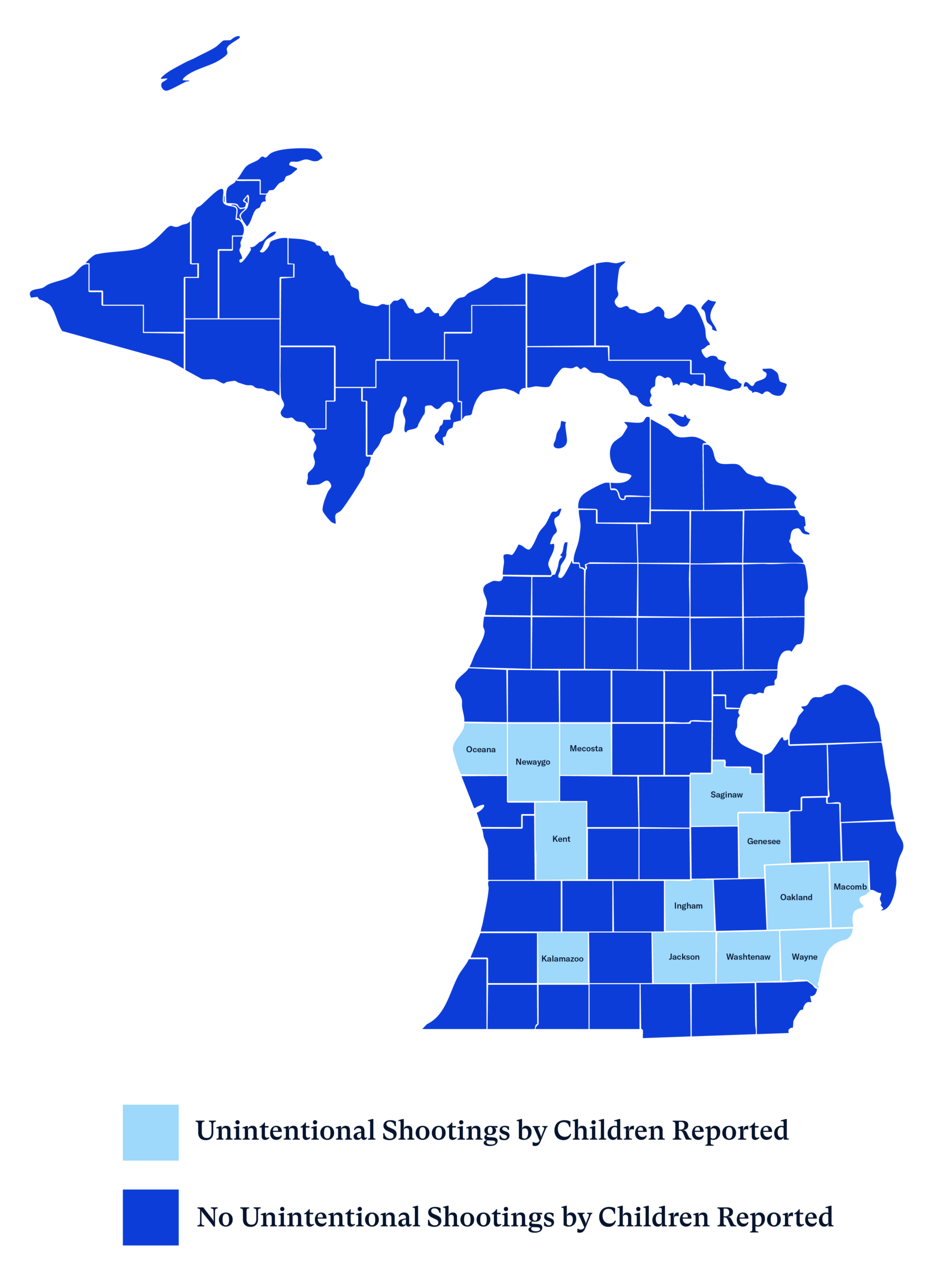
- Unintentional shootings by children were reported in 13 counties, with Wayne County accounting for more than one-third.
- Prosecutors have used the storage law frequently since its implementation. In 23 of 34 incidents, media reports indicate that prosecutors charged the gun owner. From those 23 incidents, an additional five adults were charged under the storage law.3For this study, researchers obtained prosecution decisions from media reports. Research shows that media outlets fail to cover a significant portion of shooting incidents, thus charges may have been filed in more incidents but were not reported in the media and as a result were not counted in this study.
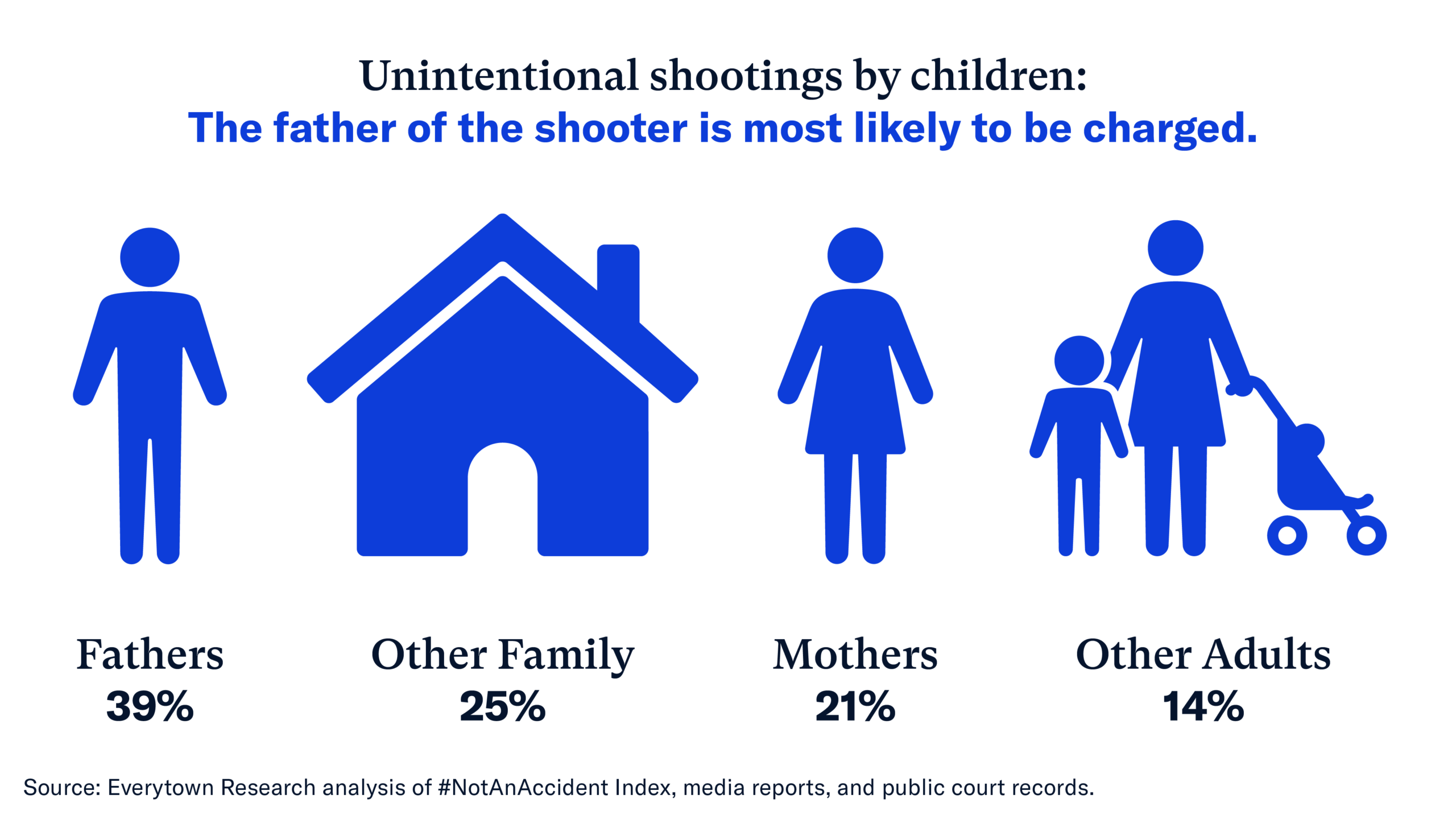
- Among the 28 people charged, 61 percent were parents of the shooter.
- Charging practices varied by county. Media reports suggested that in only 5 of the 13 counties where unintentional shootings occurred, prosecutors charged an adult with violating the gun storage law in all incidents. Researchers found no apparent media coverage about charges related to these shootings in four counties.4For this study, researchers obtained prosecution decisions from media reports. Research shows that media outlets fail to cover a significant portion of shooting incidents, thus charges may have been filed in more incidents but were not reported in the media and as a result were not counted in this study.
- As of the end of January, 22 of the 28 people had been convicted. Five cases had been dismissed and one case was still active.
- At least three adults charged under the storage law had prior weapons- or drug-related felony convictions, thus legally prohibiting them from possessing firearms. One of them had their storage-law violation case dismissed.
- Among cases with known sentences, most adults received probation, many of them for two years. Only two individuals received prison sentences.
- More research with official data is necessary to fully understand the impact of secure gun storage laws in Michigan and in other states.
On a spring day in 2024, while at home in Warren, Michigan, with his parents and three other young children, an 8-year-old boy climbed onto a chair and found an unsecured 40-caliber Glock handgun on top of a kitchen cabinet. The boy then unintentionally shot himself in the head. Fortunately, he survived. The firearm belonged to the child’s 56-year-old father. The Macomb County Prosecutor’s Office charged the father with multiple offenses, including violating Michigan’s firearm storage law. He pleaded guilty, and his sentence included probation and jail time served.1Christina Hall, “Warren Man Pleads Guilty After Young Son Accidentally Shot Himself in the Face Last Year,” Detroit Free Press, February 18, 2025 https://www.freep.com/story/news/local/michigan/macomb/2025/02/18/warren-dad-pleads-guilty-after-young-son-accidentally-shot-himself-theo-nichols/79087557007/.
Introduction
Millions of children in the US live in homes with at least one unsecured gun,2Matthew Miller and Deborah Azrael, “Firearm Storage in US Households with Children: Findings from the 2021 National Firearm Survey,” JAMA Network Open 5, no. 2 (2022): e2148823, https://doi.org/10.1001/jamanetworkopen.2021.48823. and many children know where guns are stored—even when parents believe they do not.3Carmel Salhi, Deborah Azrael, and Matthew Miller, “Parent and Adolescent Reports of Adolescent Access to Household Firearms in the United States,” JAMA Network Open 4, no. 3, (2021): e210989, https://doi.org/10.1001/jamanetworkopen.2021.0989; Frances Baxley and Matthew Miller, “Parental Misperceptions About Children and Firearms,” Archives of Pediatrics & Adolescent Medicine 160, no. 5 (2006): 542–47, http://dx.doi.org/10.1001/archpedi.160.5.542. This reality puts children and others in harm’s way, as hundreds of families across the country tragically learn every year.
Policymakers have taken a variety of actions to reduce gun violence. Adhering to secure gun storage practices—keeping guns unloaded, locked, and separate from ammunition—is a proven way to prevent unintentional shootings, as well as suicides, school shootings, and other forms of gun violence among youth. As of January 2026, 26 states and Washington, DC, have enacted laws that hold gun owners and other adults accountable when a child can or does access an unsecured gun. These laws are commonly referred to as secure gun storage or child-access prevention laws.
Extensive research shows an association between secure gun storage laws and lower rates of gun injuries, particularly among children.4RAND Corporation, “The Effects of Child-Access Prevention Laws,” July 16, 2024, https://www.rand.org/research/gun-policy/analysis/child-access-prevention.html. Yet insufficient research has examined how prosecutors use these laws. This gap exists largely because comprehensive data is unavailable, and funding for gun violence research has historically been limited, especially at the federal level.5Sandro Galea et al., “Priorities in Recovering from a Lost Generation of Firearms Research,” American Journal of Public Health 108, no. 7 (2018): 858–60, https://doi.org/10.2105/AJPH.2018.304436; Sonali Rajan et al., “Funding for Gun Violence Research Is Key to the Health and Safety of the Nation,” Journal of Public Health 108, no. 2 (2018): 194–95, https://doi.org/10.2105/AJPH.2017.304235. Some journalists have attempted to fill this void by investigating samples of cases, and in general have found that charges are inconsistently applied.6Nick Penzenstadler, “Justice Is Haphazard After Kids’ Gun Deaths in U.S.,” USA Today, May 24, 2017, https://www.usatoday.com/story/news/nation/2017/05/24/justice-haphazard-after-kids-gun-deaths-u-s/340830001/; Rosie Nguyen, “How Likely Charges Will Be Filed After 4-Year-Old Unintentionally Shot, Killed by Younger Sister,” ABC 13, https://abc13.com/child-shot-accidental-shooting-killed-fatal/12950621/; Laura Yuen, “Accidental Child Shootings: Parents Rarely Prosecuted,” MPR News, December 26, 2012, https://www.mprnews.org/story/2012/12/26/prosecutors-weigh-case-of-accidental-shooting-death-of-minneapolis-toddler.
In April 2023, the governor of Michigan signed legislation providing prosecutors with a criminal statute to hold adults accountable when a child accesses an unsecured firearm7For the law to apply, a minor must obtain the firearm and possess or exhibit it in a public place or possess or exhibit it in the presence of another in a careless, reckless, or threatening manner. Escalating penalties apply if a minor discharges the firearm and injury results. A minor is defined as a person under 18 years of age. MI Senate Bill 79 of 2023 (Public Act 17 of 2023); State of Michigan, Executive Office of the Governor, “Gov. Whitmer Signs Commonsense Gun Violence Prevention Legislation to Keep Michigan Communities Safe,” press release, April 13, 2023, https://www.michigan.gov/whitmer/news/press-releases/2023/04/13/whitmer-signs-commonsense-gun-violence-prevention-legislation-to-keep-michigan-communities-safe.—creating an opportunity to study how the state’s prosecutors are applying the law.
A New Secure Gun Storage Law in Michigan

In November 2021, a 15-year-old student at Oxford High School in Oakland County shot 11 people, four fatally.8Michigan School Shooting: Student Kills Four and Wounds Seven,” BBC News, December 1, 2021, https://www.bbc.com/news/world-us-canada-59484333; Everytown for Gun Safety Support Fund, “Guns Used in the Deadliest U.S. Mass Shootings,” The Smoking Gun, accessed February 11, 2026, https://smokinggun.org/guns-used-in-the-deadliest-u-s-mass-shooting/. He used a Sig Sauer SP2022 9mm handgun that his father had purchased for him days earlier and stored unsecured in the home.9Becky Sullivan, “Parents of Michigan School Shooting Suspect Are Charged with Involuntary Manslaughter,” NPR, December 4, 2021, https://www.npr.org/2021/12/03/1061190344/michigan-school-shooting-parents-oxford-charged; Everytown for Gun Safety Support Fund, “Guns Used in the Deadliest U.S. Mass Shootings,” The Smoking Gun, accessed February 11, 2026, https://smokinggun.org/guns-used-in-the-deadliest-u-s-mass-shooting/. With limited exceptions, people under 18 years of age are generally prohibited from possessing handguns. At the time, Michigan lacked a firearm storage law that would specifically hold his parents criminally accountable for failing to secure the handgun.
After more than a year’s worth of advocacy by Moms Demand Action, Students Demand Action, and other advocates10Everytown for Gun Safety, “Victory for Gun Safety: Surrounded by Hundreds of Moms Demand Action and Students Demand Action Volunteers, Michigan Governor Whitmer Signs Two Historic Gun Safety Bills into Law,” press release, April 13, 2023, https://www.everytown.org/press/victory-for-gun-safety-surrounded-by-hundreds-of-moms-demand-action-and-students-demand-action-volunteers-michigan-governor-whitmer-signs-two-historic-gun-safety-bills-into-law/. and in tandem with local lawmakers, Michigan passed a law requiring adults to securely store their guns11MI Public Act 17 of 2023—joining about half of the states and the District of Columbia in adopting such legislation.
This new law requires adults to lock up their guns if they know or reasonably should know that a person under 18 is, or is likely to be, present on the premises.12This includes premises under the adult’s control, as well as premises of another that the individual enters. To comply, adults must do one or more of the following:
- Store the firearm in a locked box or container.
- Unload and lock the firearm with a device that renders it inoperable to anyone other than the owner or an authorized user.
- Use one or both of the above methods if storing the firearm in a vehicle while on someone else’s premises—and lock the vehicle before entering the premises.13MCLS § 28.429(1)–(2)
With some exceptions,14MCLS § 28.429(7) prosecutors may bring criminal charges if a child obtains an unsecured firearm and engages in any of the following conduct:
- If the child possesses or exhibits the firearm in a public place or in the presence of another person in a careless, reckless, or threatening manner, the adult may be charged with a misdemeanor;15MCLS § 28.429(3) and
- If the child discharges the firearm and wounds or kills themselves or another person, the adult may be charged with a felony.16MCLS § 28.429(4)–(6)
Since the storage law took effect on February 13, 2024, Michigan prosecutors have charged adults when children have brought a gun to school,17Dylan Siwicki, “Macomb Co. Woman Charged After Grandson Brings Gun to School: Police,” Patch, May 23, 2025, https://patch.com/michigan/clintontwp/macomb-co-woman-charged-after-grandson-brings-gun-school-police. when children have shot and killed themselves or someone else,18Macomb County Prosecutor’s Office, “Macomb Township Man Arraigned on Charge of Violating Michigan’s Safe Gun Storage Law,” press release, December 18, 2025, https://www.macombgov.org/departments/prosecutors-office/news/macomb-township-man-arraigned-charge-violating-michigans-safe; Kara Berg, “Result of Michigan’s Safe Storage Gun Law: Charges Against Parents, Grandparents, Cousins,” Detroit News, February 13, 2025, https://www.detroitnews.com/story/news/local/michigan/2025/02/12/michigans-safe-gun-storage-law-used-several-dozen-times-in-first-year/78251228007/. and when children have unintentionally fired guns and harmed themselves or someone else.19Kara Berg, “Result of Michigan’s Safe Storage Gun Law: Charges Against Parents, Grandparents, Cousins,” Detroit News, February 13, 2025, https://www.detroitnews.com/story/news/local/michigan/2025/02/12/michigans-safe-gun-storage-law-used-several-dozen-times-in-first-year/78251228007/.
The Study
To examine how Michigan prosecutors have applied the new gun storage law in cases involving similar circumstances, Everytown researchers focused on cases of unintentional shootings by children. Using Everytown’s #NotAnAccident Index, an extensive online database compiled from media reports, we analyzed incidents in which children ages 17 or younger accessed a firearm and unintentionally shot themselves or someone else of any age in Michigan. We studied the period starting February 13, 2024, when the law took effect, through December 31, 2025. Based on this sample of 34 shootings, we then gathered information on prosecution decisions and case outcomes related to charges for violating the gun storage law through January 31, 2026, drawing from media reports, press releases from prosecutors’ offices, and online public court and corrections records.1Researchers compiled case outcome and sentence data through January 31, 2026, from Michigan district and circuit court public records online query systems and the Michigan Department of Corrections’ OTIS offender lookup online query system, and supplemented the data with media reports.
A key goal of gun storage laws is bringing about behavior change through deterrence—an outcome that requires the public to be aware of the law. Given that journalists play a key role in raising awareness, we chose to rely primarily on media-based sources instead of obtaining records through formal government requests, to gauge what information is accessible to the public about the law’s application. We acknowledge that media outlets often fail to cover a significant portion of shooting incidents.2Elinore J. Kaufman et al., “Making the News: Victim Characteristics Associated with Media Reporting on Firearm Injury,” Preventive Medicine 141 (2020), 106275, https://doi.org/10.1016/j.ypmed.2020.106275; Daphne Marvel et al., “More Than Mass Shootings: Gun Violence Narratives in California News,” Berkeley Media Studies Group, Issue 25, June 18, 2018, http://www.bmsg.org/resources/publications/gun-suicide-community-domestic-violence-news-narratives-california/. Thus, charges may have been filed in more incidents than what the media reported, and as a result, were not counted in this study. To foster greater awareness of the law, we encourage journalists to provide more coverage of these cases and include information in their reporting on how to securely store firearms. We also recommend that government officials make data on gun storage violations publicly available.
Unintentional Shootings by Children in Michigan
From February 13, 2024 (when the law took effect), through December 31, 2025, the #NotAnAccident Index recorded 34 unintentional shootings by children in Michigan. This aligns with prior trends: Since 2015, Michigan has averaged 16 unintentional shootings by children per year.20Everytown Research analysis of #NotAnAccident Index. Average: 2015–2025. And though unintentional shootings by children in the state reached a record high of 25 in 2024, it is important to note that the number of these shootings fell 60 percent to 10 the following year—the first full year the law was in effect.21Everytown Research analysis of #NotAnAccident Index, 2015–2025. Count and percent change: 2024 vs. 2025. Analysis is limited to unintentional shootings by children that occurred in Michigan. In 2024, one such shooting occurred before the storage law took effect. These findings are encouraging and reinforce the significance of this law in contributing to child safety.
One person was shot in each of these shootings. About 7 in 10 victims were the shooters themselves.22Among 34 shooting victims, 24 (71 percent) were the shooter themselves, 4 (12 percent) were family members of the shooter, 2 (6 percent) were friends of the shooter, 3 (9 percent) were other people, and in one shooting (3 percent) it was unknown whether the shooter shot themselves or someone else. In total, 4 people were killed and 30 were wounded. The #NotAnAccident Index dataset includes incidents involving shooters ages 17 and younger and victims of all ages. In this analysis, shooters ranged from 2 to 17 years old, and the majority of victims were also children, ranging from ages 2 to 18. All but two victims were under 18. Shooters were more likely to be preschoolers (44 percent) than high schoolers (24 percent).23Among 34 shooters, 15 (44 percent) were preschool age (5 or younger), 5 (15 percent) were elementary school age (6–10), 5 (15 percent) were middle school age (11–13), 8 (24 percent) were high school age (14–17), and the age was unknown for one shooter (3 percent). Among shooters and victims, more than 85 percent were boys.24Among 34 shooters, 30 (88 percent) were boys, 2 (6 percent) were girls, and gender was unknown for 2 children (6 percent). Among 34 shooting victims, 29 (85 percent) were boys, 4 (12 percent) were girls, and gender was unknown for one victim (3 percent).
Unintentional shootings occurred in 13 Michigan counties and most often happened in or around homes (82 percent).25Of the 34 unintentional shootings by children, 28 occurred in or around homes, 1 occurred at a school, 1 on a school bus, 1 in a car, 1 while target shooting, and 2 at unknown locations. Despite being home to only 20 percent of the children ages 17 and younger in the state, Wayne County accounted for more than one-third of all unintentional shootings by children in Michigan during the study period.26Of 34 shootings, 12 (35 percent) occurred in Wayne County. According to the US Census, an estimated 2,109,343 children ages 17 or younger reside in Michigan; 412,900 (20 percent) of them live in Wayne County. US Census, “Annual County and Puerto Rico Municipio Resident Population Estimates by Selected Age Groups and Sex: April 1, 2020 to July 1, 2024 (CC-EST2024-AGESEX),” accessed February 5, 2026, https://www.census.gov/newsroom/press-kits/2025/2024-population-estimates-characteristics.html. Ten of the 12 shootings in Wayne County took place in Detroit.27Of 34 shootings, 10 happened in Detroit, making up 29 percent of all unintentional shootings by children in Michigan and 83 percent of these incidents in Wayne County.
Unintentional shootings by children occurred in 13 Michigan counties.28Everytown Research analysis of #NotAnAccident Index, February 13, 2024–December 31, 2025.
Holding Gun Owners and Other Adults Accountable for Failing to Secure Firearms
Prosecutors appropriately have discretion over whether to file charges in most criminal cases. They may consider factors such as the strength of available evidence, the seriousness of the offense, and/or the individual’s criminal history, as well as office policies and resources.29Bruce Frederick and Don Stemen, “The Anatomy of Discretion: An Analysis of Prosecutorial Decision Making – Technical Report,” December 2012, https://www.ojp.gov/pdffiles1/nij/grants/240334.pdf. In these types of cases, prosecutors also often weigh what they believe will best serve the children affected.30Kara Berg, “Result of Michigan’s Safe Storage Gun Law: Charges Against Parents, Grandparents, Cousins,” Detroit News, February 13, 2025, https://www.detroitnews.com/story/news/local/michigan/2025/02/12/michigans-safe-gun-storage-law-used-several-dozen-times-in-first-year/78251228007/.
As expected, given prosecutorial discretion and exemptions the law includes,31Michigan’s storage law provides exceptions for certain circumstances. Some examples include when the minor had permission from their guardian to access the gun; was using it under the supervision of an authorized adult; or was using it as part of their employment, while ranching or farming, or during target practice or instruction about the safe use of a firearm. See MCLS § 28.429(7) for more exemptions. charges in cases of unintentional shootings by children were not pursued consistently across jurisdictions. In this analysis, media reports indicated that prosecutors charged a gun owner under Michigan’s gun storage law in 23 out of 34 incidents (68 percent). It should be noted that we found no media coverage of whether charges were filed for eight incidents.32For this study, researchers obtained prosecution decisions from media reports. Research shows that media outlets fail to cover a significant portion of shooting incidents, thus charges may have been filed in more incidents but were not reported in the media and as a result were not counted in this study.
Because Michigan elects prosecutors at the county level, charging practices inevitably vary by county. Media reports suggest that prosecutors in only 5 of the 13 counties charged at least one adult with violating the storage law in all unintentional shootings by children.33Genesee, Ingham, Macomb, Newaygo, and Oakland counties. In four counties, we found no apparent media coverage regarding prosecution decisions related to these shootings.34Jackson, Mecosta, Oceana, and Washtenaw counties. For this study, researchers obtained prosecution decisions from media reports. Research shows that media outlets fail to cover a significant portion of shooting incidents, thus charges may have been filed in these counties but were not reported in the media and as a result were not counted in this study.
Gun Storage Law Prosecution Decisions Across Michigan Counties
In nearly 40 percent of these shootings, the race and ethnicity of the adult(s) responsible were not known.35Of the 34 shootings, the race and ethnicity of the adult(s) responsible was not known in 13 incidents (38 percent), one or more of the responsible adults were Black in 18 incidents (53 percent), and one or more of the responsible adults were white in 3 incidents (9 percent). Among the 13 shootings in which the adult’s race and ethnicity were unknown, charges were brought in 2 incidents. Therefore, we are not able to draw any conclusions regarding racial disparities in prosecution decisions at this time. While Everytown researchers were able to obtain the race of nearly all of the adults who were charged (see below), given the small number of cases studied, we recommend caution when interpreting these results. More data is needed to confirm these findings and assess if disparities exist. It is critically important that criminal justice professionals and researchers continue to examine prosecution decisions and case outcomes to help ensure against law enforcement, prosecutorial, and judicial bias and disproportionate impacts.36Vera Institute of Justice, “The Discretionary Power of Prosecuters,” June 21, 2016, https://www.vera.org/the-human-toll-of-jail-2016/a-new-approach-to-prosecution/the-discretionary-power-of-prosecuters; Shawn Bushway et al., “Understanding Race Disparities in Criminal Court Outcomes,” RSF: The Russell Sage Foundation Journal of the Social Sciences 11, no. 3 (October 2025): 86–135, https://doi.org/10.7758/RSF.2025.11.3.03.
The People Charged
Media reports indicated that prosecutors charged 28 people under the gun storage statute in connection with 23 shootings.37For this study, researchers obtained prosecution decisions from media reports. Research shows that media outlets fail to cover a significant portion of shooting incidents, thus charges may have been filed in more incidents but were not reported in the media and as a result were not counted in this study. At least 10 people were charged with other offenses (such as child abuse, drug offenses, felon-in-possession of a weapon, or lying to police), in addition to the gun-storage law offense. In over 80 percent of incidents, only the gun owner was charged.38Of the 23 shootings in which storage violations were brought, one person was charged in 19 (83 percent) incidents; two people were charged in three (13 percent) incidents; and three people were charged in one (4 percent) incident. In three cases, both the gun owner and their intimate partner were charged—these cases involved parents or grandparents of the shooter.39“Prosecutor: Charges Filed in Newaygo 5-Year-Old’s Shooting Death,” Fox 17, May 2, 2024, https://www.fox17online.com/news/local-news/michigan/newaygo/prosecutor-charges-filed-in-newaygo-5-year-olds-shooting-death; Wayne County (MI) Prosecutor, “Westland Parents Charged in Fatal Shooting of 5-Year-Old Son,” press release, November 12, 2024, https://www.waynecountymi.gov/Prosecutor-Press-Releases/2024/Westland-Parents-Charged-in-Fatal-Shooting-of-5-Year-Old-Son; Office of the Prosecuting Attorney, Oakland County, Michigan, “Parents Sentenced to Probation for Safe Storage Gun Violation,” press release, April 1, 2025, https://www.oakgov.com/Home/Components/News/News/1876/1974. In one case, a father and his two cousins were charged.40Ryan Jeltema, “Charges Dropped Again in Flint 2-Year-Old’s Deadly Shooting,” ABC 12, November 13, 2024, https://www.abc12.com/news/crime/charges-dropped-again-in-flint-2-year-olds-deadly-shooting/article_bf859aa4-920c-11ef-9cfb-e7378f105469.html.
Of the 28 people charged, more than two-thirds were men.41Among 28 people charged, 19 (67 percent) were men and 9 (32 percent) were women. Most were family members of the shooter and a higher proportion of fathers of the shooter (39 percent) were charged than mothers (21 percent).42Of the 28 people charged, 11 (39 percent) were fathers of the shooter, 6 (21 percent) were mothers, 7 (25 percent) were other family members (i.e., three grandparents, two cousins, one uncle, and one unknown relative) and 4 (14 percent) were other adults (i.e., one babysitter, one victim’s brother, one household member, and one neighbor). The average age of those charged was 35, ranging from a 23-year-old household member to a 64-year-old grandmother. More than 7 in 10 of the people charged were Black.43Among 28 people charged, 20 (71 percent) were Black, 6 (21 percent) were white, and race was unknown for 2 people (7 percent). In the three shootings in which both parents or grandparents were charged, all six people were white. In the incident resulting in three people being charged, all of them were Black.
Case Outcomes
As of January 31, 2026, all but one of these cases had reached a resolution. Judges, like prosecutors, may also exercise discretion in case processing (for example, accepting or denying plea bargains, scheduling requests, and motions to dismiss) and sentencing.
Of the 28 people charged, 22 (79 percent) were convicted. All convictions resulted from guilty pleas (68 percent) or no-contest pleas (32 percent).44A “no contest” plea, also known as a “nolo contendere” plea, is a form of criminal plea in which an individual does not admit or deny responsibility for the charges but agrees to accept any imposed punishment. None of the cases went to jury trial.
Judges dismissed five cases for various reasons:
- Failure of a witness to appear: Three of the people who had their cases dismissed were charged in relation to a single incident in which a 2-year-old boy unintentionally shot and killed himself. The judge reportedly dismissed the charges in all three cases after prosecutors sought a delay because a police investigator was unable to appear in court at the scheduled time. Prosecutors attempted to refile charges against the child’s father, but that case was dismissed again.45Ryan Jeltema, “Charges Dropped Again in Flint 2-Year-Old’s Deadly Shooting,” ABC 12, November 13, 2024, https://www.abc12.com/news/crime/charges-dropped-again-in-flint-2-year-olds-deadly-shooting/article_bf859aa4-920c-11ef-9cfb-e7378f105469.html.
- Failure of the victim to appear: In the fourth case, the gun owner’s 18-year-old brother was unintentionally shot and wounded by his 13-year-old neighbor. When the victim failed to appear at his brother’s trial, the judge dismissed the case without prejudice, thus allowing prosecutors to refile the case in the future.46“Detroit Man Sees Safe Storage Charge Dropped After the Victim—His Brother—Fails to Appear at Court Hearing,” New Media Detroit, August 18, 2025, https://newmediadetroit.com/detroit-man-sees-safe-storage-charge-dropped-after-the-victim-his-brother-fails-to-appear-at-court-hearing/.
- Compliance with secure storage requirements: In the fifth case, prosecutors charged the 44-year-old mother of a 13-year-old boy who unintentionally shot and wounded himself after slipping on ice. At a preliminary hearing, the victim and his 19-year-old sister testified that the .380-caliber handgun had been secured in a locked safe and that the sister retrieved it with a key and gave it to the victim to scare away coyotes outside. Shortly thereafter, prosecutors entered a nolle prosequi order47A nolle prosequi order dismisses the case without prejudice, allowing prosecutors to refile charges in the future. to dismiss the case.48Cole Waterman, “Michigan Gun Storage Law Tested in Saginaw County Teen’s Accidental Shooting,” MLive, March 19, 2025, https://www.mlive.com/news/saginaw-bay-city/2025/03/michigan-gun-storage-law-tested-in-saginaw-county-teens-accidental-shooting.html.
As illustrated in the chart below describing case outcomes by demographics, a higher proportion of women (89 percent) and white people (100 percent) were convicted than men (74 percent) and Black people (75 percent).49Among the 9 women charged, 8 (89 percent) were convicted, and 1 (11 percent) had their case dismissed. Among the 19 men charged, 14 (74 percent) were convicted, 4 (21 percent) had their cases dismissed, and one case (5 percent) is still active. All six white people charged were convicted (100 percent). Among the 20 Black people charged, 15 (75 percent) were convicted, 4 (20 percent) had their cases dismissed, and one case (5 percent) is still active. Among the two people whose race is unknown, one (50 percent) was convicted and the other (50 percent) had their case dismissed. As noted earlier, given the small number of cases studied, we recommend caution when interpreting these results.
Gun Storage Violation Case Outcomes by Demographics
Sentences
Under Michigan law, a misdemeanor storage violation carries up to 93 days in jail, up to a $500 fine, or both. A felony storage violation carries up to 15 years in prison, up to a $10,000 fine, or both, depending on the offense level.50MCLS § 28.429(3)–(6). Felony storage violations in which a minor accesses an unsecured gun and causes injury carry up to 5 years in prison, up to a $5,000 fine, or both (MCLS § 28.429(4)); those that cause serious impairment of a body function carry up to 10 years in prison, up to a $7,500 fine, or both (MCLS § 28.429(5)); and those that cause death carry up to 15 years in prison, up to a $10,000 fine, or both (MCLS § 28.429(6)). Given the nature of the cases in this study, all of the adults were charged with felony-level storage law violations.51In some cases, plea negotiations resulted in the felony-level storage charge being reduced to a misdemeanor.
Sentencing information was publicly available for 19 cases.52Of the 22 cases resulting in conviction, sentence information was not available for 3 cases. For all cases, information on fines and credit for pretrial jail time served were not consistently available. Sentences varied widely, as is common in criminal cases and likely reflects these factors:
- Multiple charges: At least 10 people charged under the storage law faced additional charges (for example, child abuse, drug offenses, felon-in-possession of a weapon, or lying to police). Seven of the people in these cases were convicted of at least one offense.
- Criminal history:53Criminal history was not available for the majority of people charged. At least three people charged under the storage law had prior weapons- or drug-related felony convictions, making them legally prohibited from possessing firearms. One of their cases was dismissed.
- Shooting circumstances: In at least four cases, adults were under the influence of alcohol or other drugs at the time of the shooting, or substances were found at the scene. Three of those cases were dismissed.
- Plea bargaining: In at least five cases, negotiations with prosecutors to resolve the case before trial resulted in the storage charges being reduced to a storage offense carrying a lesser penalty. In at least two other cases, judges dismissed storage charges and obtained convictions for other offenses (for example, domestic violence or child abuse).
- Multiple people charged: In at least three cases, the gun owner and another adult were charged with violating the storage law and convicted of violating the storage law or another offense.
Among these 19 cases, 89 percent of adults received a period of probation. At least three people received jail time in addition to probation.54Several people charged were held in pretrial detention and received time served for the days spent in jail; court and corrections records did not provide enough detail for researchers to accurately determine the number of people or the length of time they were incarcerated. The average jail sentence was 12 months and the average probation term was 31 months. The most common sentence included 24 months of probation.
Only two people received prison sentences. One of the cases stemmed from a shooting that occurred the day after the law took effect. In that incident, a 2-year-old girl unintentionally shot and wounded herself in a home after finding an unsecured, loaded handgun in a bedroom. The firearm belonged to her 44-year-old father, who was prohibited by law from possessing firearms due to a prior felony conviction. The Genesee County Prosecutor’s Office charged him with multiple offenses. Under a plea agreement, he pleaded no contest to violating the gun storage law, possession of a firearm by a prohibited person, child abuse, lying to an officer during a violent crime investigation, and multiple other weapons offenses. He was sentenced to 10.8 to 25 years in prison.55Dylan Goetz, “Flint Man Gets 10 Years in Prison in Michigan’s First Safe Gun Storage Case,” MLive, November 12, 2025, https://www.mlive.com/news/flint/2025/11/flint-man-gets-10-years-in-prison-in-michigans-first-safe-gun-storage-case.html.
The other case involved a 6-year-old boy who unintentionally shot and killed his 5-year-old cousin after finding an unsecured, loaded shotgun in his grandparents’ bedroom. The Newaygo County Prosecutor’s Office charged both grandparents with violating the gun storage law. The children’s 62-year-old grandfather pleaded no contest to the gun storage violation and was sentenced to 3.2 to 15 years in prison.56Corinne Moore & Demetrios Sanders, “Grandfather Sentenced After Grandson was Shot, Killed,” WOOD, October 7, 2024, https://www.woodtv.com/news/newaygo-county/grandfather-sentenced-after-grandson-was-shot-killed/. His spouse, the children’s 65-year-old grandmother, pleaded no contest to a felony-level child abuse offense following a plea negotiation that dismissed the storage law violation. She was sentenced to one year in jail and two years of probation.57Rachel Van Gilder and Meghan Bunchman, “Grandmother Sentenced After Boy Shot, Killed By Cousin,” WOOD, December 9, 2024, https://www.woodtv.com/news/newaygo-county/grandmother-sentenced-after-boy-shot-killed-by-cousin/.
More Research Is Needed
Because this study relied on media reports and public records for only 28 court cases, more comprehensive research using official data is necessary to understand the application of storage laws, assess potential disproportionate impacts across demographic groups and geography, and evaluate whether the law influences storage behaviors.
Future research should examine:
- All factors that may have contributed to the observed 60 percent decline in unintentional shootings by children in Michigan from 2024 to 2025 (such as policy impact, shifts in media coverage, programmatic and prevention efforts, and changes in storage behaviors).
- Why enforcement varies by county, and whether additional training is needed.
- All factors contributing to differences across demographic groups at key decision points in the justice system process (such as arrest, case filing, pretrial release, and sentencing).
- How storage education programs, public awareness, media coverage, reasons for gun ownership, and local culture and conditions influence storage behaviors.
- The effectiveness of Michigan’s public education efforts as required under the law.1The law included provisions requiring the Michigan Department of Health and Human Services to inform the public about the penalties for failing to securely store firearms, provide information to gun dealers about these penalties so they can inform their customers, and publish information about lethal means counseling (MI Public Act 17 of 2023).
- The roles of prior criminal history, substance use, domestic violence, and child welfare involvement in incidents of unintentional shootings by children and on firearm storage decisions.2As noted earlier, several of the adults charged were prohibited by law from possessing firearms due to prior felony convictions, and there was evidence of adult substance use or possession at the time of some shootings. What’s more, the larger #NotAnAccident Index dataset shows that some families who have experienced unintentional shootings had prior histories of domestic violence or child welfare cases. Assessing these factors could help to identify opportunities for prevention and education, and may reveal that probation offices, prisoner reentry programs, drug treatment providers, domestic violence prevention organizations, and child welfare agencies could be valuable partners in promoting secure gun storage education.
- The firearm types, storage methods, and gun models involved in shootings involving children and teens.3Media coverage on the types of guns, how the guns were stored prior to the shootings, and how the child gained access to them was limited. Given that some models of guns are known to unintentionally fire, it is important to collect data on the manufacturers and models of the guns used in these types of shootings. Researchers should examine these factors to help identify opportunities for intervention and hold the gun industry accountable.
- The use of storage laws in other types of offenses (such as gun possession at school or shootings on school grounds).
- Prosecutions for violations of storage laws across states, including utilization across jurisdictions and geography, as well as barriers and facilitators to the successful implementation of the law.
Ultimately, researchers need access to official data on the enforcement of these laws. At least quarterly, officials should collect and review data on:
- incidents of gun storage violations (including locations, storage practices, firearm type, involvement of stolen guns, and co-occurring crimes);
- demographics of offenders and the children involved;
- criminal history of those involved (including whether they have previously been arrested for storage or other firearm-related offenses);
- case processing and outcomes by demographics and jurisdiction;
- related crimes (such as illegal gun possession and shootings);
- the number of guns reported lost or stolen; and
- prevention efforts (for example, public education programs, gun dealer and school compliance with storage notification requirements, and the number of gun locks distributed).58Johns Hopkins Center for Gun Violence Solutions, “Safe Storage Model Policy Guide,” March 2025, https://publichealth.jhu.edu/sites/default/files/2025-03/JHU-CGVS-Safe-Storage-Model-Policy-Guide-2025.pdf.
States should make this data available to researchers, policymakers, and the public to develop evidence-informed policies and so that people better understand the impact of secure gun storage laws.
Conclusion
Everytown Research’s review of incidents of unintentional shootings by children and new analyses show that Michigan prosecutors have frequently used the state’s new gun storage law during its first two years to hold adults accountable for failing to securely store their firearms. Still, more work is needed to keep guns out of children’s hands.
Unintentional shootings by children are preventable tragedies. Public awareness campaigns, school-based notifications,59Students Demand Action, “Urge Your School Board to Act on School Safety,” January 26, 2022, https://studentsdemandaction.org/report/urge-your-school-board-to-act-on-school-safety/; Everytown for Gun Safety Support Fund, “Inaugural SMART Week Campaign Begins as Part of Nationwide Effort to Raise Awareness About Secure Gun Storage,” press release, August 26, 2024, https://everytownsupportfund.org/press/inaugural-smart-week-campaign-begins-as-part-of-nationwide-effort-to-raise-awareness-about-secure-gun-storage/. and community education—such as Everytown’s Be SMART program—should be deployed so that people know how to store guns securely and the related laws. All efforts should reinforce that it is always an adult’s responsibility to prevent unauthorized access to guns, not a curious child’s responsibility to avoid them.