

Disarming Fear: Debunking Myths of Defensive Gun Use

Introduction
On Wednesday, April 12, 2023, a Walmart employee shot and wounded a pregnant woman accused of shoplifting in Tennessee.1Natalie Neysa Alund, “Nashville Walgreens Worker Shoots Pregnant Shoplifting Suspect, Forcing Emergency C-Section,” Newsweek, April 14, 2023, https://www.usatoday.com/story/news/nation/2023/04/14/nashville-walgreens-shooting-pregnant-shoplifting-suspect/11664297002/. The next day in Missouri, a 16-year-old boy was shot and wounded after ringing the doorbell at the wrong house when trying to pick up his brothers.2Deon J. Hampton and Antonia Hylton, “Missouri Teen Ralph Yarl Copes with Life after Wrong-Door Shooting: ‘It Is a Constant Uphill Battle,’” NBC News, April 11, 2024, https://www.nbcnews.com/news/us-news/ralph-yarl-black-teen-shot-kansas-city-missouri-rcna146311. Three days later, a woman was shot and killed in New York after pulling into the wrong driveway.3Laura Ly and Brynn Gingras, “A 20-Year-Old Woman Was Shot and Killed after Her Friend Turned into the Wrong Driveway in Upstate New York, Officials Say,” CNN, last updated April 19, 2023, https://www.cnn.com/2023/04/18/us/woman-shot-wrong-driveway-upstate-new-york/index.html. Two days after that, two cheerleaders were shot and wounded after one mistakenly got into the wrong car outside a supermarket in Texas.4Marlene Lenthang, “Texas Cheerleader Shot 3 Times after Friend Got into Wrong Car Recalls Harrowing Attack and Hurdles in Recovery,” NBC News, June 2, 2023, https://www.nbcnews.com/news/us-news/texas-cheerleader-shot-3-friend-got-wrong-car-recalls-harrowing-attack-rcna87397.
Each of these incidents, over the course of one week, was reported as an act of defensive gun use, a story of avoidable violence, and a case study in the subjective perception of safety and fear that has the potential to determine another person’s fate.
Americans are buying more and more guns5Daniel Nass and Champe Barton, “How Many Guns Did Americans Buy Last Month?” The Trace, March 2, 2025, https://www.thetrace.org/2020/08/gun-sales-estimates/. and increasingly citing self-protection as a major reason for doing so.6Katherine Schaeffer, “Key Facts About Americans and Guns,” Pew Research Center, July 2024, https://pewrsr.ch/3Y32boH. Over time, views and perceptions of the need for protection have changed considerably: The proportion of gun owners who cite protection as a main reason to own a gun has nearly tripled from 1999 to 2023. Now, nearly three in four gun owners feel this way.7In August 1999, 26 percent of surveyed gun owners reported the main reason they own a gun is for protection, compared to 72 percent in June 2023. Pew Research Center, “Why Own a Gun? Protection Is Now Top Reason,” March 12, 2013, https://www.pewresearch.org/politics/2013/03/12/why-own-a-gun-protection-is-now-top-reason/; Katherine Schaeffer, “Key Facts About Americans and Guns,” Pew Research Center, September 2021, https://www.pewresearch.org/short-reads/2024/07/24/key-facts-about-americans-and-guns/.
In times of uncertainty, political and social unrest, and increased fear of being victimized, some people may judge the world to be a dangerous place and believe they need a gun to be safe.8Michael D. Anestis et al., “Threat Sensitivity, Intolerance of Uncertainty, and Firearm Purchasing during a Firearm Purchasing Surge,” Journal of Psychiatric Research 162 (June 2023): 200–206, https://www.sciencedirect.com/science/article/abs/pii/S0022395623002248; Michael D. Anestis and Craig J. Bryan, “Threat Perceptions and the Intention to Acquire Firearms,” Journal of Psychiatric Research 133 (January 2021): 113–18, https://doi.org/10.1016/j.jpsychires.2020.12.033; Nicholas Buttrick, “Protective Gun Ownership as a Coping Mechanism,” Perspectives on Psychological Science 15, no. 4 (2020): 835–55, https://doi.org/10.1177/174569161989884. Some have undoubtedly been helped to this conclusion by the drumbeat of TV, magazine, and social media campaigns from the gun lobby, baldly claiming that defensive gun use is common and that the only thing standing between law-abiding citizens and a dark, violence-filled world is a loaded gun, always at the ready to be deployed to protect self, property, and family. But no one who purchases a gun pictures themselves shooting a pregnant woman for shoplifting, a teenage boy looking for his brother, a lost woman in their driveway, or cheerleaders in a parking lot. Knowing the facts of defensive gun use are critical for making sound personal and social decisions.
In this report, Everytown for Gun Safety presents a more accurate and clearer understanding of defensive gun use by analyzing the federal National Crime Victimization Survey (NCVS)9The National Crime Victimization Survey (NCVS) is the primary data source in the United States on crime victimization. Conducted by the federal Bureau of Justice Statistics, the NCVS is an annual survey conducted on a nationally representative sample of about 240,000 people in about 150,000 households. It collects data on nonfatal personal crimes such as robbery, rape and sexual assault, and aggravated and simple assault, and household property crimes such as burglary, motor vehicle theft, and other theft. The survey includes crimes that were both reported and not reported to police. to determine the frequency of defensive use of firearms.10US Bureau of Justice Statistics, National Crime Victimization Survey (NCVS), 2019–2023, https://doi.org/10.3886/ICPSR38963.v1. To create our estimate of defensive gun use, we used the questions from the NCVS, “Did you do anything with the idea of protecting yourself or your property while the incident was going on?”, “Was there anything you did or tried to do about the incident while it was going on?”, and “What did you do?” If the respondent answered “yes” and said they attacked the offender with, fired, or threatened the offender with a gun, this counted as defensive gun use. We draw on the decades of excellent work on this topic by research scientists and legal scholars,11There has been excellent work on this topic by Dr. David Hemenway and Dr. Deborah Azrael at Harvard University, Dr. John J. Donohue III at Stanford University, Devin Hughes at GVPedia, and researchers at the Center for American Progress. See, e.g., D. Hemenway, D. Azreal, and M. Miller, “Gun Use in the United States: Results from Two National Surveys,” Injury Prevention 6, no. 4 (2000): 263–67, https://injuryprevention.bmj.com/content/6/4/263; Michael D. Anestis et al., “Lifetime and Past-Year Defensive Gun Use,” JAMA Network Open 8, no. 3 (2025): e250807, https://doi.org/10.1001/jamanetworkopen.2025.0807; David Hemenway, Chloe Shawah, and Elizabeth Lites, “Defensive Gun Use: What Can We Learn From News Reports?” Injury Epidemiology 9 (2022) https://doi.org/10.1186/s40621-022-00384-8; Devin Hughes, “The Defensive Gun Use Lie and the Gun Lobby’s Firehose of Falsehood – Part 2,” Armed with Reason, June 20, 2023, https://armedwithreason.substack.com/p/the-defensive-gun-use-lie-and-the-682; David McDowall et al., “Levels and Changes in Defensive Firearm Use by US Crime Victims, 1987‒2021.” American Journal of Public Health 114, no. 12 (December 2024): 1384–87, https://ajph.aphapublications.org/doi/full/10.2105/AJPH.2024.307838?role=tab. as well as on research showing the individual and societal impact of firearms on rates of injury and death from unintentional shootings, homicides, and suicides. We find that defensive gun use is exceedingly rare, often deployed against unarmed perpetrators, and often accompanied by underappreciated personal and social risks, including loss of life and property.
-
KEY FINDINGS
Using the National Crime Victimization Survey from 2019 to 2023 and other federal data sources, we find that:1To estimate the occurrences of defense gun use, we examined unweighted and weighted frequencies by year and pooled for 2019–2023 from the National Crime Victimization Survey (NCVS). Victimizations outside the United States were excluded from the analysis, as were incidents where the victim was not present. We compared incidents involving the defensive use of a gun to incidents where the victim kept still or did nothing, and to incidents that involved other ways of defending oneself other than with a gun. All estimates presented have a coefficient of variation below 30 percent and an unweighted frequency above 10 which are the reliability thresholds recommended by the Bureau of Justice Statistics.
With most gun owners citing protection as their reason to own a firearm, it’s important to put the risks into perspective.
- Homicides, assaults, and home invasions are all down in the United States, having fallen significantly since pandemic highs.
- Residential break-ins involving an armed stranger and someone at home account for fewer than 1 percent of all crime incidents in the United States.
- In 94 percent of personal or property crime incidents, the suspect is not armed with a gun.
In response to these thankfully uncommon incidents, we find that victims rarely use a gun for defense, either in their homes or outside:
- Defensive gun uses occur in fewer than 1 percent of all personal and property crimes. An estimated 69,000 defensive gun use incidents happen each year in the United States—a likely overestimate of defensive gun uses.
While rare, we find that in a high proportion of these cases, using a gun not only doesn’t protect people and property, but also causes harm and sometimes fatalities.
- Crime victims who respond with a gun are 2.5 times less likely to get away from the offender than those who respond without one and 10 percent less likely to avoid injury.
- Nearly 13 percent of those who used their gun defensively in a crime lose property, more than those who defend themselves in other ways.
- Keeping a gun in one’s home comes with broader risks, including injury and death from unintentional shootings, school shootings, suicides, and intimate partner homicides.
What is defensive gun use?
Defensive gun use (DGU) involves brandishing or shooting a gun to defend oneself, others, or property against a threat or ongoing crime.1While there is no nationally-agreed consensus on this term, this definition comes from the National Research Council and is in line with the questions in the NCVS on this topic as well. NCVS probes how people responded while they were being victimized during an ongoing crime and in a situation with a threat. As such, we define defensive gun use as defending oneself “against a threat or ongoing crime.” The National Research Council explains that self-defense can be an “ambiguous term”2National Research Council, “Firearms and Violence: A Critical Review,” National Academies Press, 2004, https://nap.nationalacademies.org/catalog/10881/firearms-and-violence-a-critical-review. because of one’s subjective determination of the threat.
Debunking Myths of Defensive Gun Use with the Facts
Myth 1: Society is under constant threat of violence.
If you are listening to the gun industry’s advertisements, some cable news channels, and plenty of social media influencers, the answer is yes, every corner of the United States is dangerous. This fear was fueled by the gun industry during COVID-19, with the NRA using many different platforms to encourage gun ownership for self-protection. Videos posted on X (formerly Twitter), for example, use messaging like this:
“You might be stockpiling up on food right now to get through this current crisis. But if you aren’t preparing to defend your property when everything goes wrong, you’re really just stockpiling for somebody else.”1National Rifle Association (@NRA), Twitter (now X), March 21, 2020, https://x.com/nra/status/1241418470341980167.
Such fear-provoking messaging has long-urged Americans to have a gun at the ready to defend themselves against “Riots. Terrorists. Gangs. Lone criminals”2Wayne LaPierre, “Stand and Fight,” Daily Caller, February 13, 2013, https://dailycaller.com/2013/02/13/stand-and-fight/#ixzz2Kuwu6Ot6. in the streets or at home. This bleak worldview, crafted by the gun industry, relies on stark depictions of riots, civil unrest, violent crime, and home invasions or violent intruders to portray the world as a dangerous place.3Lisa Jordan, James Kalin, and Colleen Dabrowski, “Characteristics of Gun Advertisements on Social Media: Systematic Search and Content Analysis of Twitter and YouTube Posts,” Journal of Medical Internet Research 22, no. 3 (2020): e15736, https://doi.org/10.2196/15736; Zach Beauchamp, “This Chilling NRA Ad Calls on Its Members to Save America by Fighting Liberals,” Vox, June 29, 2017, https://www.vox.com/world/2017/6/29/15892508/nra-ad-dana-loesch-yikes; Summer Meza, “The NRA’s First Ad of the Election Season Is a False Claim about Joe Biden,” The Week, August 21, 2020,https://theweek.com/speedreads/932904/nras-first-ad-election-season-false-claim-about-joe-biden; Alex Horton, “‘Organized Anarchy’: The NRA’s New Dark Video Talks Politics, Not Guns,” Washington Post, July 11, 2017, https://www.washingtonpost.com/news/post-nation/wp/2017/07/11/organized-anarchy-the-nras-new-dark-video-talks-politics-not-guns/; Brendan Gauthier, “WATCH: Latest NRA Attack Ad Uses Recycled B-Roll Footage to Claim Hillary Wants to Take Women’s Guns,” Salon, September 20, 2016, https://www.salon.com/2016/09/20/watch-latest-nra-attack-ad-uses-recycled-b-roll-footage-to-claim-hillary-wants-to-take-womens-guns/.
These narratives are reflected in the steady decline of “Gun Culture 1.0,” focused on hunting and recreational shooting, and transition to “Gun Culture 2.0,” centering home and personal protection through armed citizenship and the legal carrying of concealed weapons in public.4David Yamane, “The Sociology of US Gun Culture,” Sociology Compass 11, no. 7 (July 2017): e12497, https://doi.org/10.1111/soc4.12497; Jennifer Carlson, Citizen-Protectors: The Everyday Politics of Guns in an Age of Decline (Oxford University Press, 2015). Researchers have shown that targeted advertisements in magazines such as The American Rifleman and Guns are increasingly promoting the idea that a firearm is essential for survival in a dangerous society, with defensive gun use advertisements superseding those for hunting and recreational use.5David Yamane, Paul Yamane, and Sebastian L. Ivory, “Targeted Advertising: Documenting the Emergence of Gun Culture 2.0 in Guns Magazine, 1955–2019,” Palgrave Communications 6, no. 61 (2020), https://doi.org/10.1057/s41599-020-0437-0; David Yamane, Sebastian L. Ivory, and Paul Yamane, “The Rise of Self-defense in Gun Advertising: The American Rifleman, 1918-2017,” in Gun Studies (Routledge, 2018), 9–27, https://www.taylorfrancis.com/chapters/edit/10.4324/9781315696485-2/rise-self-defense-gun-advertising-david-yamane-sebastian-ivory-paul-yamane. Selling fear masks the reality of crime trends and the social and personal risks of firearms.
Fact 1: Communities across America are becoming safer each year.
The facts do not support the world of violence portrayed by the gun industry. In reality, violent crime has recently been trending downward: FBI data shows that annual homicides decreased by 12 percent in 2023 from 2022, and by 23 percent through June 2024 in comparison to the same period in the previous year.6Federal Bureau of Investigation, “Crime Data Explorer: Crime,” accessed June 18, 2025, https://cde.ucr.cjis.gov/LATEST/webapp/#/pages/explorer/crime/crime-trend; Federal Bureau of Investigation, “FBI Releases 2024 Quarterly Crime Report and Use-of-Force Data Update,” press release, September 30, 2024, https://www.fbi.gov/news/press-releases/fbi-releases-2024-quarterly-crime-report-and-use-of-force-data-update-q2. Assault-related gun deaths and injuries have followed similar trends, declining by 20 percent and 14 percent, respectively, compared to peak levels in 2021.7Everytown Research analysis of Gun Violence Archive, Assault-Related Fatal and Nonfatal Shootings, accessed July 26, 2024, https://www.gunviolencearchive.org/. Count percent change: 2021 vs. 2023. Additionally, home invasions fell by more than 30 percent between 2019 and 2023.8Federal Bureau of Investigation, “Crime Data Explorer: Expanded Property,” https://cde.ucr.cjis.gov/LATEST/webapp/#/pages/explorer/crime/property-crime. In 2019, 641,483 burglaries at residences were reported to police, compared to 429,835 in 2023. While defensive gun use (DGU) is often framed as a way to protect against crime, the continued decline in violent and property crime reveals a growing disconnect between perceived risk and actual threat.
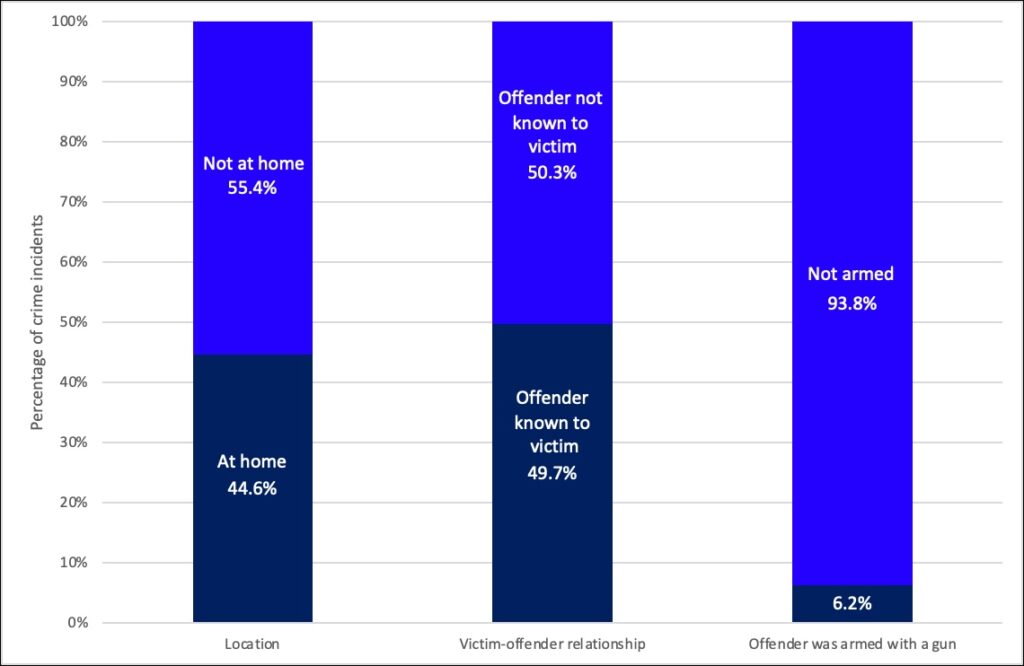
Before examining incidents involving the defensive use of a gun, it’s important to understand more broadly the landscape of armed street encounters and residential break-ins, a primary reason people give for keeping a firearm on their person or nightstand. To contextualize this fear, we use the NCVS to estimate violent home invasions from 2019 through 2023, those where the offender was armed, and how many involved DGUs in this period.
We find that attacks from armed strangers are rare:
- Personal and property crimes impact a small fraction of the US population: Each year between 2019 and 2023, fewer than 3 percent9The National Crime Victimization Survey surveys residents age 12 or older about crime victimizations. More than one person can be affected during a crime. There were an average of 7.4 million crime victimizations out of 280 million people, age 12 or older. of the US population are affected by personal and property crimes—both violent and nonviolent.
- Most suspects are not armed: In 94 percent of these personal or property crime incidents, the suspect was not armed with a gun.
- Most suspects are not strangers in crimes at home: In two-thirds of home incidents,10Nearly half of crime incidents happened at the victim’s home or the home of their neighbor, relative, or friend. the victim(s) knew the suspect(s).11Known well, a casual acquaintance, or known by sight.
- Crime incidents at home involving an armed stranger are rare: Fewer than 1 percent of all crime incidents where the victim was present involved such cases.
Characteristics of personal and property crime in the United States
Myth #2: Guns are commonly used for self-defense.
The number of times a gun is reported to be used defensively varies widely, in part because we do not have a definitive data source for this type of gun use, and in part because a defensive action can be highly subjective. Research has shown that people who report defensive gun use may not be acting in response to a genuine criminal threat or the incident may not constitute lawful self-defense.12See, e.g., D. Hemenway, D. Azreal, and M. Miller, “Gun Use in the United States: Results from Two National Surveys,” Injury Prevention 6, no. 4 (2000): 263–67, https://injuryprevention.bmj.com/content/6/4/263; Michael D. Anestis et al., “Lifetime and Past-Year Defensive Gun Use,” JAMA Network Open 8, no. 3 (2025): e250807, https://doi.org/10.1001/jamanetworkopen.2025.0807; David Hemenway, Chloe Shawah, and Elizabeth Lites, “Defensive Gun Use: What Can We Learn From News Reports?” Injury Epidemiology 9 (2022) https://doi.org/10.1186/s40621-022-00384-8; Chris Davis, “Florida’s Stand Your Ground Law,” Tampa Bay Times, June 3, 2012, https://bit.ly/3c1KZub. For example, a teenage boy returning from a party runs out of gas at 2 a.m. and, along with his friend, knocks on a neighbor’s door for help. The homeowner, fearing this late-night knock and still half-asleep, shoots the teenager at close range, killing him. Is this a crime, or is it a legal use of a firearm for self-defense? Either way, NCVS counts this a DGU, and determining whether DGUs are legal or illegal can only be answered through police investigation and the criminal justice system.
The myth that DGU is common started with a series of phone surveys conducted in the 1990s. These surveys estimated that defensive gun use incidents occur between 760,000 and 3.6 million times annually.13Devin Hughes, “The Defensive Gun Use Lie and the Gun Lobby’s Firehose of Falsehood – Part 2,” Armed with Reason, June 20, 2023, https://armedwithreason.substack.com/p/the-defensive-gun-use-lie-and-the-682. But these estimates are highly flawed and have been repeatedly debunked.14David McDowall et al., “Levels and Changes in Defensive Firearm Use by US Crime Victims, 1987‒2021,” American Journal of Public Health 114 (2024): 1384–87, https://doi.org/10.2105/AJPH.2024.307838; David Hemenway, “Survey Research and Self-Defense Gun Use: An Explanation of Extreme Overestimates,” Journal of Criminal Law and Criminology 87, no. 4 (1997): 1430–45, https://scholarlycommons.law.northwestern.edu/jclc/vol87/iss4/5; David Hemenway, “The Myth of Millions of Annual Self-Defense Gun Uses: A Case Study of Survey Overestimates of Rare Events,” Chance 10, no. 3 (1997): 6–10, https://doi.org/10.1080/09332480.1997.10542033. The NRA frequently references a 1993 survey conducted by Gary Kleck and Matt Gertz,15Gary Kleck and Marc Gertz, Armed Resistance to Crime: The Prevalence and Nature of Self-Defense with a Gun,” Journal of Criminal Law and Criminology 86, no. 1 (Fall 1995): 150–187, https://scholarlycommons.law.northwestern.edu/cgi/viewcontent.cgi?article=6853&context=jclc. which suggested that guns were used defensively in approximately 845,000 burglaries that year.16David Hemenway, “Survey Research and Self-Defense Gun Use: An Explanation of Extreme Overestimates,” Journal of Criminal Law and Criminology 87, no. 4 (1997): 1430–45, https://scholarlycommons.law.northwestern.edu/jclc/vol87/iss4/5; David Hemenway, “The Myth of Millions of Annual Self-Defense Gun Uses: A Case Study of Survey Overestimates of Rare Events,” Chance 10, no.3 (1997): 6–10, https://doi.org/10.1080/09332480.1997.10542033. But the numbers don’t add up. Victimization surveys from that year17US Bureau of Justice, “National Crime Victimization Survey,” Bureau of Justice Statistics Bulletin, May 1995, https://bjs.ojp.gov/content/pub/pdf/Cv93.pdf. show that there were 1.3 million burglaries when someone was home,18David Hemenway, “Survey Research and Self-Defense Gun Use: An Explanation of Extreme Overestimates,” Journal of Criminal Law and Criminology 87, no. 4 (1997): 1430–45, https://scholarlycommons.law.northwestern.edu/jclc/vol87/iss4/5; David Hemenway, “The Myth of Millions of Annual Self-Defense Gun Uses: A Case Study of Survey Overestimates of Rare Events,” Chance 10, no.3 (1997): 6–10, https://doi.org/10.1080/09332480.1997.10542033. and only 42 percent of households at that time owned firearms.19Tom W. Smith and Jaesok Son, “General Social Survey: Trends in Gun Ownership in the United States, 1972-2014,” NORC at the University of Chicago, March 2015, https://www.norc.org/content/dam/norc-org/pdfs/GSS_Trends%20in%20Gun%20Ownership_US_1972-2014.pdf. For the 1993 survey to be accurate, an impossibility would need to have occurred: burglary victims would have to have used their guns for self-defense in over 100 percent of incidents.20Using these surveys, David Hemenway estimated that fewer than 550,000 burglaries occurred in a home with a gun owner present. David Hemenway, “Survey Research and Self-Defense Gun Use: An Explanation of Extreme Overestimates,” Journal of Criminal Law and Criminology 87, no. 4 (1997): 1430–45, https://scholarlycommons.law.northwestern.edu/jclc/vol87/iss4/5.
A second impossibility from the Kleck and Gertz survey is related to the number of times someone was killed or wounded in a defensive gun use incident. The survey claims that 8.3 percent of these defensive uses involved a person who was killed or wounded.21Gary Kleck and Marc Gertz, ‘‘Armed Resistance to Crime: The Prevalence and Nature of Self-Defense with a Gun,’’ Journal of Criminal Law and Criminology 86, no. 1 (1995): 150–87. This means 207,000 shootings per year.22David Hemenway, “Survey Research and Self-Defense Gun Use: An Explanation of Extreme Overestimates,” Journal of Criminal Law and Criminology 87, no. 4 (1997): 1430–45, https://scholarlycommons.law.northwestern.edu/jclc/vol87/iss4/5. Yet the Centers for Disease Control and Prevention reported 143,985 total fatal and nonfatal shootings in 1993.23Center for Disease Control and Prevention (CDC), “Nonfatal and Fatal Firearm-Related Injuries- United States 1993-1997,” Morbidity and Mortality Weekly Report, November 1999, https://bit.ly/3P6pD0c. While there is a common misconception that offenders shot in these incidents may avoid seeking medical attention, research shows that over 90 percent of offenders who were wounded before their incarceration sought treatment in a hospital. J P May, D Hemenway, and A Hall, “Do Criminals Go to the Hospital When They Are Shot?” Injury Prevention: Journal of the International Society for Child and Adolescent Injury Prevention 8, no. 3 (2002): 236–38,https://pubmed.ncbi.nlm.nih.gov/12226123/. Again, the numbers do not add up.
Most recently, political economist William English’s estimate of DGU from his 2021 National Firearms Survey24William English, “2021 National Firearms Survey: Updated Analysis Including Types of Firearms Owned,” Georgetown McDonough School of Business Research Paper No. 4109494, May 13, 2022, https://ssrn.com/abstract=4109494; William English, “2021 National Firearms Survey,” Georgetown McDonough School of Business Research Paper No. 3887145, July 14, 2021, https://ssrn.com/abstract=3887145.—a paper that was self-published and never appeared in a peer-reviewed journal—has been cited by the gun lobby and in the courts.25Mike McIntire and Jodi Kantor, “The Gun Lobby’s Hidden Hand in the 2nd Amendment Battle,” New York Times, June 18, 2024, https://www.nytimes.com/2024/06/18/us/gun-laws-georgetown-professor.html. English did not disclose in his paper that he has served as a paid expert for the NRA, and eminent social scientists have widely criticized his findings.26Mike McIntire and Jodi Kantor, “The Gun Lobby’s Hidden Hand in the 2nd Amendment Battle,” New York Times, June 18, 2024, https://www.nytimes.com/2024/06/18/us/gun-laws-georgetown-professor.html; Deborah Azrael et al., “A Critique of Findings on Gun Ownership, Use, and Imagined Use from the 2021 National Firearms Survey: Response to William English,” Duke Law School Public Law & Legal Theory Series No. 2024-50, 78 SMU Law Review (forthcoming 2025), https://papers.ssrn.com/sol3/papers.cfm?abstract_id=4894282. His research methodology, in which he estimated 1.67 million annual DGUs,27William English, “2021 National Firearms Survey: Updated Analysis Including Types of Firearms Owned” Georgetown McDonough School of Business Research Paper No. 4109494, May 13, 2022, https://ssrn.com/abstract=4109494; William English, “2021 National Firearms Survey,” Georgetown McDonough School of Business Research Paper No. 3887145, July 14, 2021, https://ssrn.com/abstract=3887145. https://papers.ssrn.com/sol3/papers.cfm?abstract_id=4109494. suffers from many of the classic pitfalls of weak survey design, including asking questions with leading statements, relying on poor recall over the lifetime of respondents who averaged 48 years old, and other serious methodological flaws.28Deborah Azrael et al., “A Critique of Findings on Gun Ownership, Use, and Imagined Use from the 2021 National Firearms Survey: Response to William English,” Duke Law School Public Law & Legal Theory Series No. 2024-50, 78 SMU Law Review (forthcoming 2025) https://papers.ssrn.com/sol3/papers.cfm?abstract_id=4894282. It’s not surprising, then, that his estimate is 24 times our estimated annual number of DGUs based on the federal NCVS, as explained below.29William English estimated 1.67 million annual DGUs; this is 24 times our estimate of 69,000 DGUs annually from the NCVS.
Fact #2: Defensive gun use is rare.
To understand how frequently DGUs actually occur, we used NCVS, the primary data source on crime victimization in the United States. The NCVS asks people whether they were the victim of a crime over the past six months, regardless of whether it was reported to the police or not. As such, it is a unique source of information about victimization beyond FBI and other crime statistics. Analyzing data in NCVS, we learn that people rarely use a gun for defense against personal or property crimes, either in their home or outside:
- Defensive gun use occurs in fewer than 1 percent of all personal and property crimes. Our analysis of NCVS data show an estimated 69,000 defensive gun use incidents happened each year between 2019 and 2023 in the United States. This number is less than 1 percent of all personal and property crime incidents, and likely overestimates lawful DGU.
- In the majority of these uses, suspected perpetrators are unarmed. In fact, 58 percent of perpetrators are not armed with any weapon. In eight out of 10 DGUs, the suspected perpetrator is not armed with a gun.30Just under one-quarter (22.4 percent) were armed with another type of weapon.
- Defensive gun use at home against a stranger is rare: DGUs in the victim’s home against a stranger armed with a gun is so rarely reported in the NCVS that it cannot be estimated, even for the whole country.
Our analysis shows that defensive gun use is very uncommon. Other researchers have confirmed this finding.31David Hemenway, “The Myth of Millions of Annual Self-Defense Gun Uses: A Case Study of Survey Overestimates of Rare Events,” Chance 10, no. 3 (1997): 6–10, https://sites.stat.columbia.edu/gelman/surveys.course/Hemenway1997.pdf; Devin Hughes, “The Defensive Gun Use Lie and the Gun Lobby’s Firehose of Falsehood – Part 2,” Armed with Reason, June 20, 2023, https://armedwithreason.substack.com/p/the-defensive-gun-use-lie-and-the-682; David Hemenway, “Survey Research and Self-Defense Gun Use: An Explanation of Extreme Overestimates,” Journal of Criminal Law and Criminology 87, no. 4 (1997): 1430–45, https://scholarlycommons.law.northwestern.edu/cgi/viewcontent.cgi?article=6936&context=jclc. A recent estimate from researchers at the State University of New York–Albany and University of California–Irvine shows that incidents of DGU for personal or property crimes across four periods from 1987 to 2021 ranged from 61,000 to 65,000 incidents annually.32David McDowall et al., “Levels and Changes in Defensive Firearm Use by US Crime Victims, 1987‒2021.” American Journal of Public Health 114, no. 12 (December 2024): 1384–87, https://ajph.aphapublications.org/doi/full/10.2105/AJPH.2024.307838?role=tab. A Rutgers School of Public Health 2024 survey shows that fewer than 1 percent of respondents reported any form of defensive gun use in the past year.33Michael D. Anestis et al., “Lifetime and Past-Year Defensive Gun Use,” JAMA Network Open 8, no. 3 (2025): e250807, https://doi.org/10.1001/jamanetworkopen.2025.0807. These estimates are a far cry from the 3 million defensive gun uses frequently cited by gun lobby advocates, including by the Founder of Women for Gun Rights in a US House Judiciary hearing on March 4, 2025.34Dianna Muller, “The Right to Self Defense: Testimony before the US House Judiciary Committee, Subcommittee on Crime and Federal Government Surveillance,” March 4, 2025, https://judiciary.house.gov/sites/evo-subsites/republicans-judiciary.house.gov/files/evo-media-document/muller-testimony.pdf; https://www.youtube.com/watch?v=6hs4mnINwN4.
Myth #3: Defensive gun use can effectively protect you.
In the United States, most gun owners now cite self-protection as a major reason for owning a firearm. A 2023 Pew Research survey found that nearly three-quarters of firearm owners listed this as a major reason for owning a gun.35 Pew Research Center, “For Most U.S. Gun Owners, Protection Is the Main Reason they Own a Gun,” August 16, 2023,https://www.pewresearch.org/politics/2023/08/16/for-most-u-s-gun-owners-protection-is-the-main-reason-they-own-a-gun/. This is in stark contrast to the mid-1990s, when most people said their main motivation was recreational use such as hunting.36Philip J. Cook and Jens Ludwig, “Guns in America: National Survey on Private Ownership and Use of Firearms,” Research in Brief, National Institute of Justice, May 1997, https://www.ojp.gov/pdffiles/165476.pdf. This shift comes at a time of surging gun sales,37Matthew Miller, Wilson Zhang, and Deborah Azrael, “Firearm Purchasing During the COVID-19 Pandemic: Results from the 2021 National Firearms Survey,” Annals of Internal Medicine 175, no. 2 (2022); 219–25, https://doi.org/10.7326/M21-3423; Daniel Nass and Champe Barton, “How Many Guns Did Americans Buy Last Month?” The Trace, March 2, 2025, https://www.thetrace.org/2020/08/gun-sales-estimates/. and the uptick is no coincidence.
The gun lobby has promoted the idea that firearms are essential for immediate protection, advancing fear-driven narratives like, “When seconds count, police are minutes away” and “Be your own first responder.”38Citizens Committee for the Right to Keep and Bear Arms and Second Amendment Foundation, “New CCRKBA, SAF Video Reveals The ‘Real War on Women,’” news release, June 3, 2013, https://www.prnewswire.com/news-releases/new-ccrkba-saf-video-reveals-the-real-war-on-women-209951991.html; National Rifle Association (@NRA), “When seconds count, police are minutes away.” Twitter (now X), May 31, 2020, https://x.com/nra/status/1267273664631889922; https://x.com/NRAA1F/status/1921917811338686903 This reinforces the belief that a firearm is both necessary and effective for self-protection and for minimizing injury or property loss. Recent analyses of gun advertisements targeting women show that this messaging normalizes defensive gun use as the first and only line of defense for protecting their homes and children, and against assaults by strangers.39Lisa Jordan, James Kalin, and Colleen Dabrowski, “Characteristics of Gun Advertisements on Social Media: Systematic Search and Content Analysis of Twitter and YouTube Posts,” Journal of Medical Internet Research 22, no. 3 (2020): e15736, https://pmc.ncbi.nlm.nih.gov/articles/PMC7148552/.
The NRA has amplified the research of Gary Kleck and John Lott to support the claim that defensive gun use can effectively protect you. Kleck argues that DGU is generally effective to prevent injury and property loss, citing his research that found forceful tactics, including resistance with a gun, has the strongest effects on reducing risk of injury.40Jongyeon Tark and Gary Kleck, “Resisting Crime: The Effects of Victim Action on the Outcomes of Crimes,” Criminology 42 (2004): 861–910, https://onlinelibrary.wiley.com/doi/abs/10.1111/j.1745-9125.2004.tb00539.x. Based on these findings, he contends that laws restricting a victim’s ability to use a gun defensively “impairs their capacity for effective self-protection and increases the likelihood of the victims suffering injury or property loss.”41Declaration of Gary Kleck, Duncan v. Becerra, No: 17-cv-1017-BEN-JLB, Document 6-11 (S. D. Cal. filed May 26, 2017), https://michellawyers.com/wp-content/uploads/2017/05/6.11_2017-05-26_Declaration-of-Gary-Kleck-In-Support-of-Plaintiffs-Motion-for-Preliminary-Injunction-Exhibit-MMM.pdf. Similarly, John Lott claims that having a gun is the most effective means of self-protection, especially for vulnerable populations such as women and the elderly.42John R. Lott, The War on Guns: Arming Yourself against Gun Control Lies (Simon and Schuster, 2016). However, as we will show, and other researchers have shown: Owning a gun for defensive use comes with significant risks and does not reduce the likelihood of harm compared to other protective actions such as running away, driving away, or calling law enforcement.43David Hemenway and Sara J. Solnick, “The Epidemiology of Self-Defense Gun Use: Evidence from the National Crime Victimization Surveys 2007–2011,” Preventive Medicine 79 (2015): 22–27, https://doi.org/10.1016/j.ypmed.2015.03.029.
Fact #3: Using a gun for self-defense is no more effective than other forms of protection.
To prove the claim that guns offer the most effective protection to be true, a person using a gun defensively must be more likely to walk away unharmed and to better avoid property loss than someone who doesn’t respond with a gun. We would expect less harm, and better outcomes. Everytown’s analysis of NCVS data show that this is not the reality:44While the coefficients of variation for these estimates are below 30 percent, thus meeting the standard reliability threshold, these estimates are based on a small subset of NCVS respondents. This supports Everytown’s observation that DGUs are exceedingly rare occurrences.
- More harm in DGU scenarios: Crime victims who responded with a gun were less likely to get away from the offender than those who responded without one (7 percent with a gun compared to 18 percent without) and less likely to avoid injury (39 percent compared to 44 percent).45“Avoided injury” means that they did not get hurt. “Got away” means that they were able to get away from the situation; they may or may not have been hurt.
- Slightly worse outcomes defending property: While doing nothing in response to a criminal incident is most likely to result in losses, nearly 13 percent of those who used their gun to defend themselves in a crime lost property; of those who defended themselves in other ways, just under 10 percent lost property.
Crime victims who used a gun were more likely to experience harm.
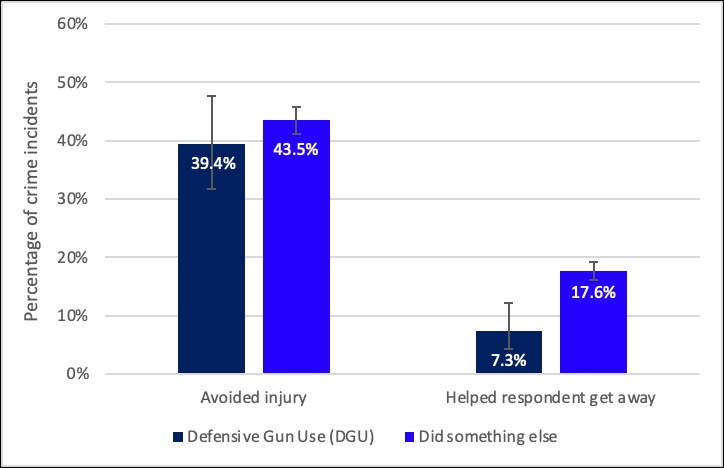
Note: 95 percent confidence intervals are in brackets.
Myth #4: Having a gun in your home makes you and your family safer.
The gun lobby continues to urge people to protect themselves and their families with firearms, in response to the perceived threat of a break-in or violent intrusion from a stranger. Owning a gun is a response some choose when driven by the fear that a stranger will harm their loved ones. In particular, the gun lobby is increasingly pulling at the heartstrings of parents and women, encouraging them to see firearm ownership as a form of protection for their children. A recent analysis of Guns & Ammo magazine found that gun advertisements depict women as defenseless, vulnerable, and incapable of safeguarding their families without a firearm. Researchers have shown that taglines such as “Built for Defense,” “Empower Yourself,” and “Personal Home Defense for Women” position women as heroes and domestic defenders, whose strength is tied to gun ownership.46Aimee Dinnín Huff, Brett C. Burkhardt, and Michelle Barnhart, “Advertising Frames and the Legitimation of the Armed American Woman,” Journal of Macromarketing 44, no. 1 (2024): 153–77, https://journals.sagepub.com/doi/10.1177/02761467231221227?icid=int.sj-full-text.citing-articles.1
The narrative that a firearm will give people the ability to become domestic defenders is further reinforced through safety planning strategies crafted by the gun industry. Even though Everytown’s analysis above shows that personal and property crimes are uncommon and declining, and that DGU against a stranger is extremely uncommon, the gun lobby continues to insist that a firearm is integral to safety planning. The NRA’s home invasion strategies include carrying a firearm on your person inside the home, keeping loaded guns readily accessible, storing firearms in every room in the home, and teaching children how to use them.47Jim Wilson, “Dealing with Home Invasions,” Shooting Illustrated, October 26, 2010, https://www.shootingillustrated.com/content/dealing-with-home-invasions/; Kevin Creighton, “Protecting Your Home against a Home Invasion,” AmmoMan.com, (accessed June 10, 2025). https://www.ammoman.com/blog/what-to-do-during-a-home-invasion/; Jo Deering, “Access vs Security: Keeping Guns Accessible and Safe at Home,” NRA Women, September 30, 2024, https://www.nrawomen.com/content/access-vs-security-keeping-guns-accessible-and-safe-at-home. Normalizing these tactics presents an illusion of preparedness that ignores the risks that firearms pose to family members.
Fact #4: Guns in the home increase risks for young people and for women in abusive relationships.
A 3-year-old boy, at home with his 5-year-old brother, died from a self-inflicted gunshot wound in Hammond, Louisiana, at 1 pm in July 2024. The toddler found his father’s loaded, unsecured gun under a mattress.48Arielle Brumfield, “Hammond Father Could Face Charges in Accidental Deadly Shooting of Toddler,” WDSU News, last updated July 18, 2024, https://www.wdsu.com/article/hammond-toddler-accidental-shooting/61637794.
In addition to the tragedies of mistaken identities or impulsive reaction shootings out of fear,49Albert Samaha and Sean Campbell, “She Thought She’d Shot a Burglar. Then She Realized It was Her Roommate,” The Trace, March 23, 2018, https://www.thetrace.org/2018/03/mistaken-identity-shooting-self-defense/. research has shown that keeping a gun in one’s home comes with broader risks, including injury and death from unintentional shootings, suicides, homicides, and intimate partner abuse and death. These guns kept for self-defense, when not securely stored, can be particularly perilous for young people. Nearly every day in the United States, a child under 18 finds a loaded gun and unintentionally shoots themself or someone else, often a sibling or friend over for a playdate.50Everytown for Gun Safety Support Fund, “#NotAnAccident Index,” https://everytownresearch.org/maps/notanaccident/; Everytown for Gun Safety Support Fund, “Preventable Tragedies: Unintentional Shootings by Children,” April 2023, https://everytownresearch.org/report/notanaccident/. And nearly 80 percent of firearm suicides by children 17 or younger involve a gun owned by a family member.51Catherine Barber et al., “Who Owned the Gun in Firearm Suicides of Men, Women, and Youth in Five US States?” Preventive Medicine 164 (2022): 107066, https://doi.org/10.1016/j.ypmed.2022.107066. Firearms are also transferred outside of the home: In three out of four of the shootings plaguing our schools, the firearms came from the home of a parent or close relative.52National Threat Assessment Center, “Protecting America’s Schools: A US Secret Service Analysis of Targeted School Violence,” US Secret Service, Department of Homeland Security, 2019, https://www.secretservice.gov/sites/default/files/2020-04/Protecting_Americas_Schools.pdf; Brent R. Klein et al., “Characteristics and Obtainment Methods of Firearms Used in Adolescent School Shootings,” JAMA Pediatrics 178, no. 1 (2024): 73–79, https://doi.org/10.1001/jamapediatrics.2023.5093. The reality is that the guns bought by parents to protect their families can erode safety in our schools and put young people at risk.
And the risk to women in abusive relationships is grave: Domestic abusers with a gun are five times more likely to kill their female victims.53Jacquelyn C. Campbell et al., “Risk Factors for Femicide in Abusive Relationships: Results from a Multisite Case Control Study,” American Journal of Public Health 93 (2003): 1089–97, https://doi.org/10.2105/ajph.93.7.1089. While there is a common misconception that offenders shot in these incidents may avoid seeking medical attention, research shows that over 90 percent of offenders who were wounded before their incarceration sought treatment in a hospital. J P May, D. In fact, women in the US are 28 times more likely to die by firearm homicide than women in peer nations, 54Everytown Research analysis of the most recent year of gun homicides by country (2015–2019), GunPolicy.org (accessed January 7, 2022). and intimate partner violence (three in 10 firearm homicides of women) drives these numbers.55Everytown Research analysis of Centers for Disease Control and Prevention, National Violent Death Reporting System (NVDRS), Average: 2020–2022. Ages: 18–85+. Everytown for Gun Safety Support Fund, “Guns and Violence Against Women: America’s Uniquely Lethal Intimate Partner Violence Problem,” May 27, 2025, https://everytownresearch.org/report/guns-and-violence-against-women/. Access to firearms in the home amplifies the power and control of an abuser over their intimate partner, and children are often deeply traumatized as they witness or live with these patterns of threats and violence.56Everytown for Gun Safety Support Fund, “Guns and Violence Against Women: America’s Uniquely Lethal Intimate Partner Violence Problem,” May 27, 2025, https://everytownresearch.org/report/guns-and-violence-against-women/. As shown above, the gun lobby’s solution to prevent such violence is to arm women with guns,57Lisa Jordan, James Kalin, and Colleen Dabrowski, “Characteristics of Gun Advertisements on Social Media: Systematic Search and Content Analysis of Twitter and YouTube Posts,” Journal of Medical Internet Research 22, no. 3 (2020): e15736, https://doi.org/10.2196/15736; Everytown for Gun Safety Support Fund, “Toxic Marketing,” accessed June 20, 2025, https://smokinggun.org/issue/toxic-marketing/; Ben Wofford, “The NRA’s Most Wanted Customer: Women,” Glamour, June 28, 2018, https://www.glamour.com/story/how-the-nra-is-trying-to-reach-women. but that firearm is far more likely to be used against her than by her.58Ruth W. Leemis et al., “The National Intimate Partner and Sexual Violence Survey: 2016/2017 Report on Intimate Partner Violence,” Centers for Disease Control and Prevention, October 2022, https://stacks.cdc.gov/view/cdc/124646 (4.7 percent of women (5.9 million) in the United States reported having a gun used on them by a current or former intimate partner at some point in their lifetime, compared to 1.4 percent of men (1.7 million).); Garen J. Wintemute et al., “Mortality among Recent Purchasers of Handguns,” New England Journal of Medicine 341, no. 21 (1999): 1583–89, https://doi.org/10.1056/NEJM199911183412106.
Myth #5: An armed society is a safe society.
The gun lobby has promoted a worldview of constant threat from various enemies, including criminals, government regulations, and tyranny, and an armed society can protect us from these dangers.59Mugambi Jouet, “Guns, Identity, and Nationhood,” Palgrave Communications 5, no. 138 (2019), https://www.nature.com/articles/s41599-019-0349-z; Lisa Jordan, James Kalin, and Colleen Dabrowski, “Characteristics of Gun Advertisements on Social Media: Systematic Search and Content Analysis of Twitter and YouTube Posts,” Journal of Medical Internet Research 22, no. 3 (2020): e15736, https://doi.org/10.2196/15736; Everytown for Gun Safety Support Fund, “Toxic Marketing,” accessed June 20, 2025, https://smokinggun.org/issue/toxic-marketing/; Everytown for Gun Safety Support Fund, “Armed and Dangerous: How the Gun Lobby Enshrines Guns as Tools of the Extreme Right,” September 30, 2020, https://everytownresearch.org/report/extreme-right/; Everytown for Gun Safety Support Fund, “Paranoia and Profit: Armed Extremism and the Gun Industry’s Role in Fostering It,” July 12, 2024, https://everytownresearch.org/report/armed-extremism-paranoia-profit-gun-industry/. A cornerstone for the NRA’s agenda to expand the presence of firearms in more places rests on the widely discredited research conducted by John Lott, who claims that more guns in society lead to less crime, and therefore, communities are safer when free from government restrictions on gun ownership and gun carrying.60John R. Lott, More Guns, Less Crimes (University of Chicago Press, 1998); John R. Lott, Jr. and David B. Mustard, “Crime, Deterrence, and Right-to-Carry Concealed Handguns,” Journal of Legal Studies 26, no. 1 (1997): 1–68. However, social scientists have shown that his methodology is flawed61Daniel Webster and Jens Ludwig, “Myths about Defensive Gun Use and Permissive Gun Carry Laws” Media Studies Group, 2000, https://www.bmsg.org/wp-content/uploads/2000/01/bmsg_report_myths_about_defensive_gun_use.pdf; https://nap.nationalacademies.org/read/10881/chapter/8#150; Ian Ayres and John J. Donohue III, “Shooting Down the ‘More Guns, Less Crime’ Hypothesis,” Stanford Law Review 55, no. 4 (April 2003): 1193–1312, https://www.jstor.org/stable/1229603; Ian Ayres and John J. Donohue III, “The Latest Misfires in Support of the More Guns, Less Crime Hypothesis,” Stanford Law Review 55, no. 4 (April 2003): 1371–98, https://digitalcommons.law.yale.edu/fss_papers/1242/; John J. Donohue III and Ian Ayres, “More Guns, Less Crime Fails Again: The Latest Evidence from 1977 – 2006,” Econ Journal Watch 6, no. 2 (May 2009): 217–38, https://econjwatch.org/File+download/248/2009-05-ayresdonohue-com.pdf?mimetype=pdf5. and have reached an opposite conclusion: more guns in society are associated with more violent crime.62John J. Donahue et al., “Why do Right to Carry Laws Increase Violence? Effects on Gun Theft and Clearance Rates,” Journal of Urban Economics 147 (2025): 103761, https://www.sciencedirect.com/science/article/abs/pii/S0094119025000269; John J. Donohue, Abhay Aneja, and Kyle D. Weber, “Right-to-Carry Laws and Violent Crime: A Comprehensive Assessment Using Panel Data and a State-Level Synthetic Control Analysis,” Journal of Empirical Legal Studies 16, no. 2 (2019): 198-247, https://doi.org/10.1111/jels.12219.
Despite this, the gun lobby continues to cite Lott’s findings to justify their legislative push for laws that allow people to carry concealed guns in public spaces without a permit, background check, or safety training. This has led to a divide across the nation on gun policy, with some states enacting gun safety laws to prevent shooting injuries and death, while others repeal safety laws including by allowing people to carry concealed, loaded guns in public with no permit, training, or background check.
Fact #5: Defensive gun use can lead to deadly outcomes in society.
If access to guns made society safer, America would be the safest country on earth. Instead, the United States has both the highest rate of civilian gun ownership in the world63Small Arms Survey, “Civilian Firearms Holdings, 2017,” annex to “Estimating Global Civilian-held Firearms Numbers,” briefing paper, June 2018, https://www.smallarmssurvey.org/sites/default/files/resources/SAS-BP-Civilian-held-firearms-annexe.pdf. and a gun homicide rate 26 times that of our peer high-income nations.64Everytown Research analysis of the most recent year of gun homicides by country (2013 to 2019), GunPolicy.org (accessed January 7, 2022). In contrast to the NRA’s claim that gun laws make us less safe, a study of 50 gun safety laws across the 50 states finds that states with the weakest gun safety laws have a gun death rate two and a half times higher than states that are national gun safety leaders.65State gun laws come from Everytown’s Gun Law Ranking, 2025. These rankings are updated annually, scoring every state based on the strength of 50 key gun safety policies. States with the weakest laws are: Kansas, New Hampshire, Kentucky, Alaska, Missouri, Oklahoma, Arizona, Wyoming, South Dakota, Georgia, Montana, Arkansas, Mississippi, and Idaho. The national leaders, states with the strongest laws are: California, Massachusetts, Illinois, New York, Connecticut, New Jersey, Hawaii, Maryland, and Washington. And in particular, research shows that more guns in public spaces lead to violent crimes: states that have weakened their firearm permitting system have experienced a 13 to 15 percent increase in violent crime rates.66John J. Donohue, Abhay Aneja, and Kyle D. Weber, “Right-to-Carry Laws and Violent Crime: A Comprehensive Assessment Using Panel Data and a State-Level Synthetic Control Analysis,” Journal of Empirical Legal Studies 16, no. 2 (2019): 198–247, https://doi.org/10.1111/jels.12219.
One type of law that is important for this issue are Shoot First laws,67Everytown for Gun Safety Support Fund, “Everytown Gun Law Rankings: Which states have rejected Shoot First laws?” accessed March 2025, https://everytownresearch.org/rankings/law/no-shoot-first-law/. Alabama, Alaska, Arizona, Arkansas, Florida, Georgia, Idaho, Indiana, Iowa, Kansas, Kentucky, Louisiana, Michigan, Mississippi, Missouri, Montana, Nevada, New Hampshire, North Carolina, North Dakota, Ohio, Oklahoma, Pennsylvania, South Carolina, South Dakota, Tennessee, Texas, Utah, and Wyoming have Shoot First laws in place. which encourage people to take on self-appointed neighborhood watch roles and sometimes use violence as a first—not last—resort. Multiple studies have confirmed that Shoot First laws do not prevent violent crime; rather, there is ample evidence that these laws are associated with increases in firearm homicides.68Rosanna Smart et al., “Stand-Your-Ground Laws,” in The Science of Gun Policy: A Critical Synthesis of Research Evidence on the Effects of Gun Policies in the United States, Second Edition (RAND Corporation, 2020), 235–50, www.rand.org/t/RR2088-1; RAND Corporation, “The Effects of Stand-Your-Ground Laws,” April 22, 2020, https://www.rand.org/research/gun-policy/analysis/stand-your-ground.html; RAND Corporation, “Gun Policy Research Review,” Gun Policy in America, accessed December 11, 2020, https://www.rand.org/research/gun-policy/analysis.html; Michelle Degli Esposti et al., “Analysis of ‘Stand Your Ground’ Self-Defense Laws and Statewide Rates of Homicides and Firearm Homicides,” JAMA Network Open 5, no. 2 (February 21, 2022): e220077, https://doi.org/10.1001/jamanetworkopen.2022.0077; Marc Levy et al., “Stand Your Ground: Policy and Trends in Firearm-Related Justifiable Homicide and Homicide in the US,” Journal of the American College of Surgeons 230, no. 1 (2020): 161-167.e4, https://doi.org/10.1016/j.jamcollsurg.2019.11.003. We saw how these laws can encourage self-deputization when Ahmaud Arbery lost his life while jogging in his neighborhood, a Georgia suburb.69Richard Fausset et al., “Ahmaud Arbery Shooting: A Timeline of the Case,” New York Times, August 8, 2022, https://nyti.ms/3HtQWzE. Armed vigilantes who may determine that another person poses a threat, confront them, and introduce a gun into the mix, can use deadly force on a whim, like the father and son who killed Mr. Arbery.70Lindsay Livingston, “From Self-Defense to Self-Deputization: Defensive Gun Use and the Performance of Reasonable Belief,” Duke Center for Firearms Law, January 7, 2022, https://firearmslaw.duke.edu/2022/01/from-self-defense-to-self-deputization-defensive-gun-use-and-the-performance-of-reasonable-belief. The result can be deadly. We have to ask ourselves, is this the society that we want to live in?
Society suffers when these laws make it hard to hold shooters accountable. They also confuse the public about lawful self-defense.71Traditional self-defense laws require that you retreat if you know you can clearly and safely walk away before using deadly force, except when in one’s home. Shoot First laws eliminate the requirement to disengage if possible before defending yourself outside the home, and erect legal barriers to holding shooters accountable. Research has shown that justifiable homicides increased by 55 percent in states with Shoot First laws, in comparison to a 20 percent increase in states without these laws.72Marc Levy et al., “Stand Your Ground: Policy and Trends in Firearm-Related Justifiable Homicide and Homicide in the US,” Journal of the American College of Surgeons 230, no. 1 (2020): 161–167.e4, https://doi.org/10.1016/j.jamcollsurg.2019.11.003. The outcome of these cases cannot be disentangled from race: In states with Shoot First laws, homicides in which white shooters kill Black victims are deemed justifiable four times more frequently, compared to three times as often in other states.73Everytown Research analysis of the FBI’s Supplementary Homicide Reports (SHR) data, 2019–2023. In SHR, justifiable homicides are coded as either 80 (“felon killed by private citizen”) or 81 (“felon killed by police”). For the purposes of this analysis, only homicides involving a private citizen killed by a felon are included. Alabama was excluded from the analysis due to inconsistent data reporting to the FBI. Florida was excluded as they do not report to the FBI. Everytown Research analysis compared the percentage of homicides deemed justifiable by victim and offender demographics by state. Racial biases and other forms of prejudice can lead people to perceive individuals from certain identities and backgrounds as dangerous, even if there is no threat or crime.
Ways to Protect Yourself and Others
“Can I stop a bad guy with a gun because I am a good guy with a gun?” Studies of firearm-involved incidents say no. It is more common for active shooters to be neutralized by unarmed civilians than armed civilians.74Larry Buchanan and Lauren Leatherby, “Who Stops a ‘Bad Guy With a Gun’?,” New York Times, June 22, 2022, https://www.nytimes.com/interactive/2022/06/22/us/shootings-police-response-uvalde-buffalo.html. The best solution for preventing catastrophic situations is to hold shooters accountable, to implement proven interventions such as passing common-sense gun laws like extreme risk laws and background checks on all gun sales, and to make investments in evidence-informed violence intervention programs and initiatives that eliminate structural and racial inequities and other root causes of gun violence.
“How else can I protect my home and family?” There are affordable and effective systems for protecting one’s property and loved ones that do not require a firearm. Outdoor protective measures include fences, alarm systems, motion-sensor lighting, doorbell cameras, and landscaping. Security solutions indoors can include having a dog and being careful on social media about your whereabouts and personal possessions.75Greg Lickenbrock, Safe Gun Ownership for Dummies (John Wiley & Sons Inc., 2022).
“Where and how will I store my gun?” Secure storage is essential, even if a gun is owned for self-protection. Gun owners are often concerned that secure storage will defeat the purpose of owning a gun for self-defense, since they might need it loaded and ready at a moment’s notice. Yet, it can take mere seconds to retrieve a securely stored gun and load it. Further, these seconds can be instrumental for gathering composure, especially if one was asleep, helping gun owners to avoid reflex reactions. Experts recommend that guns be stored unloaded, locked, and separate from ammunition. And several states require guns to be stored securely any time they are not in the owner’s possession. There are many affordable secure storage options that still allow quick access to a gun.
“Should I attend a training course?” Every gun owner should complete firearm safety training. While many gun owners (61 percent)76Ali Rowhani-Rahbar et al., “Formal Firearm Training Among Adults in the USA: Results of a National Survey,” Injury Prevention 24, no. 2 (2018):161–65, https://doi.org/10.1136/injuryprev-2017-042352. have taken some formal firearm training, only 10 states77Everytown for Gun Safety, “Everytown Gun Law Rankings: Which States Require Gun Buyers to Have Firearm Training?,” accessed March 2025, https://everytownresearch.org/rankings/law/training-required-to-purchase-guns/. California, Connecticut, Delaware, Hawaii, Massachusetts, Maryland, New Jersey, Oregon, Rhode Island, and Washington require training. require training prior to purchasing a gun. This training can teach a person how to handle a gun safely, shoot accurately, and build decision-making skills. Research has found, however, that some training classes can lead to socialization into a subculture that believes the world is a dangerous place, and killing another human being in self-defense is a moral action that saves lives.78Harel Shapira and Samantha J. Simon, “ Learning to Need a Gun,” Qualitative Sociology 41 (2018): 1–20, https://doi.org/10.1007/s11133-018-9374-2. Dialogue in training courses and by instructors should never fuel fear or condition people to disassociate from the lethality of their weapon and their role in killing another human being.
“Do I understand my state’s Castle Doctrine?” Generally, if someone breaks into your home or threatens to kill or injure you or your family in your home, you are justified in using force without having to try to retreat first. This longstanding principle is commonly known as the “Castle Doctrine.” However, Castle Doctrine laws differ across states. While the Castle Doctrine provides a presumption that deadly force was justified in some circumstances, it does not automatically allow the use of deadly force in your home in all cases. The police will investigate and, depending on the circumstances, you could still face arrest and prosecution for using deadly force against another person.
“Do I need to carry my gun in public?” Every gun owner should think carefully about carrying their gun outside their home. First, without a gun, you may be more likely to find a nonviolent way to de-escalate a situation.79Greg Lickenbrock, Safe Gun Ownership for Dummies (John Wiley & Sons Inc., 2022). When guns are used defensively in robberies, thefts, domestic disputes, and unarmed home invasions, they often place innocent people at risk of being shot.80David Hemenway, Chloe Shawah, and Elizabeth Lites, “Defensive Gun Use: What Can We Learn from News Reports?” Injury Epidemiology 9, no. 19 (2022), https://doi.org/10.1186/s40621-022-00384-8. Additionally, hundreds of thousands of guns are stolen each year, and they have been recovered at the scenes of violent crimes.81ATF, “National Firearms Commerce and Trafficking Assessment (NFTCA), Volume IV: Protecting America from Trafficked Firearms—Part II: Firearm Thefts and Losses Updates and New Analysis,” January 2025, https://www.atf.gov/firearms/docs/report/nfcta-volume-iv-part-ii-%E2%80%93-firearm-thefts-and-losses-updates-and-new-analysis/download; Brian Freskos, “Missing Pieces: Gun Theft From Legal Gun Owners Is on the Rise, Quietly Fueling Violent Crime,” The Trace, November 20, 2017, https://www.thetrace.org/2017/11/stolen-guns-violent-crime-america/. Everytown’s recent analysis of gun thefts revealed that nearly 112,000 guns were reported stolen in small- to large-sized cities across 44 states in 2022 alone. And cars are the most common source of stolen guns in the US.82Everytown for Gun Safety, “Gun Thefts from Cars: The Largest Source of Stolen Guns,” May 9, 2024, https://bit.ly/3Hg8f7e. More people carrying guns in public, and firearm theft from cars, can also complicate the work of police. As a gun owner, you can safeguard your family and community most by keeping your gun out of the hands of the wrong person.
Conclusion
In a world that can feel uncertain, firearm ownership may provide a sense of security and peace of mind, offering reassurance that you can keep your loved ones safe. While protecting your family from the threat of strangers coming into your home is important, it turns out this threat is statistically very rare. But the risks your gun poses from within your own home, or of a knee-jerk reaction to a sound or movement that turns into a grave error, are real. As illustrated above, they can be responsible for a tragic mistake driven by fear that forever changes a family’s life. And when we think about the impact on children, firearms are the top cause of death for youth in America.83Centers for Disease Control and Prevention, National Center for Health Statistics, WONDER Online Database, Underlying Cause of Death, Injury Mechanism & All Other Leading Causes, 2023. Ages: 1–17. Ages 0 to 1 are excluded because leading causes of death for newborns and infants are specific to that age group. Nearly 80 percent of guns used in youth suicides belong to a family member.84Catherine Barber et al., “Who Owned the Gun in Firearm Suicides of Men, Women, and Youth in Five US States?” Preventive Medicine 164 (2022): 107066, https://doi.org/10.1016/j.ypmed.2022.107066. And many Americans are stunned to learn that nearly every day in the United States, a child under 18 finds a loaded gun and unintentionally shoots themself or someone else, often a sibling or another young person.85Everytown for Gun Safety Support Fund, “#NotAnAccident Index,” https://everytownresearch.org/maps/notanaccident/; Everytown for Gun Safety Support Fund, “Preventable Tragedies: Unintentional Shootings by Children,” April 2023, https://everytownresearch.org/report/notanaccident/. The reality is that guns in the home, especially when not securely stored, can increase the risk of harm, and even death, for all family members.
Everytown Research & Policy is a program of Everytown for Gun Safety Support Fund, an independent, non-partisan organization dedicated to understanding and reducing gun violence. Everytown Research & Policy works to do so by conducting methodologically rigorous research, supporting evidence-based policies, and communicating this knowledge to the American public.