

Assault Weapons and High-Capacity Magazines
Last Updated: 6.24.2026

Introduction
In recent months, gun violence has unfolded in everyday settings with assault weapons. In Austin, a man armed with an AR-style rifle opened fire in a crowded nightlife district, killing three people and injuring more than a dozen in minutes.1Andrew Weber and Chelsey Zhu, “Austin Police Release Video, Audio from Officers and Bystanders at West Sixth Street Shooting,” KUT 90.5, updated March 9, 2026, https://www.kut.org/crime-justice/2026-03-05/austin-tx-west-sixth-street-shooting-bufords-apd-fbi-updates. In Vero Beach, a man used an AR-style rifle to kill his estranged wife and another man outside a public library.2Brian Hamacher, “Manhunt Continues for Husband Accused of Killing Wife, Another Man in Vero Beach,” WTVJ/NBC6, March 27, 2026, https://www.nbcmiami.com/news/local/manhunt-continues-for-husband-accused-of-killing-wife-another-man-in-vero-beach/3787227. And in Lawrence County, a 6-year-old accessed an unsecured AR-style rifle and unintentionally shot his teenage brother inside their home.3Mary Sell, “Teen Son of Rep. Yarbrough Accidentally Shot by 6-Year-Old Brother in Home,” Alabama Daily News, March 24, 2026, https://aldailynews.com/teen-son-of-rep-yarbrough-accidentally-shot-by-6-year-old-brother-in-home.
Following the expiration of the federal assault weapons ban,4Public Law 103-322, Title XI (1994). Part of the Violent Crime Control and Law Enforcement Act of 1994, the Public Safety and Recreational Firearms Act prohibited semiautomatic assault weapons designated by specific make or model or by a combination of specific characteristics, such as a folding or telescopic stock or a pistol grip that extends below the action of the weapon (former 18 USC § 921(a)(30)(B)). It also prohibited ammunition magazines with more than 10 rounds, with exemptions for those lawfully possessed on or before the law’s enactment (former 18 USC § 921(31)). The law took effect September 13, 1994, and expired on September 13, 2004. Vivian S. Chu, “Federal Assault Weapons Ban: Legal Issues,” Congressional Research Service, February 14, 2013, https://sgp.fas.org/crs/misc/R42957.pdf. the use of deadly assault weapons and high-capacity magazines has surged on the United States’ streets, in its communities, and at the sites of its deadliest mass shootings. The gun industry’s marketing of firearms designed for military use to civilian consumers—particularly young men and children—has helped fuel the rise in the manufacture and sale of these weapons and magazines.5 Everytown for Gun Safety Support Fund“Assault Weapons and High-Capacity Magazines,” The Smoking Gun, https://smokinggun.org/assault-weapons-and-high-capacity-magazines. As the gun industry continues to profit, communities across the country pay the price.
Assault weapons and high-capacity magazines enable shooters to fire rapidly and inflict mass casualties in seconds. Although often characterized as weapons used only in high-profile mass shootings, evidence shows that assault weapons are increasingly recovered at the scenes of everyday violence in our country. Whether used in targeted crime, school shootings, or escalating arguments, they pose a danger beyond those of other firearms. Despite the unique lethality and the devastating toll these weapons inflict on our communities, there has been no federal restriction on their access or possession for more than two decades, and laws in only some states prohibit assault weapons and/or high-capacity magazines. Research shows that such regulations can save lives by reducing the risk of mass shootings and firearm violence overall.
The research in this report demonstrates the inherent dangers of assault weapons and high-capacity magazines, examines the policies that have addressed them, and highlights the ways these weapons affect our nation’s gun violence epidemic beyond high-profile mass shootings. This analysis draws on Everytown for Gun Safety’s tracking of mass shooting incidents, decades of research on firearm violence, and The Smoking Gun.6Everytown for Gun Safety Support Fund, The Smoking Gun, https://smokinggun.org. The Smoking Gun is an online resource committed to exposing the gun industry’s role in our gun violence epidemic today through news stories, in-depth research, profiles on firearm manufacturers and suppliers, data, and more.
As assault weapons appear in more shootings and at more crime scenes, the country faces an urgent need to enact new restrictions on assault weapons and high-capacity magazines to prevent further harms.
KEY FINDINGS:
In this report, we find that:
- When used in mass shootings, assault weapons and high-capacity magazines drastically increase the number of people shot. Mass shootings involving at least one assault weapon or firearm equipped with a high-capacity magazine lead to 400 percent more victims.7Everytown Research analysis of mass shootings in the United States, 2016–2025. A mass shooting is defined as any incident in which four or more people were shot and killed in a single incident.
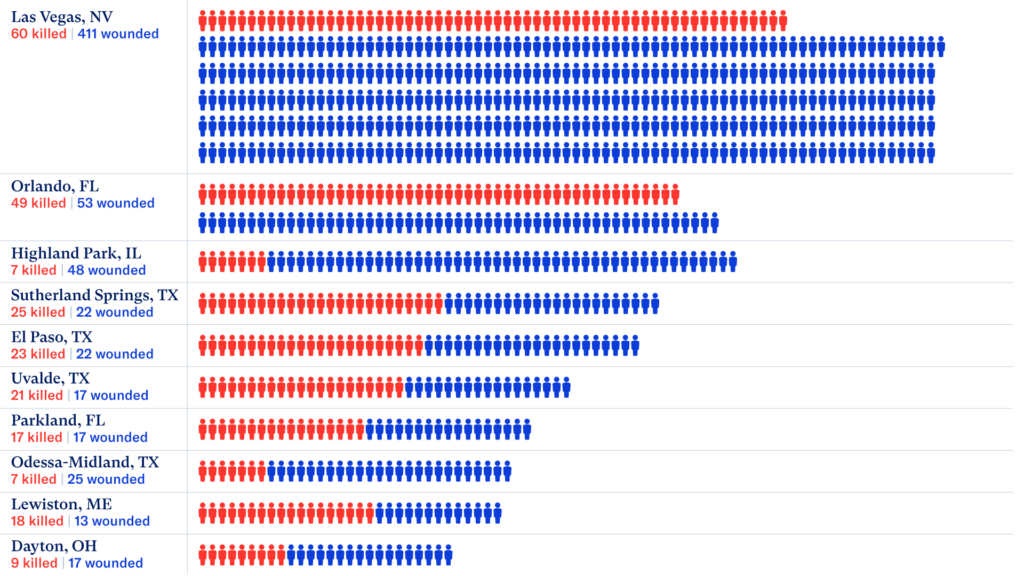
- Since 2016, all 10 of the highest-casualty mass shootings in the US have involved both an assault weapon and a high-capacity magazine.8 Everytown Research analysis of Mass Shootings in the United States, 2016–2025. A mass shooting is defined as any incident in which four or more people were shot and killed. The following shootings were those with the most casualties: Las Vegas, Nevada, with 60 killed, 411 wounded; Orlando, Florida, with 49 killed, 53 wounded; Highland Park, Illinois, with 7 killed, 48 wounded; Sutherland Springs, Texas, with 25 killed, 22 wounded; El Paso, Texas, with 23 killed, 22 wounded; Uvalde, Texas, with 21 killed, 17 wounded; Parkland, Florida, with 17 killed, 17 wounded; Odessa-Midland, Texas, with 7 killed, 25 wounded; Lewison, Maine, with 18 killed, 13 wounded; and Dayton, Ohio, with 9 killed, 17 wounded.
- Research suggests that if the federal ban on assault weapons and high-capacity magazines had remained in place from 2005 through 2022, an estimated 38 public mass shootings could have been prevented.9Alex Lars Lundberg et al., “Public Mass Shootings: Counterfactual Trend Analysis of the Federal Assault Weapons Ban,” JMIR Public Health and Surveillance 10 (2024): e62952, https://doi.org/10.2196/62952.
- Mass shootings with assault weapons and high-capacity magazines inflict a heavy financial toll, with each mass shooting costing a minimum of over $60 million.10Everytown for Gun Safety Support Fund, “Calculate the Economic Cost of Gun Violence,” February 9, 2023, https://everytownresearch.org/report/economic-cost-calculator/. Analysis includes 4 people killed in a mass shooting in the United States. These shootings burden taxpayers while the gun industry profits.
- Assault weapons make up a growing share of guns police recover in connection with a crime in cities, with recoveries increasing by 27 percent from 2020 to 2024.11Everytown for Gun Safety Support Fund, “Who Is Manufacturing the Guns Used in Crimes? City-Level Data on Crime Gun Recoveries,” December 16, 2025, https://everytownresearch.org/report/city-level-data-crime-gun-recoveries. Analysis was for assault weapon recoveries in 17 cities from 2020 to 2024. Data from the ATF also show that recoveries of firearms in calibers associated with assault weapons (.223, 5.56mm, 7.62mm)12 Shooters commonly use .223 cal, 5.56mm, and 7.62mm ammunition in assault weapons. See Everytown for Gun Safety Support Fund, “Guns Used in the Deadliest US Mass Shootings,” The Smoking Gun, https://smokinggun.org/guns-used-in-the-deadliest-u-s-mass-shooting; Brendin R. Beaulieu-Jones et al., “Nearly 20 Years Since the Federal Ban: Can State-Level Assault Weapon Prohibitions Fill the Void? Comparative Analysis of Case Fatality and Assault Weapon Recovery in States With and Without an Assault Weapon Ban,” Journal of Surgical Research 300 (2024): 458–66, https://doi.org/10.1016/j.jss.2024.05.018. rose from about 18,000 in 2018 to nearly 30,000 in 2023—a 64 percent increase.13Everytown Research analysis of ATF, “Top Calibers Recovered and Traced in the United States and Territories,” 2018 and 2023 data, https://www.atf.gov/resource-center/data-statistics/firearms-trace-data-reports. Analysis includes total crime gun recoveries with .223 caliber, 5.56mm, and 7.62mm reported on the trace request. Recoveries increased from 17,962 in 2018 to 29,441 in 2023.
Assault weapons and high-capacity magazines are uniquely lethal.
Assault weapons are semiautomatic rifles, shotguns, and pistols that work with high-capacity magazines and have certain military-style features that increase their lethality.14 In general most current state laws define “assault weapons” as semiautomatic firearms that have a number of military-style features, semiautomatic firearms that come equipped with fixed high-capacity magazines, or other specifically enumerated high-powered firearms. States have typically defined high-capacity to include magazines that hold more than 10 rounds, though a few states use different thresholds. The most notable example is the AR-15, which is modeled after rifles used by the United States military and which dramatically increased in popularity during the Global War on Terror.15Everytown for Gun Safety Support Fund, “Assault Weapons and High-Capacity Magazines,” The Smoking Gun, https://smokinggun.org/assault-weapons-and-high-capacity-magazines.
These firearms are specifically designed to load and fire subsequent rounds much faster than manually operated firearms. When paired with high-capacity magazines, which hold more than 10 rounds of ammunition, shooters can fire anywhere from 11 to 100 shots before needing to reload. Studies show that when victims are shot more than once, they are much more likely to die.16 Louis Klarevas, Andrew Conner, and David Hemenway, “The Effect of Large-Capacity Magazine Bans on High-Fatality Mass Shootings, 1990–2017,” American Journal of Public Health 109, no. 12 (2019): 1754–61, https://doi.org/10.2105/AJPH.2019.305311. Daniel W. Webster et al. “Epidemiologic Changes in Gunshot Wounds in Washington, DC, 1983–1990,” Archives of Surgery 127, no. 6 (1992):694–698. Christopher S. Koper and Jeffrey A. Roth. “A Priori Assertions Versus Empirical Inquiry: A Reply to Kleck,” Journal of Quantitative Criminology 17, no. 1 (2001):81–88. And because a person can reload these weapons quickly and easily, they are able to continue firing, removing critical intervention points during a mass shooting for law enforcement or others to disarm the shooter or escape.17Larry Buchanan and Lauren Leatherby, “Who Stops a ‘Bad Guy with a Gun’?” New York Times, June 22, 2022, https://www.nytimes.com/interactive/2022/06/22/us/shootings-police-response-uvalde-buffalo.html; Marjory Stoneman Douglas High School Public Safety Commission, “Initial Report Submitted to the Governor, Speaker of the House of Representatives and Senate President,” 2019, https://www.fdle.state.fl.us/MSDHS/CommissionReport.pdf; Joe Curley and Mary Bowerman, “People Threw Barstools Through Window to Escape Thousand Oaks, California, Bar During Shooting,” USA Today, November 8, 2018, https://www.usatoday.com/story/news/nation-now/2018/11/08/thousand-oaks-bar-shooting-people-broke-windows-stools-escape/1928031002; Emilee Speck, “ ‘Time Froze:’ Jurors Hear Pulse Shooting Survival Stories in Noor Salman’s Trial,” WKMG News 6, March 14, 2018, https://www.clickorlando.com/news/2018/03/15/time-froze-jurors-hear-pulse-shooting-survival-stories-in-noor-salmans-trial; Travis Loller, “Attorney: Waffle House Shooter Believed God Commanded Him,” AP News, January 31, 2022, https://apnews.com/article/shootings-nashville-travis-reinking-8a6d24d3fcb1d72adf35bf3e838a9849.
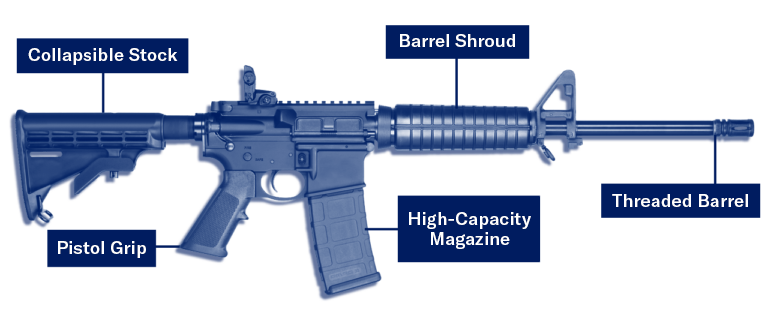
Although the gun industry often argues that military-style features such as pistol grips, collapsible stocks, and barrel shrouds are largely cosmetic,18National Shooting Sports Foundation, “NSSF Fast Facts: Background Information on So-Called ‘Assault Weapons,’ ” 2021, https://www.nssf.org/wp-content/uploads/2021/05/NSSF-factsheet-Assault-Weaspons.pdf. these accessories make it easier for shooters to maneuver, conceal, and operate these weapons19Everytown for Gun Safety Support Fund, “Assault Weapons and High-Capacity Magazines,” The Smoking Gun, https://smokinggun.org/assault-weapons-and-high-capacity-magazines.—some of the very reasons our soldiers carry firearms with these features.
Conventional AR-15s feature several military-style features.
The extreme lethality of assault weapons means that when shooters use them, they take more lives, cause more traumatic injuries, and leave more survivors facing lifelong trauma.20Elzerie de Jager et al., “Lethality of Civilian Active Shooter Incidents With and Without Semiautomatic Rifles in the United States,” Journal of the American Medical Association 320, no. 10 (2018): 1034, https://doi.org/10.1001/jama.2018.11009; Louis Klarevas, Andrew Conner, and David Hemenway, “The Effect of Large-Capacity Magazine Bans on High-Fatality Mass Shootings, 1990–2017,” American Journal of Public Health 109, no. 12 (2019): 1754–61, https://doi.org/10.2105/AJPH.2019.305311; Everytown Research analysis of mass shootings in the United States, 2016–2025.
“Advances in firearm technology and increased accessibility of military grade firearms to civilians has exacerbated the nature of domestic [gunshot wound] injury and complicated clinical decision-making, as these weapons are associated with increased tissue damage and often result in retained bullets.”21Gracie R. Baum et al., “Gunshot Wounds: Ballistics, Pathology, and Treatment Recommendations, with a Focus on Retained Bullets,” Orthopedic Research and Reviews 14 (2022): 293–317. https://doi.org/10.2147/ORR.S378278.
Injuries from assault weapons also have uniquely devastating health consequences. Treating gunshot wounds often involves more complexities and challenges than treating other types of traumatic injuries. An analysis of one hospital’s trauma registry found that gunshot wound victims were more than 5 times more likely to require blood transfusions, required 10 times more blood units, and were 14 times more likely to die than emergency room patients suffering from other traumatic injuries.22Vincent M. DeMario et al., “Blood Utilization and Mortality in Victims of Gun Violence,” Transfusion 58 (2018): 2326–34, https://doi.org/10.1111/trf.14925. Assault weapons intensify this problem: Compared with handguns, semiautomatic rifles can fire bullets at velocities up to four times faster, causing more severe injuries23Peter M. Rhee et al., “Gunshot Wounds: A Review of Ballistics, Bullets, Weapons, and Myths,” Journal of Trauma and Acute Care Surgery 80, no. 6 (2016): 853–67, https://doi.org/10.1097/TA.0000000000001037. and drastically reducing a victim’s odds of survival.24Nick Kirkpatrick, Atthar Mirza, and Manuel Canales, “The Blast Effect: How Bullets from an AR-15 Blow the Body Apart,” Washington Post, March 27, 2023, https://www.washingtonpost.com/nation/interactive/2023/ar-15-damage-to-human-body. Surgeons and trauma doctors describe the devastation caused by AR-15s and similar weapons as reminiscent of battlefield wounds.25Gina Kolata and C. J. Chivers, “Wounds From Military-Style Rifles? ‘A Ghastly Thing to See,’ ” New York Times, March 4, 2018. https://www.nytimes.com/2018/03/04/health/parkland-shooting-victims-ar15.html. For children—who are particularly vulnerable to shootings targeting schools—the problem is even more severe, as wounds from assault weapons inflict catastrophic damage to smaller bodies.26Nick Kirkpatrick, Atthar Mirza, and Manuel Canales, “The Blast Effect: How Bullets from an AR-15 Blow the Body Apart,” Washington Post, 2023, https://www.washingtonpost.com/nation/interactive/2023/ar-15-damage-to-human-body; Patrick Boyle and Laura Zelaya, “Never the Same: How Mass Shootings Forever Change the Doctors Who Respond,” AAMC (Association of American Medical Colleges), October 9, 2024, https://www.aamc.org/news/never-the-same.
Weapons of Choice for Mass Shooters: Assault Weapons and High-Capacity Magazines
Assault weapons and high-capacity magazines lead to more deadly mass shootings.

In 2019, a gunman attacked a crowd in Dayton, Ohio. Armed with an AR-15-style pistol equipped with a 100-round drum magazine and over 100 additional rounds, he began firing in the city’s Oregon District, killing 9 people and wounding 17 others.27Bill Chappell, “The Pistol That Looks Like a Rifle: The Dayton Shooter’s Gun,” NPR, August 8, 2019. https://www.npr.org/2019/08/08/748665339/the-pistol-that-looks-like-a-rifle-the-dayton-shooters-gun; “Dayton Shooter Had 250 Rounds on Him; Police Chief Says That’s ‘Fundamentally Problematic,’ ” WEWS News 5 Cleveland, August 5, 2019, https://www.news5cleveland.com/news/state/dayton-shooting/dayton-shooter-had-250-rounds-on-him-police-chief-says-thats-fundamentally-problematic. All 26 victims were shot in just 32 seconds,despite law enforcement intervening almost immediately.28Adeel Hassan, “Dayton Gunman Shot 26 People in 32 Seconds, Police Timeline Reveals.” New York Times, August 13, 2019. https://www.nytimes.com/2019/08/13/us/dayton-shootfirepowerer-video-timeline.html.
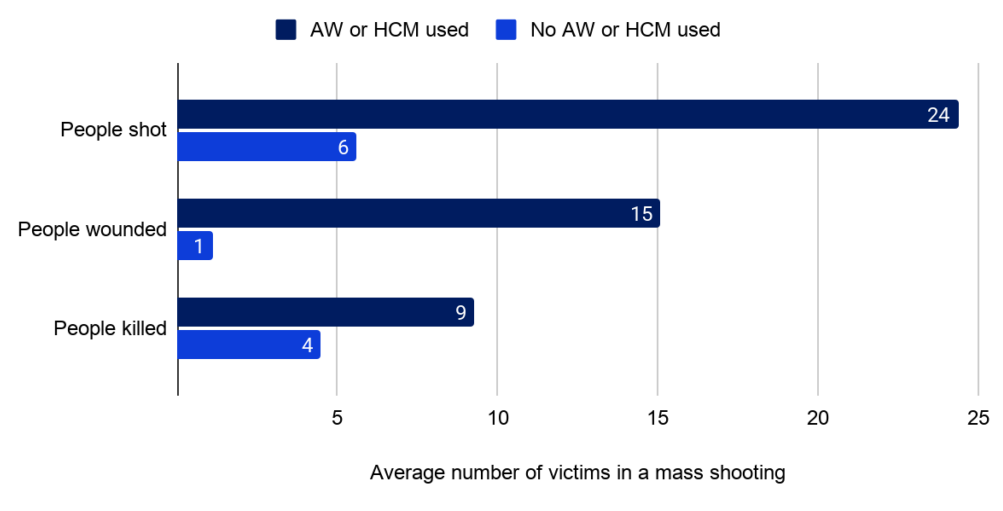
When used together, assault weapons and high-capacity magazines cause significantly more destruction than other firearms. The data bears this out: Mass shooters who use assault weapons and high-capacity magazines kill and wound substantially more people than mass shooters who use other kinds of firearms, such as handguns or manually operated firearms. Everytown Research analyzed 10 years of mass-fatality shootings and found that those involving assault weapons and/or firearms equipped with high-capacity magazines resulted in twice as many people killed and more than 13 times as many people nonfatally injured. These weapons also cause a disproportionate share of woundings and killings in mass shootings: Our analysis of data on mass shootings shows that assault weapons are used in at least 18 percent of mass shootings but account for 32 percent of all mass-shooting deaths and 77 percent of all mass-shooting injuries. Similarly, high-capacity magazines are used in at least 17 percent of mass shootings but account for 33 percent of deaths and 75 percent of injuries.29Everytown Research analysis of mass shootings in the United States, 2016–2025. A mass shooting is defined as any incident in which four or more people are shot and killed.
Mass shootings involving assault weapons (AW) and/or high-capacity magazines (HCM) result in more victims
When attackers intend to commit a mass shooting, they often use both assault weapons and high-capacity magazines to harm as many people as possible. For example, the white supremacist who shot 13 people, killing 10, at a supermarket in Buffalo, New York, wrote, “The AR-15 and its variants are very deadly when used properly, which is the reason why I picked one. High-capacity magazines and ammunition that causes (enough) ballistic damage to kill effectively will be used.”30Mary B. Pasciak, “Tops Markets Shooter Chose AR-15 to Stoke Controversy,” Buffalo News, updated January 27, 2024, https://bit.ly/3PNO9DC; Craig Whitlock, David Willman, and Alex Horton, “Massacre Suspect Said He Modified Bushmaster Rifle to Hold More Ammunition,” Washington Post, May 15, 2022, https://wapo.st/3SkEe8N. Consequently, assault weapons and high-capacity magazines commonly appear at the scenes of the nation’s most deadly mass shootings. Since 2016, all 10 of the highest-casualty mass shootings have involved both an assault weapon and a high-capacity magazine.31Everytown Research analysis of mass shootings in the United States, 2016–2025. A mass shooting is defined as any incident in which four or more people are shot and killed. The following shootings were those with the most casualties: Las Vegas, Nevada, with 60 killed, 411 wounded; Orlando, Florida, with 49 killed, 53 wounded; Highland Park, Illinois, with 7 killed, 48 wounded; Sutherland Springs, Texas, with 25 killed, 22 wounded; El Paso, Texas, with 23 killed, 22 wounded; Uvalde, Texas, with 21 killed, 17 wounded; Parkland, Florida, with 17 killed, 17 wounded; Odessa-Midland, Texas, with 7 killed, 25 wounded; Lewison, Maine, with 18 killed, 13 wounded; and Dayton, Ohio, with 9 killed, 17 wounded. These shootings have marred gatherings at schools, shopping centers, and nightclubs—devastating the very parts of a community where people learn, connect, and socialize.
Highest-Casualty Mass Shootings
Trauma and economic hardship ripple out from every mass shooting.

“And then just like this constant state of paranoia… just every time you… hear about a shooting or anything like, you know, you can’t go to work . . .you can’t go to Target, you can’t go to a gas station, you can’t go to school, you can’t go to a play. … We went and saw a comedian last weekend, and I bought tickets in the next exit row at the edge of the aisle just because it’s something that I think about now.”
—Survivor of a mass shooting
In Everytown’s 2023 focus group study on gun violence trauma, survivors of mass shootings described living in persistent fear, feeling chronically unsafe, and navigating daily life with hypervigilance. In particular, students exposed to school shootings involving assault weapons and high-capacity magazines reported difficulty remaining on campus and feeling constantly on alert in both school and surrounding environments. These feelings were compounded by suicidal thoughts, panic attacks, and post-traumatic stress disorder (PTSD).
Similarly, recent research shows that 94 percent of people injured in mass shootings report a mental health impact, with significantly higher levels of depression and panic attacks compared to those injured in other forms of gun violence.32Jillian K. Peterson, James A. Densley, and David C. Pyrooz, “Mental Health Consequences of Exposure to Mass and Non-Mass Shootings in a National Sample of US Adults,” Nature Mental Health, 3 (2025): 530–37, https://doi.org/10.1038/s44220-025-00413-7. The trauma also reverberates through entire communities: In six communities affected by mass violence, researchers found elevated rates of PTSD—nearly one in four residents reported past-year PTSD symptoms, and nearly 1 in 10 had current symptoms meeting the criteria for a PTSD diagnosis, exceeding national estimates for US adults.33Angela D. Moreland et al., “Posttraumatic Stress Disorder Among Adults in Communities With Mass Violence Incidents,” JAMA Network Open, 7, no. 7 (2024): e2423539, https://doi.org/10.1001/jamanetworkopen.2024.23539.
The financial costs of these shootings fall hardest on the families and communities already suffering from the tremendous impacts of a shooting. Families and survivors experience high medical costs, loss of income, and reduced productivity and work. Communities that experience gun violence are less likely to be hubs for economic growth and commerce, and face lower property values, fewer business startups, and loss of jobs.34Rosanna Smart, Rachel Nesbit, and Terry L. Schell, “Mass Shootings in the United States,” RAND Corporation, January 29, 2026,” https://www.rand.org/research/gun-policy/analysis/essays/mass-shootings.html; Yasemin Irvin-Erickson et al., “A Neighborhood-Level Analysis of the Economic Impact of Gun Violence,” Urban Institute, 2017, https://www.urban.org/sites/default/files/publication/90671/eigv_final_report_3.pdf. Communities that endure mass shooting tragedies often face temporary or permanent closures of schools, grocery stores, and other essential services and businesses.35Candace McDuffie, “This is What Happened To School Sites After Mass Shootings,” The Root, June 23, 2022, https://www.theroot.com/this-is-what-happened-to-school-sites-after-mass-shooti/slides/2; Jaclyn Diaz, “The Buffalo Shooting Shuttered Tops and Left a Food Desert. Locals are Stepping In,” NPR WNYC, May 19, 2022, https://www.npr.org/2022/05/19/1099833194/buffalo-shooting-shuttered-tops-food-desert-locals-help; Tracey Leong, “Monterey Park Businesses Struggling to Stay Open Since Mass Shooting,” NBC Los Angeles, May 11, 2023, https://www.nbclosangeles.com/news/local/monterey-park-businesses-struggling-to-stay-open-since-mass-shooting/3152121/.
Other Impacts of Assault Weapons and High-Capacity Magazines
Assault weapons and high-capacity magazines are frequently used in crimes.

Although the gun lobby claims that assault weapons are rarely used in firearm-related crimes,36NRA-ILA, “The Truth About So-called ‘Assault Weapons,’” accessed April 27, 2026, https://www.nraila.org/the-truth-about-so-called-assault-weapons/. evidence suggests that these weapons are increasingly used in everyday gun violence. Across US cities, assault weapons make up a growing share of guns that police recover. Even as overall crime gun recoveries have declined, the number of assault weapons recovered in cities has increased by 27 percent since 2020.37Everytown for Gun Safety Support Fund, “Who is Manufacturing the Guns Used in Crimes? City-Level Data on Crime Gun Recoveries,” December 16, 2025, https://everytownresearch.org/report/city-level-data-crime-gun-recoveries/. This study was limited to 17 cities that consistently reported assault weapon recovery data, suggesting that the scope of the problem may be even greater. Indeed, nationwide data from the ATF shows a surge in firearms recovered annually from crime scenes in the calibers commonly associated with AR-15s and other assault weapons—.223, 5.56mm, and 7.62mm38Shooters commonly use .223 cal, 5.56mm, and 7.62mm ammunition in assault weapons. See Everytown for Gun Safety Support Fund, “Guns Used in the Deadliest US Mass Shootings,” The Smoking Gun, https://smokinggun.org/guns-used-in-the-deadliest-u-s-mass-shooting; Brendin R. Beaulieu-Jones et al., “Nearly 20 Years Since the Federal Ban: Can State-Level Assault Weapon Prohibitions Fill the Void? Comparative Analysis of Case Fatality and Assault Weapon Recovery in States With and Without an Assault Weapon Ban,” Journal of Surgical Research 300 (2024): 458–66, https://doi.org/10.1016/j.jss.2024.05.018.—from about 18,000 in 2018 to nearly 30,000 in 2023, reflecting a 64-percent increase.39Everytown Research analysis of ATF, “Top Calibers Recovered and Traced in the United States and Territories,” 2018 and 2023 data, https://www.atf.gov/resource-center/data-statistics/firearms-trace-data-reports. Analysis includes total crime gun recoveries with .223 caliber, 5.56mm, and 7.62mm reported on the trace requests. Recoveries increased from 17,962 in 2018 to 29,441 in 2023.
Research studies have shown similar patterns. A 2018 study estimated that guns equipped with high-capacity magazines—including assault weapons and other semiautomatic firearms—account for 22 to 36 percent of crime guns in most places, with some estimates of up to 40 percent in cases involving serious violence, including homicides of law enforcement officers.40Christopher S. Koper et al., “Criminal Use of Assault Weapons and High-Capacity Semiautomatic Firearms: An Updated Examination of Local and National Sources,” Journal of Urban Health 95, no. 3 (2018): 313–21, https://doi.org/10.1007/s11524-017-0205-7. These findings underscore the reality that assault weapons and high-capacity magazines are increasingly used in everyday gun crime, not just high-profile mass shootings.
Assault weapons and high-capacity magazines put law enforcement officers in danger.
Assault weapons and high-capacity magazines pose a direct threat to law enforcement officers who respond to shootings. An Everytown Research analysis of mass shootings found that law enforcement officers are more likely to be shot or killed in mass shootings when assault weapons or high-capacity magazines are present.41 Everytown Research analysis of mass shootings in the United States, 2016–2025. A mass shooting is defined as any incident in which four or more people are shot and killed. A study of 219 murders of law enforcement officers over a five-year period found that 13 to 16 percent involved assault weapons and 41 percent involved firearms with high-capacity magazines.42Christopher Koper et al, “Criminal Use of Assault Weapons and High-Capacity Semiautomatic Firearms: An Updated Examination of Local and National Sources,” Journal of Urban Health 95, no. 3 (2018): 313–21, https://doi.org/10.1007/s11524-017-0205-7.
When responding to mass shootings, officers often confront military-style assault weapons and/or high-capacity magazines, creating a mismatch that can prolong violence even after police arrive. For example, responding officers at multiple mass shootings, including at Robb Elementary School in Uvalde and the Inland Regional Center in San Bernardino, have expressed feeling outgunned by attackers armed with military-style assault rifles.43Community Oriented Policing Services, “Critical Incident Review: Active Shooter at Robb Elementary School,” accessed May 13, 2026, https://cops.usdoj.gov/uvalde; National Policing Institute, “Bringing Calm to Chaos: A National Policing Institute Review of the San Bernardino Terrorist Attacks,” 2016, https://www.policinginstitute.org/publication/bringing-calm-to-chaos-a-police-foundation-review-of-the-san-bernardino-terrorist-attacks. In active shooter events with assault weapons, police officers can face challenges finding cover and shielding themselves when assailants are armed with assault weapons. And the rifle-caliber rounds used in assault weapons can pierce the handgun-rated bulletproof vests that police officers commonly wear.44Ralph A. Weber, “A ‘Good Guy With A Gun’ Doesn’t Stand Much of a Chance Against an AR-15 Style Rifle and Body Armor,” Milwaukee Journal Sentinel, June 14, 2022, https://www.jsonline.com/story/opinion/2022/06/14/good-guy-gun-outgunned-facing-ar-15-style-rifle-body-armor/7584894001/; Chris Halsne and Chris Koeberl, “137 Officers Have Been Killed Over 10 Years While Wearing Body Armor,” KDVR, May 7, 2018, https://kdvr.com/news/problem-solvers/137-police-officers-killed-while-wearing-body-armor/; Associated Press, “Bullet Pierced Slain SC Deputy’s Body Armor,” KSL, September 10, 2014, https://www.ksl.com/article/news/us/bullet-pierced-slain-sc-deputys-body-armor/31509137; Everytown for Gun Safety Support Fund, “Assault Weapons and High-Capacity Magazines,” The Smoking Gun, https://smokinggun.org/assault-weapons-and-high-capacity-magazines.
The Gun Industry Reaps the Benefits
The gun industry’s publications and advertisements often blur the line between “assault rifles” and “sporting arms,” promoting these firearms as “modern sporting rifles.”45Emily Witt, “How the AR-15 Became an American Brand,” New Yorker, September 27, 2023, https://www.newyorker.com/books/under-review/how-the-ar-15-became-an-american-brand: Justin Peters, “Omar Mateen Had a ‘Modern Sporting Rifle’,” Slate, June 14, 2016, https://slate.com/news-and-politics/2016/06/the-sig-sauer-mcx-used-in-orlando-is-a-modern-sporting-rifle-not-an-assault-weapon-according-to-gunmakers-heres-why.html; Everytown for Gun Safety Support Fund, “Assault Weapons and High- Capacity Magazines,” The Smoking Gun, https://smokinggun.org/assault-weapons-and-high-capacity-magazines. Manufacturers have even produced smaller-caliber versions to attract children.46 Noor Al-Sibai, “The ‘JR-15’ Rifle for Kids Is Back, Without Baby Skulls in Marketing This Time,” Vice, January 19, 2023, https://www.vice.com/en/article/the-jr-15-rifle-for-kids-is-back-without-baby-skulls-in-marketing-this-time; Everytown for Gun Safety Support Fund, “Gun Companies Market Recklessly,” The Smoking Gun, https://smokinggun.org/issue/toxic-marketing. These advertisements frame assault weapons as symbols of self-defense and masculine identity; for example, in Remington ads promising that men would have their “man cards reissued” if they purchased a Bushmaster AR-style rifle47Everytown for Gun Safety Support Fund, “Gun Companies Market Recklessly,” The Smoking Gun, https://smokinggun.org/issue/toxic-marketing.—the same gun that was advertised to and used by the mass shooter who shot 28 people, 20 of whom were children, at Sandy Hook Elementary School.48Dave Collins, “Sandy Hook Families Settle for $73M with Gun Maker Remington,” Associated Press, February 15, 2022, https://whyy.org/articles/sandy-hook-families-73m-settlement-remington.
The gun industry reaps immense profits from recent strategies to sell assault weapons. These extreme tactics have paid off for gun companies: A Washington Post analysis found that at least two-thirds of the assault weapons in circulation by 2020 were made and sold after the mass shooting at Sandy Hook Elementary School in 2012.49Todd C. Frankel et al., “The Gun That Divides a Nation,” Washington Post, March 27, 2023, https://www.washingtonpost.com/nation/interactive/2023/ar-15-america-gun-culture-politics/. A 2022 report from the House Oversight and Reform Committee found that four firearm manufacturers collectively earned more than $1 billion in revenue from assault weapons sales alone in the past decade.50US House of Representatives, Committee on Oversight and Reform, “The Committee’s Investigation into Gun Industry Practices and Profits,” memorandum, July 27, 2022, https://oversightdemocrats.house.gov/imo/media/doc/2022.07.27%20Supplemental%20MEMO%20for%20the%207-27-2022%20FC%20Gun%20Manufacturer%20Hearing.pdf. Even without accounting for high-capacity magazine sales, this revenue is the same amount as the estimated cost of health care, police response, and lost quality of life incurred from the 2017 mass shooting at the Route 91 Harvest Festival in Las Vegas.51Everytown for Gun Safety Support Fund, “Calculate the Economic Cost of Gun Violence,” February 9, 2023, https://everytownresearch.org/report/economic-cost-calculator. Analysis includes 60 people killed and 411 people wounded in a mass shooting in Las Vegas. Mass shootings involving assault weapons lead to a cycle of profit for gun manufacturers, who have shifted their focus to selling higher-margin assault weapons.52Todd C. Frankel et al., “The Gun That Divides a Nation,” Washington Post, March 27, 2023, https://www.washingtonpost.com/nation/interactive/2023/ar-15-america-gun-culture-politics. Research has found that gun sales spike in the months immediately after the deadliest mass shootings,53Rachael A. Callcut et al., “Effect of Mass Shootings on Gun Sales—A 20-Year Perspective,” Journal of Trauma and Acute Care Surgery 87, no. 3 (2019): 531–40, https://doi.org/10.1097/TA.0000000000002399. driven by fear of regulation. The gun industry’s profitable myth that “the only way to stop a bad guy with a gun is a good guy with a gun”54“NRA: Full Statement by Wayne LaPierre in Response to Newtown Shootings,” The Guardian, December 21, 2012, https://www.theguardian.com/world/2012/dec/21/nra-full-statement-lapierre-newtown; Larry Buchanan and Lauren Leatherby, “Who Stops a ‘Bad Guy with a Gun’?” New York Times, June 22, 2022, https://www.nytimes.com/interactive/2022/06/22/us/shootings-police-response-uvalde-buffalo.html. compounds this problem, selling a solution to gun violence that only enriches their industry while putting Americans in danger of more violence. While gun violence costs the United States $557 billion annually, gun manufacturers profit by selling the problem.
Federal Prohibition on Assault Weapons and High-Capacity Magazines
The federal prohibition on assault weapons and high-capacity magazines saved lives.
Although the lethality and power of assault weapons and high-capacity magazines have been shown to result in far more casualties, no federal restrictions on access to them or possession of them have been in effect for more than two decades. In 1994, Congress passed the federal assault weapons ban, a law prohibiting the manufacture, transfer, or possession of certain assault weapons and high-capacity magazines. Because the law included a sunset provision after one decade and Congress did not renew it—after the National Rifle Association prioritized lobbying against it55“Assault Weapon Ban Expires,” CBS News, September 13, 2004, https://www.cbsnews.com/news/assault-weapon-ban-expires.—the prohibition on assault weapons and high-capacity ammunition magazines was in effect only from September 1994 to September 2004.56Public Law 103-322, Title XI (1994). Part of the Violent Crime Control and Law Enforcement Act of 1994, the Public Safety and Recreational Firearms Act prohibited semiautomatic assault weapons designated by specific make or model or by a combination of specific characteristics, such as a folding or telescopic stock or a pistol grip that extends below the action of the weapon (former 18 USC § 921(a)(30)(B)). It also prohibited ammunition magazines with more than 10 rounds, with exemptions for those lawfully possessed on or before the law’s enactment (former 18 USC § 921(31)). The law took effect September 13, 1994, and expired on September 13, 2004. Vivian S. Chu, “Federal Assault Weapons Ban: Legal Issues,” Congressional Research Service, February 14, 2013, https://sgp.fas.org/crs/misc/R42957.pdf.
A growing body of research shows that the decade-long federal prohibition on assault weapons and high-capacity magazines was effective in preventing public mass shootings and reducing the number of fatalities and injuries when these tragedies occurred. A 2024 study found that this prohibition was associated with a significant decrease in public mass shootings and related casualties, preventing up to five public mass shootings during the 10 years it was in effect. The researchers also estimated that, had the law remained in effect from 2005 through 2022, it would have prevented 38 public mass shootings.57Alex Lars Lundberg et al., “Public Mass Shootings: Counterfactual Trend Analysis of the Federal Assault Weapons Ban,” JMIR Public Health and Surveillance 10 (2024): e62952, https://doi.org/10.2196/62952. Similarly, a 2019 study found that the federal assault weapons and high-capacity magazine bans reduced mass shooting fatalities, and had the law continued, it would have prevented hundreds of mass shooting deaths.58Charles DiMaggio et al., “Changes in US Mass Shooting Deaths Associated with the 1994–2004 Federal Assault Weapons Ban: Analysis of Open-Source Data,” Journal of Trauma andAcute Care Surgery 86, no. 1 (2019): 11–19, https://doi.org/10.1097/TA.0000000000002060. In the absence of a federal ban, these weapons remain accessible across much of the nation, contributing to ongoing deadly shootings.
State-level prohibitions can reduce mass shootings and interstate gun trafficking.
Assault Weapons Prohibited
11 states have adopted this policy
Assault Weapons Prohibited
Alabama has not adopted this policy
Assault Weapons Prohibited
Alaska has not adopted this policy
Assault Weapons Prohibited
Arizona has not adopted this policy
Assault Weapons Prohibited
Arkansas has not adopted this policy
Assault Weapons Prohibited
California has adopted this policy
Assault Weapons Prohibited
Colorado has not adopted this policy
Assault Weapons Prohibited
Connecticut has adopted this policy
Assault Weapons Prohibited
Delaware has adopted this policy
Assault Weapons Prohibited
Florida has not adopted this policy
Assault Weapons Prohibited
Georgia has not adopted this policy
Assault Weapons Prohibited
Hawaii has not adopted this policy
Assault Weapons Prohibited
Idaho has not adopted this policy
Assault Weapons Prohibited
Illinois has adopted this policy
Assault Weapons Prohibited
Indiana has not adopted this policy
Assault Weapons Prohibited
Iowa has not adopted this policy
Assault Weapons Prohibited
Kansas has not adopted this policy
Assault Weapons Prohibited
Kentucky has not adopted this policy
Assault Weapons Prohibited
Louisiana has not adopted this policy
Assault Weapons Prohibited
Maine has not adopted this policy
Assault Weapons Prohibited
Maryland has adopted this policy
Assault Weapons Prohibited
Massachusetts has adopted this policy
Assault Weapons Prohibited
Michigan has not adopted this policy
Assault Weapons Prohibited
Minnesota has not adopted this policy
Assault Weapons Prohibited
Mississippi has not adopted this policy
Assault Weapons Prohibited
Missouri has not adopted this policy
Assault Weapons Prohibited
Montana has not adopted this policy
Assault Weapons Prohibited
Nebraska has not adopted this policy
Assault Weapons Prohibited
Nevada has not adopted this policy
Assault Weapons Prohibited
New Hampshire has not adopted this policy
Assault Weapons Prohibited
New Jersey has adopted this policy
Assault Weapons Prohibited
New Mexico has not adopted this policy
Assault Weapons Prohibited
New York has adopted this policy
Assault Weapons Prohibited
North Carolina has not adopted this policy
Assault Weapons Prohibited
North Dakota has not adopted this policy
Assault Weapons Prohibited
Ohio has not adopted this policy
Assault Weapons Prohibited
Oklahoma has not adopted this policy
Assault Weapons Prohibited
Oregon has not adopted this policy
Assault Weapons Prohibited
Pennsylvania has not adopted this policy
Assault Weapons Prohibited
Rhode Island has adopted this policy
Assault Weapons Prohibited
South Carolina has not adopted this policy
Assault Weapons Prohibited
South Dakota has not adopted this policy
Assault Weapons Prohibited
Tennessee has not adopted this policy
Assault Weapons Prohibited
Texas has not adopted this policy
Assault Weapons Prohibited
Utah has not adopted this policy
Assault Weapons Prohibited
Vermont has not adopted this policy
Assault Weapons Prohibited
Virginia has adopted this policy
Assault Weapons Prohibited
Washington has adopted this policy
Assault Weapons Prohibited
West Virginia has not adopted this policy
Assault Weapons Prohibited
Wisconsin has not adopted this policy
Assault Weapons Prohibited
Wyoming has not adopted this policy
States have passed their own laws to reduce the threat of mass shootings, including prohibitions on assault weapons and high-capacity magazines. Many of these laws were enacted after high-profile mass shootings.59California, Maryland, New York, New Jersey, Connecticut, Illinois, Delaware, and Washington all enacted or made comprehensive improvements to their prohibitions after high-profile mass shootings, including those that occurred at a law office in Stockton, California, in 1989; Sandy Hook Elementary School in Newtown, Connecticut, in 2012; a grocery store in Buffalo, New York, in 2022; Robb Elementary School in Uvalde, Texas, in 2022; and a parade in Highland Park, Illinois, in 2022. As of May 2026, 11 states and the District of Columbia prohibit the purchase and/or possession of assault weapons.60Everytown for Gun Safety Support Fund, “Everytown Gun Law Rankings: Which States Prohibit Assault Weapons?,” accessed May 14, 2026, https://everytownresearch.org/rankings/law/assault-weapons-prohibited; D.C. Code §§ 7-2502.02(a)(6); 7-2501.01(3A); 7-2505.01; 7-2505.02(a). Research shows that counties in states without assault weapons bans (AWBs) experience higher mass shooting fatality rates, while counties in states with bans have a 41 percent lower incidence of mass shooting fatalities.61Charles J. DiMaggio et al., “State Assault Weapons Bans Are Associated with Fewer Fatalities: Analysis of US County Mass Shooting Incidents (2014–2022),” Injury Prevention 32 (2026): 317–22, https://doi.org/10.1136/ip-2024-045263.
State-level AWBs are undermined by interstate gun trafficking. In the absence of a federal ban, assault weapons from states without AWBs can be trafficked into states that have enacted such prohibitions. A 2024 study found that four neighboring Northeast states with AWBs—Connecticut, Massachusetts, New York, and New Jersey—had lower proportions of assault weapons recovered within their states (3.9 percent) compared with other AWB states, including California (7 percent) and Maryland (5 percent).62Brendin R. Beaulieu-Jones et al., “Nearly 20 Years Since the Federal Ban: Can State-Level Assault Weapon Prohibitions Fill the Void? Comparative Analysis of Case Fatality and Assault Weapon Recovery in States With and Without an Assault Weapon Ban,” Journal of Surgical Research 300 (2024): 458–66, https://doi.org/10.1016/j.jss.2024.05.018. Firearm fatality rates were also lower among these clustered Northeast states compared with the national average firearm fatality rate.63Brendin R. Beaulieu-Jones et al., “Nearly 20 Years Since the Federal Ban: Can State-Level Assault Weapon Prohibitions Fill the Void? Comparative Analysis of Case Fatality and Assault Weapon Recovery in States With and Without an Assault Weapon Ban,” Journal of Surgical Research 300 (2024): 458–66, https://doi.org/10.1016/j.jss.2024.05.018. These findings suggest a protective effect when neighboring states have strong gun laws and underscore the need for federal legislation.
High Capacity Magazines Prohibited
15 states have adopted this policy
High Capacity Magazines Prohibited
Alabama has not adopted this policy
High Capacity Magazines Prohibited
Alaska has not adopted this policy
High Capacity Magazines Prohibited
Arizona has not adopted this policy
High Capacity Magazines Prohibited
Arkansas has not adopted this policy
High Capacity Magazines Prohibited
California has adopted this policy
High Capacity Magazines Prohibited
Colorado has adopted this policy
High Capacity Magazines Prohibited
Connecticut has adopted this policy
High Capacity Magazines Prohibited
Delaware has adopted this policy
High Capacity Magazines Prohibited
Florida has not adopted this policy
High Capacity Magazines Prohibited
Georgia has not adopted this policy
High Capacity Magazines Prohibited
Hawaii has adopted this policy
High Capacity Magazines Prohibited
Idaho has not adopted this policy
High Capacity Magazines Prohibited
Illinois has adopted this policy
High Capacity Magazines Prohibited
Indiana has not adopted this policy
High Capacity Magazines Prohibited
Iowa has not adopted this policy
High Capacity Magazines Prohibited
Kansas has not adopted this policy
High Capacity Magazines Prohibited
Kentucky has not adopted this policy
High Capacity Magazines Prohibited
Louisiana has not adopted this policy
High Capacity Magazines Prohibited
Maine has not adopted this policy
High Capacity Magazines Prohibited
Maryland has adopted this policy
High Capacity Magazines Prohibited
Massachusetts has adopted this policy
High Capacity Magazines Prohibited
Michigan has not adopted this policy
High Capacity Magazines Prohibited
Minnesota has not adopted this policy
High Capacity Magazines Prohibited
Mississippi has not adopted this policy
High Capacity Magazines Prohibited
Missouri has not adopted this policy
High Capacity Magazines Prohibited
Montana has not adopted this policy
High Capacity Magazines Prohibited
Nebraska has not adopted this policy
High Capacity Magazines Prohibited
Nevada has not adopted this policy
High Capacity Magazines Prohibited
New Hampshire has not adopted this policy
High Capacity Magazines Prohibited
New Jersey has adopted this policy
High Capacity Magazines Prohibited
New Mexico has not adopted this policy
High Capacity Magazines Prohibited
New York has adopted this policy
High Capacity Magazines Prohibited
North Carolina has not adopted this policy
High Capacity Magazines Prohibited
North Dakota has not adopted this policy
High Capacity Magazines Prohibited
Ohio has not adopted this policy
High Capacity Magazines Prohibited
Oklahoma has not adopted this policy
High Capacity Magazines Prohibited
Oregon has adopted this policy
High Capacity Magazines Prohibited
Pennsylvania has not adopted this policy
High Capacity Magazines Prohibited
Rhode Island has adopted this policy
High Capacity Magazines Prohibited
South Carolina has not adopted this policy
High Capacity Magazines Prohibited
South Dakota has not adopted this policy
High Capacity Magazines Prohibited
Tennessee has not adopted this policy
High Capacity Magazines Prohibited
Texas has not adopted this policy
High Capacity Magazines Prohibited
Utah has not adopted this policy
High Capacity Magazines Prohibited
Vermont has adopted this policy
High Capacity Magazines Prohibited
Virginia has adopted this policy
High Capacity Magazines Prohibited
Washington has adopted this policy
High Capacity Magazines Prohibited
West Virginia has not adopted this policy
High Capacity Magazines Prohibited
Wisconsin has not adopted this policy
High Capacity Magazines Prohibited
Wyoming has not adopted this policy
Some states have also taken action to prohibit high-capacity magazines. As of May 2026, 15 states and the District of Columbia prohibit the purchase of high-capacity magazines, and 12 of those states also regulate the possession of such magazines.64Everytown for Gun Safety Support Fund, “Everytown Gun Law Rankings: Which States Prohibit High-Capacity Magazines?” accessed May 20, 2026, https://everytownresearch.org/rankings/law/high-capacity-magazines-prohibited/; D.C. Code § 7-2506.01(b)). States have typically defined high-capacity to include magazines that hold more than 10 rounds, though a few states use different thresholds. One study found that from 1990 to 2017, the use of high-capacity magazines in high-fatality shootings resulted in a 62 percent increase in the average death toll of mass shootings.65Louis Klarevas, Andrew Conner, and David Hemenway, “The Effect of Large-Capacity Magazine Bans on High-Fatality Mass Shootings, 1990–2017,” American Journal of Public Health 109, no. 12 (2019): 1754–61, https://doi.org/10.2105/AJPH.2019.305311. The study defined a mass shooting as one with six people or more shot and killed, excluding the shooter. The policies are highly effective: States with restrictions on magazine size experience mass shootings at less than half the rate of states without such laws.66Sam Petulla, “Here Is 1 Correlation Between State Gun Laws and Mass Shootings,” CNN, October 5, 2017, https://cnn.it/2J4sWCC. This study defines mass shootings as incidents in which three or more victims, not including the shooter, are shot and killed or wounded.
“Whether a state has a large-capacity ammunition magazine ban is the single best predictor of the mass shooting rates in that state.”67Sam Petulla, “Here Is 1 Correlation between State Gun Laws and Mass Shootings,” CNN, October 5, 2017, https://cnn.it/2J4sWCC.
—Dr. Michael Siegel, a researcher at Boston University
Federal action can also help prevent these tragedies. In Virginia, for example, the federal ban was associated with significant reductions in the share of guns used in crimes equipped with high-capacity magazines, reaching a low of 10 percent in 2004. After the federal prohibition expired, the share of Virginia crime guns equipped with high-capacity magazines rapidly increased, reaching 22 percent by 2010.68 David S. Fallis and James V. Grimaldi, “Va. Data Show Drop in Criminal Firepower during Assault Gun Ban,” Washington Post, January 22, 2011, https://web.archive.org/web/20240703123220/ https://www.washingtonpost.com/local/va-data-show-drop-in-criminal-firepower-during-assault-gun-ban/2011/01/22/ABjCRLR_story.html.
Recommendations
Policies should address the threat of assault weapons and high-capacity magazines.
Assault weapons and high-capacity magazines are disproportionately used in some of the most lethal forms of gun violence in the United States. Federal and state policymakers can take action to protect communities across the nation while still allowing gun owners who already own these guns to keep them legally.
Pass federal-level legislation to regulate assault weapons and high-capacity magazines.
Research shows that the federal assault weapons ban was effective in preventing gun violence,69Alex Lars Lundberg et al., “Public Mass Shootings: Counterfactual Trend Analysis of the Federal Assault Weapons Ban,” JMIR Public Health and Surveillance 10 (2024): e62952, https://doi.org/10.2196/62952; Charles DiMaggio et al., “Changes in US Mass Shooting Deaths Associated with the 1994–2004 Federal Assault Weapon Ban: Analysis of Open-Source Data,” Journal of Trauma and Acute Care Surgery 86, no. 1 (2019): 11–19, https://doi.org/10.1097/TA.0000000000002060. and new restrictions can help address mass shootings as well as the daily devastation of gun violence in America. These policies can also allow for gun owners who already possess assault weapons to keep their guns while preventing future purchases, which are often what fuel mass shootings.70Reese Oxnar, “Uvalde Gunman Legally Bought AR Rifles Days Before Shooting, Law Enforcement Says,” Texas Tribune, May 25, 2022, https://www.texastribune.org/2022/05/25/uvalde-shooter-bought-gun-legally/; Oriana González, “Boulder Massacre Suspect Purchased Gun 6 Days Before Shooting,” Axios, May 23, 2021, https://www.axios.com/2021/03/23/boulder-mass-shooting-suspect-alissa-gun-purchase; Cassandra Vinograd and Frank Thorp V, “Omar Mateen Probed for Terror Ties but Legally Purchased Weapons,” NBC News, June 13, 2016, https://www.nbcnews.com/storyline/orlando-nightclub-massacre/omar-mateen-probed-terror-ties-legally-purchased-weapons-n590836; “Upstate NY Gun Shop Confirms Peyton Gendron Legally Purchased Semi-Automatic Used in Mass Shooting,” WABC, May 15, 2022, https://abc7ny.com/post/buffalo-shooting-mass-tops-grocery-store-semi-automatic/11853729/.
As with the former federal ban, the states that have passed their own restrictions use a “features test” defining assault weapons as semiautomatic rifles, pistols, and shotguns that have certain military-style features, such as second grips, folding stocks, and the ability to accept detachable magazines.71RAND Corporation, “The Effects of Bans on the Sale of Assault Weapons and High-Capacity Magazines,” January 29, 2026, https://www.rand.org/research/gun-policy/analysis/ban-assault-weapons.html; Vivian S. Chu, “Federal Assault Weapons Ban: Legal Issues,” Congressional Research Service, February 14, 2013, https://sgp.fas.org/crs/misc/R42957.pdf. These accessories increase a weapon’s lethality by making it easier to control the weapon in rapid fire, for example, or easier to reload, maneuver, and conceal.72Everytown for Gun Safety Support Fund, “Assault Weapons and High-Capacity Magazines,” The Smoking Gun, https://smokinggun.org/assault-weapons-and-high-capacity-magazines. This approach has long been an effective way to address the danger of assault weapons and high-capacity magazines at the federal and state levels.
In 2023 and again in 2025, federal lawmakers introduced novel legislation to address assault weapons and high-capacity magazines without a features test. The Gas-Operated Semi-Automatic Firearms Exclusion (GOSAFE) Act73S. 3369 (118th Congress, 2023–2024); S. 1370 and H.R. 2790 (119th Congress, 2025–2026). would prohibit assault weapons based on their gas operating systems, which enable semiautomatic rifles to load new rounds in milliseconds. The bill is narrowly tailored to target the guns that are often used in mass shootings, particularly assault weapons like the AR-15 and AK-47, without impacting manual-action firearms or most handguns.74Greg Lickenbrock, “Senators Introduce New Bill to Regulate Assault Weapons,” The Smoking Gun, December 1, 2023, https://smokinggun.org/senators-introduce-new-bill-to-regulate-assault-weapons/.
Pass state-level legislation to prohibit assault weapons and high-capacity magazines.
In the absence of a federal law, state legislators can take action to save lives by passing laws to prohibit these dangerous weapons. Research shows that state-level legislation addressing assault weapons and high-capacity magazines are effective in preventing violence.75Charles J. DiMaggio et al., “State Assault Weapons Bans are Associated with Fewer Fatalities: Analysis of US County Mass Shooting Incidents (2014-2022),” Injury Prevention 32 (2026): 317–22, https://doi.org/10.1136/ip-2024-045263; Brendin R. Beaulieu-Jones et al., “Nearly 20 Years Since the Federal Ban: Can State-Level Assault Weapon Prohibitions Fill the Void? Comparative Analysis of Case Fatality and Assault Weapon Recovery in States With and Without an Assault Weapon Ban,” Journal of Surgical Research 300 (2024): 458–66, https://doi.org/10.1016/j.jss.2024.05.018; Louis Klarevas, Andrew Conner, and David Hemenway, “The Effect of Large-Capacity Magazine Bans on High-Fatality Mass Shootings, 1990–2017,” American Journal of Public Health 109, no. 12 (2019): 1754–61, https://doi.org/10.2105/AJPH.2019.305311; Sam Petulla, “Here Is 1 Correlation Between State Gun Laws and Mass Shootings,” CNN, October 5, 2017, https://cnn.it/2J4sWCC. States can prohibit the sale and manufacture of assault weapons, the possession of such weapons, or both. States that adopt this approach make themselves and their neighbors safer, providing fewer opportunities for bad actors to acquire these weapons and use them for harm.
States may also consider prohibiting high-capacity magazines on their own. In states with no specific legislation banning assault weapons, these weapons can still be regulated through state background checks and permit laws that apply to all firearms. And federal law requires background checks on all firearm purchases—including assault weapons—from licensed dealers. This is not the case for high-capacity magazines. In fact, an aspiring shooter can acquire and stockpile as much ammunition as they like without raising any flags. Policies that address high-capacity magazines help close this gap.
Implement a comprehensive strategy in states to prevent firearm trafficking.
Although a state can take action to prevent violence with assault weapons and high-capacity magazines, it may still be vulnerable to its neighbors’ weaker laws. A shooter who is prevented from purchasing an assault weapon or high-capacity magazine in Illinois can easily get such a weapon from a trafficker who gets inventory from licensed gun stores in Indiana, Wisconsin, or Missouri. The trafficking of firearms from states with weaker gun laws to states with stronger ones is well documented and undermines states that take action to address assault weapons and high-capacity magazines. States should adopt a comprehensive strategy that includes using data to identify and interrupt trafficking; implementing robust regulatory oversight of gun dealers; and enacting foundational gun safety laws that deter trafficking. Policies to address firearm trafficking—including dealer licensing and oversight, waiting periods, and purchase limits—can help prevent interstate movement of these weapons.
Address the risks posed by ghost guns, 3D-printed firearms, and machine gun conversion devices.
Ghost guns are homemade firearms created from easy-to-use building blocks. In less than an hour, a person can turn a set of parts into a fully functioning firearm, circumventing gun safety laws, including assault weapons bans. The absence of ghost gun regulations allows people prohibited from gun ownership—such as minors and people with a history of violence—to acquire assault weapons. Homemade assault weapons, such as AR-15s, have been used in deadly shootings, including at the hate-motivated mass shooting at Club Q in Colorado Springs, which killed 5 people and wounded 17 others in 2022,76 Janet Oravetz, “Club Q Suspect Planned to Livestream Attack, Detective Testifies,” 9News KUSA-TV, February 22, 2023, https://www.9news.com/article/news/local/club-q-shooting/club-q-anderson-aldrich-hearing/73-4109065f-e341-4f55-b93e-7aaff5bed4ac. and the targeted attack in Philadelphia that killed 5 people and wounded 2 others in 2023.77Lauren Mascarenhas et al., “Philadelphia Mass Shooting Suspect Told Police He Did It to Clean Up the Neighborhood, Sources Say,” CNN, July 5, 2023, https://www.cnn.com/2023/07/05/us/philadelphia-shooting-wednesday/index.html. States that now require these guns to be regulated the same way as traditional firearms have helped close this loophole.
Ghost guns remain an urgent problem, but regulation addressing them has reduced their proliferation. Unfortunately, recent improvements in consumer 3D-printing technology have created a new predicament: the ability of an individual to print all or key parts of a firearm at home.
3D-printed firearms have already been linked to violent crimes, including everything from extremist plots to shootings involving teens. Combined with the growing danger of 3D-printed machine gun conversion devices, authorities are even encountering fully automatic assault weapons,78Alain Stephens and Keegan Hamilton, “Tiny ‘Glock Switches’ Have Quietly Flooded the US with Deadly Machine Guns,” Vice, March 24, 2022, https://www.vice.com/en/article/glock-switches-auto-sears/. guns that have been tightly regulated since the 1930s.79US Bureau of Alcohol, Tobacco, Firearms and Explosives, “National Firearms Act,” updated February 4, 2026, https://www.atf.gov/rules-and-regulations/laws-alcohol-tobacco-firearms-and-explosives/national-firearms-act. States intending to protect people from assault weapons must also consider addressing homemade versions of assault weapons: ghost guns, 3D-printed weapons, and machine gun conversion devices.
Conclusion
The evidence is clear: Assault weapons and high-capacity magazines are exceptionally dangerous and should be prohibited. Their availability harms communities—increasing firearm injury and death, causing psychological trauma, disrupting daily life, and eroding a sense of safety—while the gun industry profits. Research shows that state and federal measures addressing these weapons are specifically effective in preventing mass shootings and reducing their worst consequences. At the same time, the growing prevalence of assault weapons in crime gun recoveries indicates that restrictions could also help prevent everyday gun violence.
Acknowledgement
Everytown Research is deeply grateful to the reviewers who generously contributed their time, expert review, and thoughtful feedback throughout the development of this report:
Dr. Sonali Rajan, Senior Director of Research
Ashley Cannon, Managing Research Editor
Justin Wagner, Senior Vice President of Law and Policy
Greg Lickenbrock, Director of Investigations
Olivia Li, Senior Policy Counsel
Nick Suplina, Former Senior Vice President of Law and Policy
Learn More:
- Armed Extremism
- Background Checks on All Gun Sales
- Close the Charleston Loophole
- Disarm Hate
- Ghost Guns
- Guns in Public
- Guns in Schools
- Hate Crimes
- Keep Guns Off Campus
- Mass Shootings
- Prohibit Assault Weapons
- Prohibit Auto Sears, Bump Stocks, and Other Rapid-Fire Devices
- Prohibit High-Capacity Magazines
Everytown Research & Policy is a program of Everytown for Gun Safety Support Fund, an independent, non-partisan organization dedicated to understanding and reducing gun violence. Everytown Research & Policy works to do so by conducting methodologically rigorous research, supporting evidence-based policies, and communicating this knowledge to the American public.