
Those Who Serve: Addressing Firearm Suicide among Military Veterans
Last Updated: 6.12.2026

Executive Summary
Veteran suicide in the United States is a devastating and worsening crisis, killing thousands each year. It also constitutes an outsized part of the gun violence epidemic, with veteran suicide making up one in 10 of all gun deaths in the United States.1Everytown Research analysis of US Department of Veterans Affairs, Office of Mental Health and Suicide Prevention, “2001–2023 State Data Appendix,” March 2026, https://www.mentalhealth.va.gov/suicide_prevention/data.asp. Average is based on five years of the most recent available data: 2019–2023.
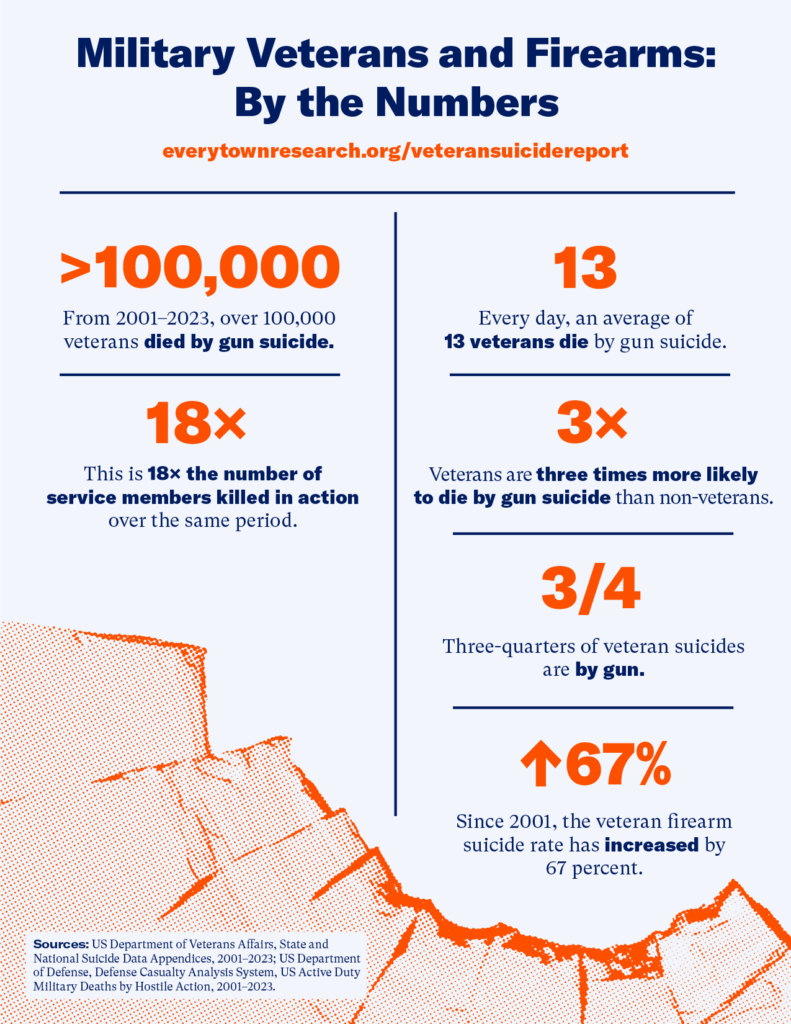
Addressing the unique role that guns play is an integral part of efforts to end veteran suicide. In fact, the use of guns in veteran suicide is becoming more frequent; in 2001, two-thirds of veteran suicides were by gun—by 2023, that rose to three-quarters.2 Everytown Research analysis of US Department of Veterans Affairs, Office of Mental Health and Suicide Prevention, “2001–2023 State Data Appendix,” March 2026, https://www.mentalhealth.va.gov/suicide_prevention/data.asp. With an average of 18 veterans dying by suicide in the United States each day, 13 of them by firearm, we cannot address veteran suicide without talking about guns.3Everytown Research analysis of US Department of Veterans Affairs, Office of Mental Health and Suicide Prevention, “2001–2023 State Data Appendix,” March 2026, https://www.mentalhealth.va.gov/suicide_prevention/data.asp. A daily average was developed using five years of the most recent available data: 2019 to 2023.
Recent federal actions have only exacerbated this crisis, posing new barriers to accessing mental and physical healthcare, cutting jobs and contracts that veterans rely on for their livelihoods, and making it easier for the most vulnerable veterans to gain access to firearms.4Ellen Barry and Nicholas Nehamas, “V.A. Mental Health Care Staff, Crowded into Federal Buildings, Raise Patient Privacy Alarms,” New York Times, May 4, 2025, https://www.nytimes.com/2025/05/04/us/politics/veterans-affairs-mental-health-privacy.html; Nicholas Nehamas et al., “Despite Promises, Veterans Affairs Department Cut Thousands of Roles for Doctors and Nurses,” New York Times, March 3, 2026, https://www.nytimes.com/2026/03/03/us/politics/veterans-affairs-nurses-doctors-cut.html; Ben Finley, “VA Hospitals Are Finding It Harder to Fill Jobs, Watchdog Says,” Associated Press, August 12, 2025, https://apnews.com/article/va-veterans-affairs-staffing-shortages-report-trump-c94f4dd7492edde788a80b092f95c4e6; Jessie Blaeser, “DOGE Had a Cutting Spree. 550 Vet-Owned Businesses Felt It,” Politico, November 22, 2025, https://www.politico.com/news/2025/11/22/veteran-owned-businesses-trump-contract-cuts-00664317; US Department of Veterans Affairs, “VA Undoes Decades-Old Wrong and Protects Veterans’ Second Amendment Rights,” press release, February 17, 2026, https://news.va.gov/press-room/va-undoes-decades-old-wrong-and-protects-veterans-second-amendment-rights/; US Department of Justice, Bureau of Alcohol, Tobacco, Firearms, and Explosives, “Revising Definitions of “Adjudicated as a Mental Defective” and “Committed to a Mental Institution,” May 8, 2026, 27 CFR Part 478 (2026), https://public-inspection.federalregister.gov/2026-09156.pdf. Veterans confront unique challenges during their service and face new ones when they return to civilian life; access to firearms can turn these challenges into a deadly tragedy.
It is vital to prevent veteran suicide through national-, state-, and community-level solutions informed by rigorous scientific evidence—including promoting secure firearm storage in and outside the home, raising awareness of the risks of firearm access, and addressing upstream factors that contribute to suicide. To truly honor those who serve, we must fully support the strategies necessary to decrease veteran firearm suicide.
Key Findings
Veteran firearm suicide is an outsize part of a larger crisis.
In the United States, firearm suicide is a devastating public health crisis, claiming nearly 27,000 lives every year—about 73 deaths each day.6Everytown Research analysis of Centers for Disease Control and Prevention, National Center for Health Statistics, WONDER Online Database, Provisional Mortality Statistics, Multiple Cause of Death, accessed December 16, 2025. Average: 2020 to 2024. Veterans make up nearly one in five adult firearm suicides, averaging more than 4,600 veteran firearm suicides every year.7Everytown Research analysis of US Department of Veterans Affairs, Office of Mental Health and Suicide Prevention, “2001–2023 State Data Appendix,” March 2026, https://www.mentalhealth.va.gov/suicide_prevention/data.asp. A yearly average was developed using five years of the most recent available data: 2019–2023.
The problem is not getting better: the US firearm suicide rate has increased overall in recent years,8Everytown Research analysis of Centers for Disease Control and Prevention, National Center for Health Statistics, WONDER Online Database, Underlying Cause of Death. A percentage change was developed using 2015 and 2024 age-adjusted rates for all ages. reaching the highest level in over two decades.9Everytown Research analysis of Centers for Disease Control and Prevention, National Center for Health Statistics. WONDER Online Database, Underlying Cause of Death. Based on age-adjusted firearm suicide rates for all ages, 2001–2023. And veterans in particular have experienced an even sharper spike. Since 2001, the veteran firearm suicide rate has increased by 67 percent compared to a 35 percent rise among non-veteran adults.10Everytown Research analysis of US Department of Veterans Affairs, Office of Mental Health and Suicide Prevention, “2001–2023 State Data Appendix,” March 2026, https://www.mentalhealth.va.gov/suicide_prevention/data.asp. Veteran and non-veteran firearm suicide crude rates were calculated using population estimates provided by the VA in the “2001–2023 National Suicide Data Appendix.” Percent change: 2001 vs. 2023. The rate increased from 15.4 veteran firearm suicides per 100,000 people in 2001 to 25.8 per 100,000 in 2023—a 67 percent increase. The non-veteran adult firearm suicide rate increased from 6.7 per 100,000 in 2001 to 9.0 per 100,000 in 2023—a 35 percent increase. Put another way, if veterans experienced the same rate of firearm suicide as non-veteran adults, there would be nearly 3,000 fewer firearm suicides every year.11Everytown Research analysis of US Department of Veterans Affairs, Office of Mental Health and Suicide Prevention, “2001–2023 State Data Appendix,” March 2026, https://www.mentalhealth.va.gov/suicide_prevention/data.asp. Veteran and non-veteran firearm suicide crude rates were calculated using population estimates provided by the VA in the “2001–2023 National Suicide Data Appendix.” A yearly average was developed using five years of the most recent available data: 2019 to 2023.
The veteran firearm suicide rate has increased 67 percent since 2001.
Last updated: 6.12.2026
Gun ownership increases the likelihood of firearm suicide, and suicide attempts with firearms are nearly always lethal.
The dynamics of suicide are complex. However, research has confirmed that before a suicide attempt, a combination of these risk factors is often present: (1) current life stressors, such as relationship problems, unemployment or financial problems, life transitions, alcohol and substance use disorders, or poor mental health conditions, (2) historical risk factors, such as childhood abuse or trauma, a previous suicide attempt, or a family history of suicide; and (3) access to lethal means of harm such as firearms.12American Foundation for Suicide Prevention, “Risk Factors, Protective Factors, and Warning Signs,” accessed June 9, 2026, https://afsp.org/risk-factors-protective-factors-and-warning-signs/. Suicide risk dramatically increases when these factors coincide to create a sense of hopelessness and despair.
Firearms are particularly dangerous, but most people who survive a suicide attempt do not go on to die by suicide.13Robert Carroll, Chris Metcalfe, and David Gunnell, “Hospital Presenting Self-Harm and Risk of Fatal and Non-Fatal Repetition: Systematic Review and Meta-Analysis,” PLoS ONE 9, no. 2 (February 28, 2014): e89944, https://doi.org/10.1371/journal.pone.0089944; David Owens, Judith Horrocks, and Allan House, “Fatal and Non-Fatal Repetition of Self-Harm: Systematic Review,” British Journal of Psychiatry 181, no. 3 (September 2002): 193–99, https://doi.org/10.1192/bjp.181.3.193.
Easy access to firearms during a moment of crisis can mean the difference between life and death. Personal or household gun ownership triples suicide risk.14Andrew Anglemyer, Tara Horvath, and George Rutherford, “The Accessibility of Firearms and Risk for Suicide and Homicide Victimization among Household Members: A Systematic Review and Meta-Analysis,” Annals of Internal Medicine 160, no. 2 (2014): 101–10, https://doi.org/10.7326/M13-1301. Approximately 90 percent of suicide attempts with a gun end in death, compared to just four percent when using other means.15Andrew Conner, Deborah Azrael, and Matthew Miller, “Suicide Case-Fatality Rates in the United States, 2007 to 2014: A Nationwide Population-Based Study,” Annals of Internal Medicine 171, no. 12 (2019): 885–95. Indeed, limiting gun access in a moment of acute crisis can ensure that veterans have a chance to live out their lives with dignity.
Veterans are more likely to own guns than non-veterans and are more likely to die by firearm suicide.
Veterans suffer a higher overall suicide rate compared to non-veteran adults. And firearms—the most lethal means of self-harm—are the prevailing method for veterans who die by suicide.16US Department of Veterans Affairs, Office of Mental Health and Suicide Prevention, “2025 National Veteran Suicide Prevention Annual Report, Part 2: Report Findings,” March 2026, https://www.mentalhealth.va.gov/docs/data-sheets/2025/2025_Annual_Report_Part_2_508.pdf. Veterans are three times more likely than non-veteran adults to die by gun suicide.17Everytown Research analysis of US Department of Veterans Affairs, Office of Mental Health and Suicide Prevention, “2001–2023 State Data Appendix,” March 2026, https://www.mentalhealth.va.gov/suicide_prevention/data.asp. Veteran and non-veteran crude rates for 2023 were calculated using population estimates provided in the Veterans Affairs “2001–2023 National Suicide Data Appendix.” By 2023, three-quarters of veteran suicides involved firearms—close to the highest proportion in over 20 years.18Everytown Research analysis of US Department of Veterans Affairs, Office of Mental Health and Suicide Prevention, “2001–2023 State Data Appendix,” March 2026, https://www.mentalhealth.va.gov/suicide_prevention/data.asp. The prevalence of firearm use among veterans means an already urgent crisis is that much more lethal. Given their training, it is no surprise that half of veterans report owning guns, compared to 20 percent of non-veterans.19Brandon Nichter et al., “Firearm Storage Practices among Military Veterans in the United States: Findings from a Nationally Representative Survey,” Journal of Affective Disorders 351 (April 2024): 82–89, https://doi.org/10.1016/j.jad.2024.01.179; Deborah Azrael et al., “The Stock and Flow of US Firearms: Results from the 2015 National Firearms Survey,” RSF: The Russell Sage Foundation Journal of the Social Sciences 3, no. 5 (October 2017): 38–57.
73%
In 2023, firearms made up 73% of veteran suicides
Source: Everytown Research analysis of US Department of Veterans Affairs, Office of Mental Health and Suicide Prevention, “2001–2023 State Data Appendix,” March 2026, https://www.mentalhealth.va.gov/suicide_prevention/data.asp. The proportion of suicides by gun was developed using the most recent year of available data: 2023. Veteran and non-veteran firearm suicide rates exclude suicides among people age 17 years and younger.
53%
In 2023, firearms made up 53% of nonveteran suicides
Source: Everytown Research analysis of US Department of Veterans Affairs, Office of Mental Health and Suicide Prevention, “2001–2023 State Data Appendix,” March 2026, https://www.mentalhealth.va.gov/suicide_prevention/data.asp. The proportion of suicides by gun was developed using the most recent year of available data: 2023. Veteran and non-veteran firearm suicide rates exclude suicides among people age 17 years and younger.
Firearms are increasingly used in suicides among female veterans.
Firearm suicide makes up a smaller proportion of all suicide deaths among female veterans than among males (49 percent and 75 percent, respectively, in 2023), but that is changing.20US Department of Veterans Affairs, Office of Mental Health and Suicide Prevention, “2025 National Veteran Suicide Prevention Annual Report, Part 2: Report Findings,” March 2026, https://www.mentalhealth.va.gov/docs/data-sheets/2025/2025_Annual_Report_Part_2_508.pdf. Compared to other suicide methods, the use of firearms in female veteran suicides is increasing faster than among their male counterparts. From 2001 to 2023, the proportion of suicide deaths by firearm increased by 31 percent among female veterans but only by 11 percent among male veterans.21Everytown Research analysis of US Department of Veterans Affairs, Office of Mental Health and Suicide Prevention, “2025 National Veteran Suicide Prevention Annual Report, Part 2: Report Findings,” March 2026, https://www.mentalhealth.va.gov/docs/data-sheets/2025/2025_Annual_Report_Part_2_508.pdf. In addition, female veterans are more likely than civilian women to use a gun to die by suicide.22US Department of Veterans Affairs, Office of Mental Health and Suicide Prevention, “2025 National Veteran Suicide Prevention Annual Report, Part 2: Report Findings,” March 2026, https://www.mentalhealth.va.gov/docs/data-sheets/2025/2025_Annual_Report_Part_2_508.pdf. This trend is consequential because women are the fastest-growing veteran group, currently comprising about 11 percent of the US veteran population.23Everytown Research analysis of US Department of Veterans Affairs, Office of Mental Health and Suicide Prevention, “2001–2023 National Suicide Data Appendix,” March 2026, https://www.mentalhealth.va.gov/suicide_prevention/data.asp.
The veteran suicide rate is highest among 18- to 34-year-olds.
In 2001, the highest suicide rate was seen among veterans ages 35 to 54,24Everytown Research analysis of US Department of Veterans Affairs, Office of Mental Health and Suicide Prevention, “2001–2023 National Suicide Data Appendix,” March 2026, https://www.mentalhealth.va.gov/suicide_prevention/data.asp. an age group of those who served during the period of US conflicts in Vietnam, the Persian Gulf, and the intervening years.25US Department of Veterans Affairs, “Veterans Employment Toolkit: Dates and Names of Conflicts,” accessed January 25, 2024, https://web.archive.org/web/20240114094703/https://www.va.gov/vetsinworkplace/docs/em_datesnames.asp. More than 20 years later, the suicide rate has increased among the youngest veterans; veterans ages 18 to 34 now have the highest rate of suicide. Unlike in the general population, where adults in this age group have among the lowest suicide rates,26Everytown Research analysis of Centers for Disease Control and Prevention, National Center for Health Statistics, WONDER Online Database, Provisional Mortality Statistics, 2023. the youngest veterans are facing some of the highest rates. In fact, in 2023, the rate of suicide among this younger (18–35) age group was 43 percent higher than the rate of suicide among other veterans (35+).27Everytown Research analysis of US Department of Veterans Affairs, Office of Mental Health and Suicide Prevention, “2001–2023 National Suicide Data Appendix,” March 2026, https://www.mentalhealth.va.gov/suicide_prevention/data.asp. In 2023, the suicide rate among veterans ages 18 to 34 was 47.9 per 100,000, compared to a rate of 33.6 per 100,000 among veterans ages 35 and older. This younger cohort of veterans began service in the post-9/11 era, and some of the youngest veterans hadn’t even been born when the conflict began.
Veteran suicide is not always the result of combat trauma.
Suicide risk in veterans is commonly assumed to result from exposure to traumatic incidents while deployed to combat. On the contrary, among veterans who served during the Iraq and Afghanistan Wars, those who were not deployed to those war zones were at higher risk for suicide than those who were.28Han K. Kang et al., “Suicide Risk among 1.3 Million Veterans Who Were on Active Duty during the Iraq and Afghanistan Wars,” Annals of Epidemiology 25, no. 2 (February 2015): 96–100, https://doi.org/10.1016/j.annepidem.2014.11.020. Combat trauma has a complex relationship with suicide risk among veterans, and while research shows that certain conditions like post-traumatic stress disorder (PTSD) can contribute to suicide risk—whether derived from combat or from other events—there is no clear association between combat exposure generally and the risk of dying by suicide.29William Hudenko, Beeta Homaifar, and Hal Wortzel, “The Relationship between PTSD and Suicide,” National Center for PTSD, US Department of Veterans Affairs, accessed February 6, 2025, https://www.ptsd.va.gov/professional/treat/cooccurring/suicide_ptsd.asp#two.
What drives this noteworthy difference is not entirely clear, though some evidence suggests the “healthy warrior effect,” where soldiers are screened for psychological resilience early in their careers.30Gerald E. Larson, Robyn M. Highfill-McRoy, and Stephanie Booth-Kewley, “Psychiatric Diagnoses in Historic and Contemporary Military Cohorts: Combat Deployment and the Healthy Warrior Effect,” American Journal of Epidemiology 167, no. 11 (June 1, 2008): 1269–76, https://doi.org/10.1093/aje/kwn084. Recruits are trained in an intense environment that may reveal traits or disorders ill-suited for a war zone, which is a consideration for deployment later in their careers. One study of Marines deployed in Iraq and Afghanistan found that all psychiatric conditions except PTSD occurred at higher rates in nondeployed soldiers, suggesting that resilience is observed before deployment.31Gerald E. Larson, Robyn M. Highfill-McRoy, and Stephanie Booth-Kewley, “Psychiatric Diagnoses in Historic and Contemporary Military Cohorts: Combat Deployment and the Healthy Warrior Effect,” American Journal of Epidemiology 167, no. 11 (June 1, 2008): 1269–76, https://doi.org/10.1093/aje/kwn084. Since veterans with mental health diagnoses have a higher suicide rate than veterans without,32US Department of Veterans Affairs, Office of Mental Health and Suicide Prevention, “2025 National Veteran Suicide Prevention Annual Report, Part 2: Report Findings,” March 2026, https://www.mentalhealth.va.gov/docs/data-sheets/2025/2025_Annual_Report_Part_2_508.pdf. such psychological resilience may be an important protective factor.
Additionally, aspects of being in the military separate from combat exposure can contribute to a veteran’s suicide risk. Military service can provide soldiers with positive experiences and skills, such as leadership, decision-making, working with a team, and commitment.33James Craig, Jeanette Leonard, Ronald Link, and Tammy White-McKnight, “Understanding Military Culture: A Primer in Cultural Competence Working with Military Members and Families,” Health Services Research and Development, US Department of Veterans Affairs, Washington, DC, April 5, 2022, https://www.hsrd.research.va.gov/for_researchers/understanding-military-culture.cfm. However, the culture that leads to success in the military—prizing discipline, group needs, and close bonds with other soldiers—may be lacking in US society when a soldier then transitions to become a veteran. Physical conditions that may result from military service can prove challenging as well; chronic pain, sleeplessness, increased health problems, and decreased physical ability are all risk factors for suicide.34US Department of Veterans Affairs, Office of Mental Health and Suicide Prevention, “2025 National Veteran Suicide Prevention Annual Report, Part 2: Report Findings,” March 2026, https://www.mentalhealth.va.gov/docs/data-sheets/2025/2025_Annual_Report_Part_2_508.pdf; US Department of Veterans Affairs, Office of Mental Health and Suicide Prevention, “2023 National Veteran Suicide Prevention Annual Report,” November 2023, https://www.mentalhealth.va.gov/docs/data-sheets/2023/2023-National-Veteran-Suicide-Prevention-Annual-Report-FINAL-508.pdf. Research shows that without support, veterans risk feeling disoriented and without identity or meaning when they transition to civilian life.35James L. Pease, Melodi Billera, and Georgia Gerard. “Military Culture and the Transition to Civilian Life: Suicide Risk and Other Considerations.” Social Work 61, no. 1 (January 1, 2016): 83–86, https://doi.org/10.1093/sw/swv050.
Recent Federal Actions Have Put Veterans at Risk
In early 2025, turmoil in the federal government impacted the benefits, access to physical and mental healthcare, and livelihoods of veterans across the country. The healthcare branch of the Department of Veterans Affairs (VA), the Veterans Health Administration (VHA), has historically faced chronic staffing shortages,36Ben Finley, “VA Hospitals Are Finding It Harder to Fill Jobs, Watchdog Says,” Associated Press, August 12, 2025, https://apnews.com/article/va-veterans-affairs-staffing-shortages-report-trump-c94f4dd7492edde788a80b092f95c4e6. but in FY 2025, the VHA suffered from an even further reduced workforce, with 94 percent of its facilities reporting severe shortages of doctors.37US Department of Veterans Affairs, Office of Inspector General, “OIG Determination of Veterans Health Administration’s Severe Occupational Staffing Shortages, Fiscal Year 2025,” August 12, 2025, https://www.vaoig.gov/sites/default/files/reports/2025-08/vaoig-25-01135-196-final.pdf. Return-to-office policies disrupted mental healthcare access, with many veterans being forced to discuss personal challenges in open, crowded spaces with little privacy.38Ellen Barry and Nicholas Nehamas, “V.A. Mental Health Care Staff, Crowded into Federal Buildings, Raise Patient Privacy Alarms,” New York Times, May 4, 2025, https://www.nytimes.com/2025/05/04/us/politics/veterans-affairs-mental-health-privacy.html. Even before this instability, veterans’ healthcare access has been a persistent challenge in suicide prevention, with many suicide decedents having documented difficulties receiving care.39Emily Wax-Thibodeaux, “The Parking Lot Suicides,” Washington Post, February 7, 2019, https://www.washingtonpost.com/news/national/wp/2019/02/07/feature/the-parking-lot-suicides/.
Moreover, with veterans comprising nearly 30 percent of the federal civilian workforce,40US Office of Personnel Management, “FY 2024 Employment of Veterans and Military-Connected Spouses and Survivors in the Federal Executive Branch Report,” January 2026, https://www.opm.gov/fedshirevets/hiring-officials/veteran-employment-data/fy-2024-employment-of-veterans-and-military-connected-spouses-and-survivors-in-the-federal-executive-branch-report.pdf. and hundreds of veteran-owned businesses facing contract cancellations—including businesses that were providing healthcare support to veterans41Jessie Blaeser, “DOGE Had a Cutting Spree. 550 Vet-Owned Businesses Felt It,” Politico, November 22, 2025, https://www.politico.com/news/2025/11/22/veteran-owned-businesses-trump-contract-cuts-00664317.—cuts across government agencies have put veterans out of work. Research shows that barriers to accessing healthcare and benefits, financial and housing insecurity, and job insecurity can all contribute to suicide risk.42Centers for Disease Control and Prevention, National Center for Injury Prevention and Control, “Suicide Prevention Resource for Action: A Compilation of the Best Available Evidence,” 2022, https://www.cdc.gov/suicide/pdf/preventionresource.pdf; White House, “Reducing Military and Veteran Suicide: Advancing a Comprehensive, Cross-Section, Evidence-Informed Public Health Strategy,” November 2021, https://web.archive.org/web/20250119173935/https://www.whitehouse.gov/wp-content/uploads/2021/11/Military-and-Veteran-Suicide-Prevention-Strategy.pdf. Reducing the number of doctors and nurses at the VHA, complicating mental health appointments, and cancelling services intended to provide care for veterans only exacerbate this problem.
A series of federal actions in recent years have also made it easier for veterans to access firearms, particularly veterans who are most at risk of harming themselves or others. Historically, the VA has shared with the FBI’s National Instant Criminal Background Check System (NICS) records of veterans determined to be prohibited from firearm ownership due to serious mental health challenges. However, the VA stopped this practice with the enactment of a new federal law that significantly limited the VA’s ability to do so.43H.R.4366, Consolidated Appropriations Act, 2024, S.Amdt.1354 to S.Amdt.1092, 118th Congress (2023–2024), https://www.congress.gov/amendment/118th-congress/senate-amendment/1354?s=a&r=78. Because of this change in law, these veterans have not been reported to the NICS since March 2024. As a result, veterans facing mental health disorders like bipolar disorder and schizophrenia are now more likely to be able to pass a background check and purchase a firearm from a federally licensed firearm dealer.
In February 2026, the Trump administration took further action, announcing that the VA would go as far as to remove historical records from NICS.44VA News, “VA Undoes Decades-Old Wrong and Protects Veterans’ Second Amendment Rights,” February 17, 2026, https://news.va.gov/press-room/va-undoes-decades-old-wrong-and-protects-veterans-second-amendment-rights/. Veterans who have been prohibited from firearm ownership for years are now able to pass a background check and purchase a firearm, eliminating a valuable tool the VA had for preventing suicide among the most vulnerable veterans. In addition, in April 2026, the Bureau of Alcohol, Tobacco, Firearms and Explosives (ATF) announced a new proposal to codify these changes in federal regulations and to do so in a manner that narrows who, including both veterans and non-veterans, are considered to be prohibited under federal law for mental health reasons. The Trump administration has proposed making these changes while explicitly acknowledging that they could result in an “increase in public safety risk,” including “potential mass casualty events.”45US Department of Veterans Affairs, “VA Undoes Decades-Old Wrong and Protects Veterans’ Second Amendment Rights,” press release, February 17, 2026, https://news.va.gov/press-room/va-undoes-decades-old-wrong-and-protects-veterans-second-amendment-rights/; US Department of Justice, Bureau of Alcohol, Tobacco, Firearms, and Explosives, “Revising Definitions of “Adjudicated as a Mental Defective” and “Committed to a Mental Institution,” May 8, 2026, 27 CFR Part 478 (2026), https://public-inspection.federalregister.gov/2026-09156.pdf. These actions undermine the federal government’s responsibility to protect and support veterans, actively putting the most vulnerable veterans in greater danger.
Recommendations
The following are evidence-informed recommendations that research shows are effective in reducing suicide for all people. While more research is urgently needed to determine the effectiveness of veteran-specific suicide prevention and intervention efforts, the strategies presented here can be used immediately to address the rising rates of suicide among veterans as well as the general public.
Promote practices that put time and space between a person contemplating suicide and their guns.
Veterans are more likely to own firearms than non-veterans. The average firearms-owning veteran owns six guns.46Emily C. Cleveland et al., “Firearm Ownership among American Veterans: Findings from the 2015 National Firearm Survey,” Injury Epidemiology 4, no. 33 (December 2017), https://doi.org/10.1186/s40621-017-0130-y. Secure gun storage practices, one foundational intervention point, are likely familiar to military service members and veterans, as military-issued guns are required to be stored securely at almost all times.
However, personal weapons are often treated differently: A 2022 survey found that while half of veterans own guns, the majority do not store all their guns securely.47Brandon Nichter et al., “Firearm Storage Practices among Military Veterans in the United States: Findings from a Nationally Representative Survey,” Journal of Affective Disorders 351 (April 2024): 82–89, https://doi.org/10.1016/j.jad.2024.01.179. Veterans with certain risk factors for suicide—including alcohol misuse, depression, and suicidal ideation—were more likely to not store their guns securely. Moreover, between 2021 and 2023, nearly one in four veterans who used VHA services before dying by suicide were found to have unsecured guns in their home in the year prior to their death.48US Department of Veterans Affairs, Office of Mental Health and Suicide Prevention, “2025 National Veteran Suicide Prevention Annual Report, Part 2: Report Findings,” March 2026, https://www.mentalhealth.va.gov/docs/data-sheets/2025/2025_Annual_Report_Part_2_508.pdf. Encouraging veterans to treat personal weapons with the same focus on safety expected while in the military is just one way to prevent gun suicides in veteran communities.
Suicidal crises are often very brief, and preventing access to lethal means can stop a moment of despair from becoming an irreversible tragedy. Methods to reduce gun access for those in crisis exist on a continuum, and depending on the circumstances, some interventions may be more effective than others. If one tactic is not successful, another intervention can be used to put time and distance between a person contemplating suicide and a particularly lethal means.
Under this continuum, in addition to securely storing firearms at home, veterans with firearms in their homes can work with friends, family members, or physicians to give the keys to the person’s secure storage device to a trusted friend or family member, put a plan in place to temporarily store their firearms with a friend or relative or in a storage facility, or take action to limit their own ability to acquire new guns in times of crisis. Voluntary Do Not Buy lists (sometimes called Voluntary Prohibition lists), currently enacted in several states, enable people to put themselves on a list that temporarily prevents them from purchasing guns.49See, e.g., Rev. Code Wash. (ARCW) § 9.41.350; Va. Code Ann. § 52-50, et seq.; Utah Code Ann. § 53-5c-301. Firearm storage maps have been developed to help community members find third-party storage options in several states and localities, including Colorado, Maryland, Mississippi, New Jersey, New York, and Washington state. Education about the ways to disrupt a person’s access to a gun when they are in crisis is an important part of preventing suicide.
Identify veterans in crisis, and ensure that all 50 states and the District of Columbia have the authority to temporarily remove their access to firearms.
Extreme Risk laws, sometimes referred to as “red flag laws,” allow immediate family members or law enforcement to petition a civil court for an order to temporarily remove guns from an individual during a crisis. A growing number of states and Washington, DC, have adopted this effective suicide intervention tool.50Aaron J. Kivisto and Peter Lee Phalen, “Effects of Risk-Based Firearm Seizure Laws in Connecticut and Indiana on Suicide Rates, 1981–2015,” Psychiatric Services 69, no. 8 (June 2018): 855–62; Jeffrey W. Swanson et al., “Implementation and Effectiveness of Connecticut’s Risk-Based Gun Removal Law: Does It Prevent Suicides?,” Law and Contemporary Problems 80, no. 2 (2017): 179–208; Jeffrey W. Swanson et al., “Criminal Justice and Suicide Outcomes with Indiana’s Risk-Based Gun Seizure Law,” Journal of the American Academy of Psychiatry and the Law 47, no. 3 (April 2019): 188–97; Jeffrey W. Swanson et al., “Suicide Prevention Effects of Extreme Risk Protection Order Laws in Four States,” Journal of the American Academy of Psychiatry and the Law Online 52, no. 3 (August 2024), https://jaapl.org/content/early/2024/08/27/JAAPL.240056-24. Risk mitigation planning is critical to preventing suicide, and veterans’ families and friends need to know the steps for intervention. If a court finds that a person poses a serious risk of injuring themselves or others with a firearm, that person becomes temporarily prohibited from purchasing and possessing guns, and any guns they already own must be turned in and held by law enforcement or another authorized party while the order is in effect.
Extreme Risk Law
22 states have adopted this policy
Extreme Risk Law
Alabama has not adopted this policy
Extreme Risk Law
Alaska has not adopted this policy
Extreme Risk Law
Arizona has not adopted this policy
Extreme Risk Law
Arkansas has not adopted this policy
Extreme Risk Law
California has adopted this policy
- Who may petition for an order?
- Law enforcement, immediate family members, employers, coworkers, teachers, roommates, people with a child in common or who have a dating relationship
Extreme Risk Law
Colorado has adopted this policy
- Who may petition for an order?
- Law enforcement, family/household members, co-responders, certain medical professionals or educators (and the institutions that employ them)
Extreme Risk Law
Connecticut has adopted this policy
- Who may petition for an order?
- Law enforcement, family/household members, and medical professionals
Extreme Risk Law
Delaware has adopted this policy
- Who may petition for an order?
- Law enforcement and family members
Extreme Risk Law
Florida has adopted this policy
- Who may petition for an order?
- Law enforcement only
Extreme Risk Law
Georgia has not adopted this policy
Extreme Risk Law
Hawaii has adopted this policy
- Who may petition for an order?
- Law enforcement, family/household members, medical professionals, educators, and colleagues
Extreme Risk Law
Idaho has not adopted this policy
Extreme Risk Law
Illinois has adopted this policy
- Who may petition for an order?
- Law enforcement and family members
Extreme Risk Law
Indiana has adopted this policy
- Who may petition for an order?
- Law enforcement only
Extreme Risk Law
Iowa has not adopted this policy
Extreme Risk Law
Kansas has not adopted this policy
Extreme Risk Law
Kentucky has not adopted this policy
Extreme Risk Law
Louisiana has not adopted this policy
Extreme Risk Law
Maine has adopted this policy
- Who may petition for an order?
- Law enforcement, family/household members
Extreme Risk Law
Maryland has adopted this policy
- Who may petition for an order?
- Law enforcement, family members, doctors, and mental health professionals
Extreme Risk Law
Massachusetts has adopted this policy
- Who may petition for an order?
- Family/household members, gun licensing authorities, certain law enforcement; certain health care providers; school principal/administrator
Extreme Risk Law
Michigan has adopted this policy
- Who may petition for an order?
- Law enforcement, family/household members, certain health care providers
Extreme Risk Law
Minnesota has adopted this policy
- Who may petition for an order?
- Law enforcement and family members
Extreme Risk Law
Mississippi has not adopted this policy
Extreme Risk Law
Missouri has not adopted this policy
Extreme Risk Law
Montana has not adopted this policy
Extreme Risk Law
Nebraska has not adopted this policy
Extreme Risk Law
Nevada has adopted this policy
- Who may petition for an order?
- Law enforcement and family/household members
Extreme Risk Law
New Hampshire has not adopted this policy
Extreme Risk Law
New Jersey has adopted this policy
- Who may petition for an order?
- Law enforcement and family/household members
Extreme Risk Law
New Mexico has adopted this policy
- Who may petition for an order?
- Law enforcement only
Extreme Risk Law
New York has adopted this policy
- Who may petition for an order?
- Law enforcement, district attorneys, family/household members, school administrators, certain medical professionals
Extreme Risk Law
North Carolina has not adopted this policy
Extreme Risk Law
North Dakota has not adopted this policy
Extreme Risk Law
Ohio has not adopted this policy
Extreme Risk Law
Oklahoma has not adopted this policy
Extreme Risk Law
Oregon has adopted this policy
- Who may petition for an order?
- Law enforcement and family/household members
Extreme Risk Law
Pennsylvania has not adopted this policy
Extreme Risk Law
Rhode Island has adopted this policy
- Who may petition for an order?
- Law enforcement only
Extreme Risk Law
South Carolina has not adopted this policy
Extreme Risk Law
South Dakota has not adopted this policy
Extreme Risk Law
Tennessee has not adopted this policy
Extreme Risk Law
Texas has not adopted this policy
Extreme Risk Law
Utah has not adopted this policy
Extreme Risk Law
Vermont has adopted this policy
- Who may petition for an order?
- States attorneys and the Office of the Attorney General; family/household members
Extreme Risk Law
Virginia has adopted this policy
- Who may petition for an order?
- Law enforcement and Commonwealth Attorneys; family/household members; certain medical professionals; school administrators
Extreme Risk Law
Washington has adopted this policy
- Who may petition for an order?
- Law enforcement and family/household members
Extreme Risk Law
West Virginia has not adopted this policy
Extreme Risk Law
Wisconsin has not adopted this policy
Extreme Risk Law
Wyoming has not adopted this policy
While not all veterans seek VHA services, the agency can, without compromising patient confidentiality, work with designated petitioners to protect at-risk veterans by temporarily preventing their access to firearms. Extreme Risk laws have been proven to reduce firearm suicides. A multistate study found that one suicide was averted for every 17 Extreme Risk Protection Order (ERPOs) issued. This study also found that when looking at only those cases in which the individual had demonstrated a threat of self-harm, for every 13 ERPOs issued, a suicide was prevented.51Jeffrey W. Swanson et al., “Suicide Prevention Effects of Extreme Risk Protection Order Laws in Four States,” Journal of the American Academy of Psychiatry and the Law Online 52, no. 3 (August 2024), https://jaapl.org/content/early/2024/08/27/JAAPL.240056-24. Warning signs that someone is suicidal are often most apparent to household or family members, and while it can sometimes feel like there is nothing that can be done, requesting an Extreme Risk Protection Order is one thing people can do.
Enact effective federal policies that take the crisis of veteran suicide seriously.
While the Trump administration has advanced policies that put veterans at risk for further harm, other federal actions can help prevent even more damage. One important step, the Saving Our Veterans’ Lives Act, would require the VA to provide veterans with lockboxes for secure firearm storage,52Saving Our Veterans Lives Act of 2025 (H.R. 1987 / S. 926), 119th Congress (2025–2026). ensuring that more veterans are equipped to put barriers between themselves and an especially lethal means. Additionally, congressional action to urgently and immediately address and reverse the deep cuts to the VA can improve services, benefits, and access to healthcare that were compromised by federal layoffs and cancelled contracts.
We need healthcare professionals to have conversations about gun access and suicide risk.
Roughly two in three Americans who attempt suicide will visit a healthcare professional in the month before the attempt.53Brian Ahmedani et al., “Racial/Ethnic Differences in Health Care Visits Made before Suicide Attempt across the United States,” Medical Care 53, no. 5 (May 2015): 430–35, https://doi.org/10.1097/MLR.0000000000000335. One survey of veterans already receiving mental healthcare found that more than half (56 percent) of patients with a suicide plan had guns in their household.54Marcia Valenstein et al., “Possession of Household Firearms and Firearm-Related Discussions with Clinicians among Veterans Receiving VA Mental Health Care,” Archives of Suicide Research 24, no. sup1 (February 2019), https://doi.org/10.1080/13811118.2019.1572555. These visits with licensed mental health providers offer critical opportunities for conversations about firearm access.
Counseling for Access to Lethal Means (CALM) is one program designed to equip medical professionals with language for discussing this risk with their patients, and some VHA facilities have offered it. Providers who have received this training are more likely to counsel clients on the importance of restricting access to lethal means of suicide. One study found that after receiving training, 65 percent of mental healthcare providers counseled on access to lethal means.55Renee M. Johnson et al., “Training Mental Healthcare Providers to Reduce At-Risk Patients’ Access to Lethal Means of Suicide: Evaluation of the CALM Project,” Archives of Suicide Research 15, no. 3 (August 2011): 259–64. And while these conversations may be challenging, a majority of US gun owners, including veterans, agree that it is appropriate for clinicians to talk about firearm safety with their patients.56Marian E. Betz et al., “Public Opinion Regarding Whether Speaking with Patients about Firearms Is Appropriate: Results of a National Survey,” Annals of Internal Medicine 165, no. 8 (October 2016): 543–50. These conversations could save lives.
We need greater public and veteran awareness about the inherent risks of firearm access.
Many Americans are unaware of the threat that firearms in the home can pose with respect to suicide. Access to a firearm increases the suicide risk threefold for all household members.57Andrew Anglemyer, Tara Horvath, and George Rutherford, “The Accessibility of Firearms and Risk for Suicide and Homicide Victimization among Household Members: A Systematic Review and Meta-Analysis,” Annals of Internal Medicine 160, no. 2 (January 2014): 101–10. As discussed, veterans are far more likely to own firearms than non-veterans,58Brandon Nichter et al., “Firearm Storage Practices among Military Veterans in the United States: Findings from a Nationally Representative Survey,” Journal of Affective Disorders 351 (April 2024): 82–89, https://doi.org/10.1016/j.jad.2024.01.179; Deborah Azrael et al., “The Stock and Flow of US Firearms: Results from the 2015 National Firearms Survey,” RSF: The Russell Sage Foundation Journal of the Social Sciences 3, no. 5 (October 2017): 38–57. and a majority cite protection of themselves, their family, or their property as a primary reason for firearm ownership.59Emily C. Cleveland et al., “Firearm Ownership among American Veterans: Findings from the 2015 National Firearm Survey,” Injury Epidemiology 4, no. 33 (December 2017), https://doi.org/10.1186/s40621-017-0130-y; Andrew Anglemyer, Tara Horvath, and George Rutherford, “The Accessibility of Firearms and Risk for Suicide and Homicide Victimization among Household Members: A Systematic Review and Meta-Analysis,” Annals of Internal Medicine 160, no. 2 (January 2014): 101–10. Yet, a significant portion of veterans do not perceive that having a gun in the home is a suicide risk factor.60Joseph A. Simonetti et al., “Firearm Storage Practices among American Veterans,” American Journal of Preventive Medicine 55, no. 4 (October 2018): 445–54. Lindsey L. Monteith et al., “Household Firearm Access, Storage, Perceptions, and Discussions among U.S. Military Veterans: Population-Based Estimates from the 2022 ASCEND Survey,” Injury Epidemiology, May 31, 2026, https://doi.org/10.1186/s40621-026-00692-3.
As service members transition to civilian life, both the VA and the Department of Defense are in a unique position to inform them of the risks of firearm ownership as a civilian. The Transition Assistance Program, which is mandatory for most people separating from the military, provides information and resources to prepare service members to become civilians. Along with providing transitional support, training for the workforce, and an explanation of veteran benefits, this program provides an important opportunity for trusted messengers to share information about the risks and best practices of personal firearm ownership.
Building public awareness about the inherent dangers of firearm access may help gun-owning veterans or their families to mitigate risks. For example, a number of innovative programs across the country bring suicide prevention information directly to gun owners. These include partnerships between suicide prevention and firearm safety organizations to deliver mandatory training sessions to those seeking concealed-carry permits in Utah.61Utah Bureau of Criminal Information, “Firearm Suicide Prevention: A Brief Module for Utah Concealed Carry Class,” 2016, https://bci.utah.gov/wp-content/uploads/sites/15/2019/05/Firearm-Safety-PPT-UT-FINAL.pdf. Likewise, the Gun Shop Project in New Hampshire, which provides suicide prevention literature at firearm retailers, has expanded to several other states.62NAMI New Hampshire, “NH Firearm Safety Coalition,” accessed April 30, 2026, https://www.naminh.org/uncategorized/nhfsc/; Harvard T.H. Chan School of Public Health, “Means Matter: Gun Shop Project,” accessed June 8, 2026, https://hsph.harvard.edu/research/means-matter/gun-owners/gun-shop-project/. Although some research has demonstrated the encouraging impact of the Gun Shop Project,63Erin Wright-Kelly et al., “Firearm Businesses as Partners in Suicide Prevention: A Cross-Sectional Study of the Gun Shop Project in Colorado, USA,” Injury Prevention 31, no. 6 (November 2025): 527–33, doi: 10.1136/ip-2023-045178, https://pubmed.ncbi.nlm.nih.gov/39009435/; Evan Polzer et al., “‘Gun Shop Projects’ for Suicide Prevention in the USA: Current State and Future Directions,” Injury Prevention 27, no. 2 (April 2021): 150–54, doi: 10.1136/injuryprev-2020-043648, https://pubmed.ncbi.nlm.nih.gov/32213533/. rigorous evaluations of training programs for firearm purchasers and public awareness campaigns are still needed to provide further information on their efficacy, particularly among veterans.
Address upstream factors to understand and prevent veteran gun suicide.
To prevent firearm suicide, recognizing intervention points well before an attempt occurs is crucial. Challenges may begin as soon as a service member separates from the military, with veterans who recently left the military facing a higher suicide rate than veterans generally.64US Department of Veterans Affairs, Office of Mental Health and Suicide Prevention, “2025 National Veteran Suicide Prevention Annual Report, Part 2: Report Findings,” March 2026, https://www.mentalhealth.va.gov/docs/data-sheets/2025/2025_Annual_Report_Part_2_508.pdf. Policies that both help veterans navigate challenges proven to increase suicide risk and address them at the root are an important part of a holistic approach to preventing suicide.
Prioritize timely data about veteran suicide and more research on the effectiveness of existing initiatives to combat this crisis.
Veteran suicide is an urgent, worsening crisis, but the lack of timely information about even the most basic aspects of this problem makes it difficult to design effective interventions. The most recent year of data available on the crisis of veteran suicide is from 2023.65US Department of Veterans Affairs, “Veteran Suicide Data and Reporting,” accessed June 5, 2026, https://www.mentalhealth.va.gov/suicide_prevention/data.asp. Looking at the trends and impacts over the last quarter-century is instructive. But public access to that data is years away, and its release requires that government officials at that time consider suicide prevention a priority. Knowing what challenges are facing today’s veterans is crucial to alleviating them and ultimately preventing suicides.
Additionally, it is important to study different programs dedicated to preventing veteran suicide to reveal which ones are effective. The VA facilitates many initiatives dedicated to ending veteran suicide, such as community-based outreach, expanding crisis line and telehealth options for veterans considering suicide, and peer support services, but too few of these programs directly address the role of firearms. Evaluating these programs and ensuring that firearms remain part of the conversation are critical steps in determining the effect of such initiatives.
Conclusion: Better Supporting Those Who Serve
Veterans are more likely than the general population to die by suicide and are much more likely to use a gun. Too many veterans don’t store their guns securely, so there is no barrier between a moment of crisis and an extremely lethal means of self-harm. Addressing the rising rates of veteran suicide requires acknowledging the outsize role of guns in this crisis.
Veterans are made up of millions of people with diverse identities, experiences, and challenges, and addressing suicide in this population requires making sure that interventions meet their needs. Resources to prevent gun-related veteran suicides must educate veterans and their families on the lethality of firearms. The recommendations outlined here are just the start of a larger dialogue on effective strategies to best support those who serve.
ACKNOWLEDGEMENTS
Everytown for Gun Safety Support Fund would like to gratefully acknowledge the reviewers who shared their invaluable expertise during the drafting of this report:
Dr. Sonali Rajan, Senior Director of Research
Ashley Cannon, Managing Research Editor
Justin Wagner, Senior Vice President of Law and Policy
Rachel Fedeli, Firearms Analyst
Everytown Veteran Lead Chris Marvin
The Everytown Veterans Advisory Council
Learn More:
Everytown Research & Policy is a program of Everytown for Gun Safety Support Fund, an independent, non-partisan organization dedicated to understanding and reducing gun violence. Everytown Research & Policy works to do so by conducting methodologically rigorous research, supporting evidence-based policies, and communicating this knowledge to the American public.