
Constant threats: the role of guns in intimate partner abuse and violence

6.5.2026
What Is the Intersection of Intimate Partner Violence (IPV) and Gun Violence?
“It was the constant threat of death. I was so scared . . . that fear shaped every choice I made while I was with him.”
-Survivor of intimate partner violence
Intimate partner homicides remain a scourge in the United States (US). The majority of these homicides are committed with a firearm. More than 70 women each month in the United States, on average, are killed by an intimate partner with a gun.1Everytown Research & Policy, Guns and Violence Against Women, March 18, 2026, https://everytownresearch.org/report/guns-and-violence-against-women/. In the context of intimate partner violence (IPV), firearms present the most dangerous risk of lethality. Accessto a gun makes it five times more likely a woman will be killed by her abusive male partner.2Jacquelyn Campbell et al., “Risk Factors for Femicide in Abusive Relationships: Results from a Multisite Case Control Study,” American Journal of Public Health 93, no. 7 (July 2003): 1089–97, doi: 10.2105/ajph.93.7.1089. When a firearm is used against an intimate partner during an incident of abuse, it is up to 41 times more likely that incident will result in a fatality than if any other weapon or physical force had been employed.3See Campbell et al., “Risk Factors for Femicide”; Linda E. Saltzman et al., “Weapon Involvement and Injury Outcomes in Family and Intimate Assaults,” JAMA 267, no. 22 (June 10, 1992): 3043–47, https://pubmed.ncbi.nlm.nih.gov/1588718/.
An intimate partner homicide is a tragedy where a person kills their current or former romantic, dating, sexual, or domestic partner.
This violence ripples beyond the intimate relationship as well. Data show the extensive overlap between those who abuse their intimate partners and those who commit gun violence in our communities: mass shootings, law enforcement line-of-duty deaths, and children and family members of IPV survivors are all often corollary victims to intimate partner gun violence at alarming rates.4See Lisa Geller, Marisa Booty, and Cassandra K. Crifasi, “The Role of Domestic Violence in Fatal Mass Shootings in the United States, 2014–2019,” Injury Epidemiology 8, no. 1 (May 31, 2021). 38, doi: 10.1186/s40621-021-00330-0; Katherine A. Fowler et al., “Childhood Firearm Injuries in the United States,” Pediatrics 140, no. 1 (2017): 7, e20163486; Cassandra Kercher et al., “Homicides of Law Enforcement Officers Responding to Domestic Violence Calls,” Injury Prevention 19, no. 5 (October 2016), 331–35, doi: 10.1136/injuryprev-2012-040723. In fact, one US city observed that 70 percent of the perpetrators of fatal and nonfatal community shootings had a misdemeanor domestic violence history.5United States Attorney’s Office, Northern District of Alabama, “Jefferson County Agencies Awarded $800,000 to Enhance Responses to Domestic Violence,” October 5, 2023, https://www.justice.gov/usao-ndal/pr/jefferson-county-agencies-awarded-800000-enhance-responses-domestic-violence.
How Is an Intimate Partner’s Experience of Gun Violence Distinct?
“I was so scared because he might shoot. Even when he wasn’t holding it, I felt like my life was in his hand because, you know, I knew he could snap at any moment.”
-Survivor of intimate partner violence
While there is striking overlap between the individuals who are perpetrating IPV with guns and community gun violence, the forms of gun violence aimed at the intimate partner victim are quite distinctive. Much of the focus is on shootings and homicides. For victims of intimate partner violence, abuse rarely starts here. IPV takes place along a continuum of abusive behaviors, all aimed at exerting power and control. Firearms are often used along that continuum.
In 2024, the Battered Women’s Justice Project (BWJP) and the National Domestic Violence Hotline conducted a national survey of 2,739 survivors of gender-based violence. More than two-thirds of survivors indicated that their current or former partner had access to a gun, and nearly half of the survivors reported that they had been threatened, coerced, stalked, or harmed by a partner with a gun.
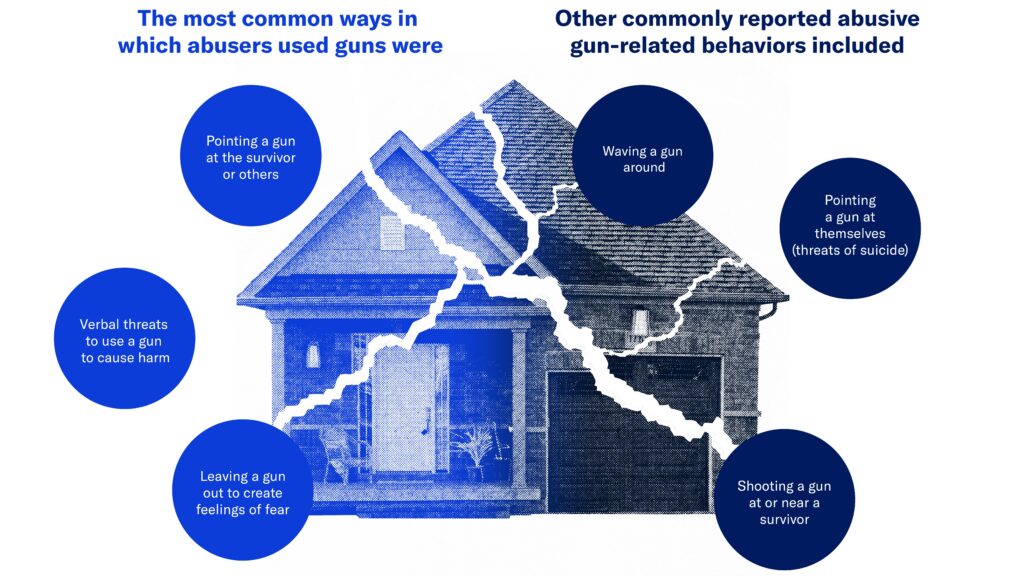
These forms of intimate partner gun violence are distinct because, often, if you isolate one incident from the full relationship history it can seem innocuous. This is by design. Take this example: After an argument or an incident of violence, the abuser gets their gun and methodically dissembles, clean, reassembles it at the kitchen table. Maybe they comment on their marksmanship. The survivor knows that this is an express threat. Without a word, the abuser is saying, “I am in control and I can kill you at any moment.” But if the survivor was to relay just that interaction to police, a friend, a healthcare worker, etc. they may very well fail to see the imminent danger in it. It is exactly these sorts of abuses, and failures to understand the risk they indicate, that lead us to the devastating homicide statistics above.
A Common Denominator
“And it started with my partner becoming more controlling at first, sadly, but like who I talked to, where I went. Then came the anger, the yelling, and eventually got physical, I guess. What made it really scary was the gun. I guess that’s what really got to me.”
-Survivor of intimate partner violence
A solid body of research around intimate partner firearm homicides exists.6Hui Zhang Kudon et al., “The National Intimate Partner and Sexual Violence Survey: 2023/2024 Report on Intimate Partner Violence,” Centers for Disease Control and Prevention, February 2026, https://www.cdc.gov/nisvs/media/pdfs/intimatepartnerviolence-brief.pdf; Emma E. Friedland and James Alan Fox, “Gender Differences in Patterns and Trends in US Homicide, 1976–2017,” Violence and Gender 6, no. 1 (2019): 27–36, https://doi.org/10.1089/vio.2019.0005. It does not, however, paint the picture of what survivors live with every day. In 2025, BWJP conducted a series of in-depth interviews with 25 survivors of intimate partner gun violence. The discussions focused on gathering a detailed understanding of how survivors are experiencing intimate partner gun violence and how those experiences are shaping their perception of their safety and making decisions based on it. The goal was to understand the gap between what the legal system and victim services offer to survivors and what they believe they need to stay safe.
Every person’s experience with intimate partner violence is individualized and the survivor interviews reflected that. Thus, it stood out these survivors shared one universal experience. Every survivor who took part in the interviews reported that the intimate partner abuse and violence started through tactics to isolate them; then firearms played a role. They were isolated from friends, family, coworkers, other means of support, from economic independence, from a means of reaching advocacy services, law enforcement, courts. Survivors generally described that it was after this isolation, or in the course of deepening the isolation, that their abusive intimate partners used guns to further control, intimidate, threaten, and physically harm.
How are survivors of intimate partner gun violence impacted?
“And, you know, a lot of people saying, why didn’t you just go? But they don’t realize how much scarier it feels when you know there’s a gun in the house. And lemme just say it’s like the constant shadow. Even when he wasn’t holding it, I knew it was there.”
-Survivor of intimate partner violence
Survivors described that the constant threat of firearms shaped every decision they made. For some, it meant they stayed, because leaving felt too dangerous. For others, it was a catalyst to plot an opportunity to seek help, because staying felt too dangerous.
For most survivors, at some point, seeking help from the traditional pathways—civil or criminal legal system, victim services, or the healthcare system—was not an option either because they feared retaliatory violence or their abuser prevented them from getting to those intervention points or they did not trust the system to increase their safety. When survivors did risk disclosing, whether they were met with a trauma-informed response had a profound impact. When survivors were believed and their fears for their safety were taken seriously, they generally credited the experience with being a factor in their ability to separate from their abuser and maintain their safety. When survivors were doubted, disbelieved, or dismissed many felt deep hopelessness and lost trust that any available intervention would keep them safe. For some, this left them even more vulnerable and exposed to more severe violence.
What survivors expressed they needed to maintain safety and separation from their abusive partners was predominantly long-term access to therapy, economic support, employment support, and affordable long-term housing.
There are easily identifiable systemic changes that would meaningfully reduce the risk of intimate partner gun violence: Primarily, legal system actors (law enforcement, prosecutors, judges, etc.) need increased awareness of what intimate partner firearm abuse looks like and the non-physical firearm threats that indicate an imminent risk of harm. The legal system also must increase effective and consistent enforcement of existing federal and state laws by removing firearms from people prohibited from accessing them due to domestic violence. Additionally, there is a need for greater resources for survivors to access legal advocacy as well as resources to support survivors in meeting their basic needs (for example, transitional housing, economic support, child care) to enable survivors to safely navigate the justice system.
All of us can contribute to lessening this risk by understanding the reality of how abusers use and threaten the use of firearms against their partners, by spreading this awareness in our communities, and by believing and supporting survivors who disclose they are in danger.
To learn more about the intersection of domestic violence and gun violence, and how communities can address it and what role you can play, explore the resources of the National Center on Gun Violence in Relationships at the Battered Women’s Justice Project.
If you or someone you know is experiencing domestic violence, please contact the National Domestic Violence Hotline by calling 1-800-799-SAFE (7233), texting “START” to 88788, or chatting online at thehotline.org. Trained advocates are available 24/7 to provide free confidential support to people anywhere in the US.